Amir&Jeff’s Excellent China Adventure Series. 2026: Xinjiang Province Red Tour. Photos and commentary. The REAL Chinese people you do not know!
Amir&Jeff’s Excellent China Adventure Series. 2025: Hunan, Jiangxi, Fujian and Shaanxi Provinces’ Red Tour. Short videos with transcripts, captioned photos, articles and commentary. The REAL Chinese people you don’t know!
https://radiosinoland.com/2025/07/27/amirjeffs-excellent-china-adventure-series-2025-hunan-jiangxi-fujian-and-shaanxi-provinces-red-tour-short-videos-captioned-photos-articles-and-commentary-the-real-chinese-people-you-don/
Short intro to Xinjiang by Jeff

Xinjiang is huge, 17% of the country’s landmass, 1.66 million square kilometers (China’s total land area = 9.6 million), which is three times the size of France, or bigger than Alaska in North America. It is mostly desert, mountains, basins and high plateaus, with a few beautiful lakes. Weather is harsh here. When we arrived on 5 August, the temperature was 41 degrees. In the winter, it can drop to minus twenty.
For our one-month Red Tour adventure in Xinjiang, we will get a far west as Aksu and as far south as Korla. It is already starting out as an amazing lunar cycle.
The Uyghur people in China are members of the Turkic language group, of which there are many derivatives, starting in Turkey, of course, and there’s a swath going from there to the east through South Central Asia. They are, at varying degrees, mutually understood, from 0 to maybe 75%, depending on the dialect. For example, Turkish and Uyghur are 30% mutually comprehensible.
So Uyghurs are, in fact, Turkic people.
Xinjiang’s population is 26 million, 58% Muslim. The capital is Urumuqi. It has four million residents. Hami has 670,000 citizens. Shihezi, Karamay, Korla, Yining and Aksu are other cities we are visiting each have about 500,000 souls.
West to east, Xinjiang has common international borders with Pakistan, Tajikistan, Afghanistan, Kyrgyzstan, Kazakhstan, Russia and Mongolia. Internally, it borders the provinces of Gansu, Qinghai and Tibet, north to south. It is now a hugely important nexus in Asia’s Belt and Road Initiative (BRI), connecting the rest of China with the rest of Mackinder’s Heartland. On that note,
Jeff J. Brown comments on Sputnik News- Putin: China’s Belt and Road Initiative ‘in Sync With Russia’s Ideas on Large Eurasian Space’. China Rising Radio Sinoland 231027
Not only industry and commerce, Xinjiang is a massive producer of high value crops, including a huge variety of fruits, vegetables and cotton. We see lush, green fields and orchards stretching kilometer after kilometer, thanks to one of the biggest water canal and irrigation systems in the world, starting in the Altai Mountains, over 400km away. The BRI has made it possible to ship large quantities of this produce all over Asia.
Jeff’s comments
Amir and I really enjoyed our visit to Karamay in Xinjiang.
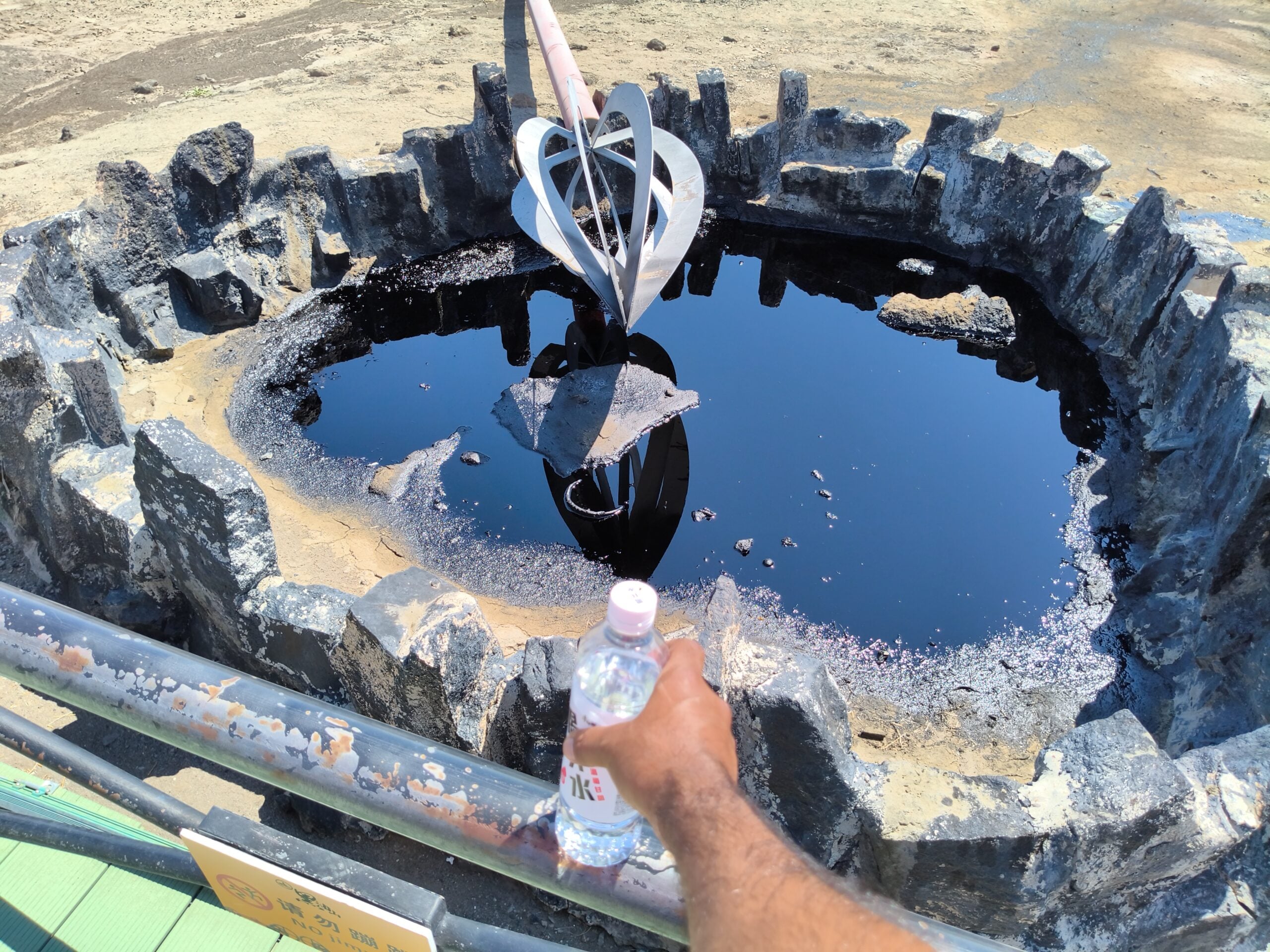
In 1955, they discovered a massive oil reserve very close to the surface of the earth. We went to Black Oil Mountain Park, where oil is still bubbling up out of the ground. It’s unbelievable. You can just see it percolating like coffee in a pot.
We toured that,which is really a funky place, with all kinds of industrial art made out of old oilfield equipment, also use to create Q&A signboards to learn about petroleum. They also used oil storage tanks to create the park’s welcoming center.
Photos below, and then we went to Wellhead Number One Park, which is actually now inside Karamay. But, at the time, that was where China’s first modern oil well was drilled.
They’ve created this oil bubble sculpture that you can walk under, which is really interesting. Next to it, they have a nice socialist-style statue of two men working at a drill head, and open area, showing the date Wellhead #1 went into operation: October 29, 1955. Photos are below for your enjoyment, plus a couple of historical photos of the Karamay Fields, to see how massive it was.
As a result, Karamay’s population exploded. Ten of thousands of people from all over China came to support this black oil gold rush. There was so much work that needed to be done and not enough local hands to do it all.
We have met many people who talk about them being third generation, second generation Xinjiangers, not just for the explosion in oil, but because of the huge development in agriculture, industry, mining, tourism, infrastructure, et cetera. We’ve met several, especially from Sichuan, who came in the 1990s to help man industry and agriculture.
Karamay spawned China’s modern oil and gas industry. Today, China has a massive impact on humanity’s petroleum sector, with four of the Top Ten global oil companies and operations around the world,
- PetroChina (China).
- CNOOC (China) – China National Offshore Oil Corporation.
- Sinopec (China) – China Petroleum & Chemical Corporation.
- China National Petroleum Company (CNPC).
Please note, in communist-socialist China, the people own them. They’re not private, they’re owned by the people.
It’s all really fascinating, with lots of pictures down below. Enjoy them. We will have plenty of videos in our book coming out next year for our 2025-2026 Red Tours.
Notice up above I italicized modern, for Wellhead Number One. Below, there’s the interesting history of China’s oil and gas production going back over 2,000 years – before Jesus Christ!
Thus, for Americans to say that the Drake well in Pennsylvania in the 1800s was the first oil well ever drilled is just Judeo-bullshit, as usual in the Talmud-Tanakh West. Just lie, lie, lie and say “We’re Number One”.
The Chinese had gas-lit street lights, heating and cooked with natural gas 2,000 years ago. They had thousands of kilometers of bamboo gas and oil pipes going back thousands of years. They had wells one kilometer deep! Therefore, their knowledge and sophistication of oil and gas production is just unbelievable. So, enjoy this. It is really a lot of fun.
Next stop is Korla.
History of Chinese petroleum production
More than two thousand years before Edwin Drake and Mayor Alekseev drilled the first commercial oil wells in the mid-19th century, the ancient Chinese were drilling, extracting, and piping natural gas on a scale that rivalled many modern operations, with surprisingly sophisticated tools still used to this day. This is the incredible story of the Sichuan gas fields.
The first brine wells in Sichuan appeared during the Warring States Period of 480-221 B.C.E. These were commissioned by Li Bing, a legendary administrator and hydraulic engineer for the State of Qin [“Chin”] most famous for creating the Dujiangyan river control system – which, incredibly, is still in use more than 2000 years later. At first these wells were dug by hand, but by the 1st Century C.E. the locals had developed a sophisticated percussive drilling system remarkably similar to early American rigs used in the late 19th and early 20th Centuries. In this system, the top few metres of the well were dug out by hand, with the hole being lined with stones drilled through with circular holes. These holes formed a cylindrical guide for the subsequent drilling operation. Once the wellhead was complete, a bamboo derrick or “heaven cart” was erected overtop. By the early 20th century, some of these derricks reached up to 100 metres in height, rivalling their more famous western counterparts. The drill bit consisted of a long vertical bamboo pole tipped with a cast-iron chisel head, which in turn was connected to a pivoting seesaw-like platform. A worker would repetitively jump on and off this platform, raising and dropping the drill bit onto the bedrock below. Unsurprisingly, this was a slow, tedious process; the drilling speed topped out at less than a metre per day, and it often took months to strike a brine deposit. Despite this, these Ancient Chinese drillers achieved some truly impressive feats. By the Tang Dynasty of 618-906 C.E, they were drilling down to depths of 250 metres. By comparison, early 19th Century American wells topped out at only 150 metres.
But perhaps more impressive than the sheer depths reached were the wide variety of specialized tools and technique the Sichuan drillers developed to tackle common drilling problems – many nearly-identical to those used in today’s oil and gas industry. For instance, different drill bits were used for different stages of the drilling process or for cutting through different kinds of rock. Long, heavy bits called “Fish Tails” were used to start wells, “Silver Ingot” bits drilled rapidly but roughly, while “Horseshoe” bits drilled slowly but produced smooth, round boreholes. Tools were also developed to deal with broken-off drill bits, caved-in wells, and deviating boreholes. For example, every so often mud composed of pulverized rock and groundwater would accumulate in the borehole and had to be cleared out. This was accomplished using a length of hollow bamboo with a hinged flap valve at one end, which was lowered down the borehole. When the device was lifted out of the well, the weight of the mud in the tube forced the valve shut, allowing the mud to be lifted out. A similar device was used to extract brine once the well was completed. To repair a caved-in well, bundles of straw were lowered down to the cave-in site, where they would absorb water and expand to plug the hole. This plug was then reinforced with a special cement made of lime and Tung oil, whereupon drilling would continue, boring through the repaired cave-in.
Around 1050 C.E., Sichuan drillers achieved a major breakthrough when they replaced their old, solid drill pipes with flexible bamboo cables. These were much lighter than the old technology and could be wound around a rotating drum, allowing drilling derricks to be smaller and even greater depths to be reached. In 1835, the Shenghai Well became the first in the world to reach 1 kilometre in depth. At this time the region’s annual salt production was 150,000 tons and growing, with the industry racing to meet the demands of a Chinese population already nearing half a billion. The rolling hills of Sichuan became carpeted with sprawling forests of bamboo derricks, while the Fuxi river was choked with trading boats carrying valuable salt to all corners of China. But this remarkable industrial operation was only made possible by another of the region’s abundant natural resources: natural gas.
From the very start of brine extraction in Sichuan, over 2,000 years ago, drillers began encountering pockets of natural gas – composed mainly of methane – trapped beneath the salt. The Jialingjiang formation which feeds Sichuan Province’s abundant brine aquifers was formed by the evaporation of a large inland sea during the mid-Triassic Period, around 225 million years ago. This salt layer forms an impermeable dome which traps large quantities of natural gas, produced by the decomposition of ancient marine zooplankton and algae. At first, this gas was seen as a useless byproduct or even an unwelcome hazard; indeed, the gas was often contaminated with hydrogen sulfide, a highly-toxic gas with could induce nausea, unconsciousness, and even death depending on its concentration. Eventually, however, the gas’ flammable properties were recognized and it began to be used for household lighting, heating, and cooking throughout the region. But it was not until the Second Century C.E. that large-scale gas extraction truly began in earnest, largely in response to a resource depletion crisis. Previously, salt had been produced by boiling brine over wood fires. But as the industry grew and local forests became severely depleted, drillers turned to the abundant supply of natural gas as an alternative source of fuel.
Exploiting Sichuan’s natural gas reserves required the development of yet more advanced technology, including the “Kang Pen” drum. Invented in the late 18th Century, this device sat atop the wellhead and allowed both natural gas and brine to be extracted and separated simultaneously. Chinese drillers also invented one of the world’s first carburetors to combine natural gas with air, producing an efficient-burning mixture for heating the brine evaporation pans. They even developed a rudimentary understanding of the area’s geology, siting brine wells at the bottom of valleys and gas wells at the top of hills where gas pockets accumulate under salt domes.
But perhaps their greatest achievement was building hundreds of kilometres of bamboo pipelines that carried brine and natural gas as far away as Beijing. As bamboo is naturally divided into closed compartments, building these pipelines was not a matter of simply joining lengths of bamboo together. Instead, the bamboo was split in half, the dividing walls carved away, and the two halves joined back together with lime and Tung oil cement. The joint was further reinforced using twine wound around the outside of the pipe. So durable and gas-tight were these pipes that as recently as the 1950s there were still over 95 kilometres of bamboo pipeline still in operation around the Sichuan city of Zigong.
The vast scale of the Sichuan salt and brine operations had a significant impact on Chinese history and culture. The slow pace of drilling and extraction meant that derricks and boiling facilities had to be manned 24 hours a day. Consequently, some of the first legal contracts in Chinese history were drawn up by Sichuan salt merchants to negotiate the allocation of workers and other resources. On a larger scale, the scramble for valuable salt and gas attracted hundreds of thousands of people and from across China and surrounding countries, creating in a volatile, conflict-ridden frontier melting pot and giving Sichuan the diverse cultural makeup it enjoys to this day.
Sichuan was not the only hydrocarbon extraction operation of the Early Modern period. In the 12th Century, small oil wells were dug near Naples in Italy, while in the 13th Century Venetian explorer Marco Polo described oil extraction at Baku, in what is now Azerbaijan:
“A hundred shiploads might be taken from it at one time…this oil is not good to use with food, but it is good to burn and is also used to anoint camels that have the mange. People come from vast distances to fetch it, for in all the countries around it they have no other oil.”
However, none of these operations came close to matching the sheer scale and sophistication of the Sichuan gas fields. Today, the region around Zigong is still a major producer of both salt and gas, producing around 30 billion cubic metres of the latter every year – much of it extracted from wells originally opened hundreds of years ago.
The legacy of these pioneering workers is preserved and celebrated in the Shanxi Salt Museum, housed in a former guild hall built by mid-18th century salt merchants. Displaying original artefacts as well as detailed models of historic salt and gas-extraction technology, the museum serves as a fitting tribute to a sophisticated industrial operation two millennia ahead of its time.
References
Historical photos of Karamay Field


Amir’s photos of Black Oil Mountain Park


Amir’s photos of Wellhead Number One Park


###
 I contribute to