
TRANSLATION MENU: LOOK UPPER RIGHT BELOW THE SOCIAL MEDIA ICONS.
IT OFFERS EVERY LANGUAGE AVAILABLE AROUND THE WORLD!
ALSO, SOCIAL MEDIA AND PRINT ICONS ARE AT THE BOTTOM OF THIS POST!
Seventeen years on the streets, living and working with the people of China, Jeff
For donations, print books, ebooks and audiobooks, please see at the bottom of this post

My comments
If you can read Cheng Li-Wun’s interview below, it is well worth it to really understand today’s Taiwanese zeitgeist. Since SCMP has a paywall, I took the liberty of publishing it in its entirety. I offer a summary to be safe, in case you don’t have time. It is of course translatable in over 100 languages, including traditional and modern Chinese characters.
Her visionary outlook and political acumen are very much appreciated by Chinese all over the world, including Taiwan Province. In my Taiwan Province Library below, you can read several articles that I have recently written on this subject, which – no exaggeration – concerns the survival of the human race.
Why? Judeans have their bloody, genocidal fangs and claws in Taiwan Island, want to turn it into Asia’s Ukraine against the Mainland, which makes it the bellwether for World War III.
If Taiwan’s so-called Democratic Progressive Party (DPP) gets its wish and pushes for independence under its vassalage with Talmud-Tanakh Uncle
Slaughter, it will definitely trigger World War III, not just in Asia, but all over the world. DPP is lying that their goals are exclusively bilateral with the Mainland.
The Island is actually much more of a critical, global flashpoint than even the Middle East, as I have written in my recent articles below.
Humanity and Taiwanese have been given today’s most urgent clarion call.
Here are 20 key highlights from the interview with KMT Chairwoman Cheng Li-wun
- 1992 Consensus as Foundation — Cheng argues that both sides accepting the 1992 consensus (one China, each side with its own interpretation) is the immediate key to easing cross-strait tensions.
- Ma Ying-jeou’s Era as a Model — She cites Ma’s 2008–2016 presidency as proof that the 1992 consensus works, pointing to the friendly exchanges and diplomatic stability during that period.
- “A Century of Cross-Strait Peace” — Her long-term goal is a durable peace resilient enough to survive changes in Taiwan’s governing party, preventing the boom-bust cycle seen after Ma left office.
- Status Quo Must Be Respected — Any future change to the status quo must be peaceful, voluntary, and reflect the will of Taiwan’s people — it cannot be forced.
- Beijing Meeting Exceeded Expectations — Her April meeting with Xi Jinping was described as warmer and more emotionally open than anticipated, with far less hostility than critics predicted.
- “One Family” Framework — Xi expressed that any party accepting the 1992 consensus and opposing Taiwan independence could engage with Beijing, not just the KMT.
- Reunification Not Personally Discussed — Cheng clarified that Xi’s reference to “promoting reunification” appeared only in the official written release, not in his actual spoken remarks to her.
- Institutionalised KMT–CCP Platform — The visit resulted in an ongoing, institutionalized communication channel between the two parties through forums and exchanges.
- 2028 Election is the Real Prize — Cheng is frank that meaningful cross-strait policy change requires the KMT to win the presidency in 2028; as an opposition party, it cannot formally negotiate with Beijing now.
- DPP’s “Resist China” Card is Weakening — She points to the failure of the DPP’s legislative recall campaign as evidence that Taiwan’s public is growing tired of the confrontational approach.
- Declining Chinese Identity is Political Engineering — Cheng attributes the drop in young Taiwanese identifying as Chinese to 30 years of deliberate de-Sinicisation by the DPP, not an organic cultural shift.
- Taiwanese and Chinese Identity Can Coexist — She personally holds that being Taiwanese and being Chinese are not mutually exclusive identities, and frames the conflict as an artificial political construction.
- NT$1.25 Trillion Defence Budget Criticized — The KMT opposes the DPP’s defence budget not because it opposes defence spending, but because it lacks itemization and accountability — calling it a “blank cheque.”
- KMT’s Counter-Proposal: NT$380 Billion Plus N — The KMT supports NT$380 billion tied to confirmed arms purchases (LOAs), with additional funding unlocked as new purchases are formalized.
- US Arms Delays are a Real Problem — Cheng highlights persistent delivery delays on items like the F-16V as undermining public confidence in defence spending, regardless of the amount allocated.
- Upcoming US Trip in June — She plans a two-week visit to major US cities on both coasts to explain the KMT’s positions on defence, the budget, and cross-strait relations.
- Taiwan Must Not Be a Bargaining Chip — On the anticipated Xi–Trump summit, Cheng insists Taiwan must maintain its own voice and agency rather than becoming a pawn in great-power negotiations.
- One-China Policy as Global Bedrock — She frames the one-China principle not as a concession but as the universal diplomatic foundation accepted by nearly all nations, including the US.
- “Peace Dividends” as Electoral Advantage — Industries hurt by a decade of poor cross-strait relations — especially tourism and agriculture — are eager for relief, which Cheng sees as a major asset heading into local elections in November.
- War vs. Peace is the Defining Issue of 2028 — Cheng frames the next general election as fundamentally a choice between the KMT’s path to peace and the DPP’s path toward potential conflict, confident the majority of Taiwanese will choose peace.
Interview
Cross-strait relations have been increasingly tense for more than 10 years. What approach can change this situation?
The eight years of [former Taiwanese leader] Ma Ying-jeou’s administration were successful precisely because of his acceptance of the 1992 consensus. During that period, cross-strait relations were characterised by very friendly exchanges and were entirely free of major issues. At that time, we enjoyed significant space for international participation and did not face the constant predicament of diplomatic breaks. This was because the 1992 consensus provided a friendly foundation that made a “diplomatic truce” – a cornerstone of Ma Ying-jeou’s foreign policy – achievable. His eight years in office [2008-16] stand as proof of this point.
In contrast, the nearly 10 years that followed have seen cross-strait relations rapidly deteriorate to the point of a perilous and dreadful prospect of war. This has created a sense of extreme danger, with the situation appearing to be on the verge of a breakout. My visit was to demonstrate once more that by returning to the 1992 consensus and opposing Taiwan independence, the cross-strait situation can ease immediately, reopening the door to peaceful exchange and dialogue.
As long as the 1992 consensus is accepted, the two sides can initiate comprehensive dialogue and exchange. To be honest, achieving peace and stability across the strait is not nearly as difficult as many imagine. However, if a government – like the DPP [Democratic Progressive Party] since taking power – blindly follows the “two-state theory”, pursues de-Sinicisation and refuses to recognise the 1992 consensus, the situation will deteriorate rapidly, leading to the tensions we see today. Taiwan’s mainstream public opinion clearly favours peace and exchange over war. Therefore, by returning to the 1992 consensus, ample room for development will immediately open up.
You have used the phrase “a century of cross-strait peace”. How is that goal achieved? Some on the mainland note that your proposal seems to differ from the mainland’s focus on actively promoting national reunification. How do you respond?
The century of peace I am proposing must be resilient enough to withstand political party alternations within Taiwan. During Ma Ying-jeou’s eight years, everything seemed good; yet, as soon as the government changed and the DPP refused to recognise the 1992 consensus, ties immediately deteriorated. This kind of instability and constant swaying is itself a source of regional danger. Our goal must be to find a way for cross-strait peace to exist sustainably, regardless of who is in power.
The core of the 1992 consensus is that both sides belong to “one China”, which aligns with the constitution of the Republic of China – itself a “one-China constitution”. At the same time, we cannot deny the reality that the two sides have developed vastly different social systems and lifestyles. We must respect and accept these differences as the natural results of our separate historical developments.
However, difference does not have to mean hostility, and it certainly shouldn’t mean war. We hope to re-familiarise ourselves with one another, resolve misunderstandings and stabilise the relationship through open dialogue.
This is the foundation of what we call “maintaining the status quo”. Regarding future developments and the mainland’s “ultimate goal” of reunification: if the status quo is ever to change, it must be done through peaceful means, it must serve the interests and welfare of the people on both sides, and it must respect the will of the people of Taiwan. It cannot be forced. If a process is truly peaceful, it must be voluntary; and if it is voluntary, it must be because our people see it as beneficial.
To put it simply, my long-term goal is to foster a peaceful and stable relationship where the interests and will of both peoples are fully respected. If a future emerges from that foundation that differs from the status quo, everyone – on both sides of the strait and across the world – would welcome it.
But we must face the fact that our immediate task is arduous: we have to stop the current deterioration and prove that a path to peace is actually viable. As long as we show sincerity and return to the 1992 consensus while opposing Taiwan independence, we can begin to deepen our relationship.
We have been separated for a very long time, so future exchanges hold many possibilities. I agree with the sentiment General Secretary Xi expressed: we must do things one by one. “Ice three feet thick is not frozen in a single day” and resolving these deep-seated issues is a massive, complex project. The road to peace must be walked step by step.
We have only just taken the first step. My hope is to move forward steadily and pragmatically, ensuring we never take a step backward. We must avoid the situation we saw after Ma Ying-jeou’s eight years, where progress suddenly halted and turned into rapid deterioration. That is exactly what we are working to prevent.
In recent years, the mainland side has shown a new line of thought: to communicate directly with different groups in Taiwan. There are also voices stating that the KMT’s influence on cross-strait relations is waning. How can the KMT expand its influence in cross-strait relations?
Taiwan, under the leadership of the DPP, is taking a path – pursuing the two-state theory and de-Sinicisation – that is a dead end. It has also provoked strong hostility from the Communist Party, which is absolutely not good for Taiwan. However, the DPP’s route is not the choice of the majority of people in Taiwan, nor does it represent mainstream public opinion. This is why the mainland hopes to be more diverse in reaching out to and communicating with the public and different sectors.
We believe that at least 60 per cent of public opinion in Taiwan does not want to fight a war, hopes for peaceful exchange and does not identify with the DPP’s cross-strait policy. Therefore, I believe this is also why the Communist Party chose to clearly express its political stance opposing the DPP’s pursuit of division and Taiwan independence. They also do not equate the DPP with Taiwan, nor do they believe the DPP represents all 23 million people.
So, how can we expand exchanges between different sectors and increase mutual goodwill? This is why they are [engaging] with different sectors. Even during my visit this time, I expressed the hope that this should not be limited to the KMT. General Secretary Xi expressed the same: that [as long as] the 1992 consensus is accepted and Taiwan independence is opposed, and under the principle of “both sides as one family”, any political party or group can be contacted and engaged. [The relationship with the mainland] is not the KMT’s monopoly.
Taiwan must maintain its own voice and agency – which is exactly why I actively sought a meeting with Xi Jinping – Cheng Li-wun
Regarding the KMT being out of power for the past decade, it is true that our cross-strait discourse gradually became blurred and we struggled to compete with the DPP’s “resist China, protect Taiwan” narrative. This is a challenge the KMT must confront. In the recent party chairperson election, many within the “blue camp” expressed deep frustration with the DPP and a desire for the KMT to revitalise itself. My election as chairperson reflects that expectation – a call for the KMT to provide a clearer, more robust cross-strait vision that can regain the trust of the Taiwanese people and prove that peace is truly attainable.
This is the role the KMT must play. We must convince the people that to avoid war in 2028, supporting the KMT’s cross-strait route is the only way to secure peace. We must represent the mainstream public opinion. Reversing our past disadvantages is critical. It is not enough to simply point out the DPP’s corruption and incompetence; we must prove that the KMT has the capability to stabilise cross-strait relations and lead the way to a peaceful future.
Public opinion polls in Taiwan show that identifying as “Chinese” is gradually declining among young people. How will the KMT balance its own Chinese identity with mainstream public opinion in Taiwan?
The sharp decline in [Chinese] identity is the result of 30 years of deliberate political manipulation and de-Sinicisation by the DPP. This direction of development is unfavourable for Taiwan and its youth. This [heritage] should be our advantage and our foundation of confidence, yet we are cutting the umbilical cords that link us to the origins of Chinese civilisation. In doing so, [we are] forfeiting a very powerful cultural edge.
For a long time, the DPP’s deliberate framing has characterised Taiwan and China as incompatible, opposing concepts. This violates both reality and nature; it is simply unnatural. Taiwan and China should not be seen as opposites; rather, they should be viewed through a lens of mutual brilliance and inclusiveness. The long-term demonisation of and hostility towards mainland China – which eventually expanded into the belittling and severing of our entire civilisational heritage – is a product of political engineering that does not reflect the reality of Taiwan.
The reality is that we are all inheritors of Chinese civilisation. Our culture, our bloodlines and our history all confirm this. Even today, many of our daily habits fully demonstrate this heritage. This narrative needs to be adjusted. As mainland China’s national power grows and its modernisation accelerates, its cultural influence and revival are also exploding.
This is why more young people – such as [Taiwanese online celebrities] Guan Zhang or Zhong Ming-xuan – find that once they take off the “tinted glasses” provided by politics and actually experience the modern lifestyle of the mainland, they discover it is nothing like they imagined. We simply hope to return to a normal, natural state – one that doesn’t use political power to either unfairly belittle or artificially praise. It was originally a natural thing: we are the stewards of Chinese civilisation.
The West has always mentioned theories like the “clash of civilisations” or the “end of history”. History has proven them incorrect. From the perspective of Eastern philosophy and the cultivation of Chinese civilisation, we do not believe the world is black and white or inherently confrontational. The world is home to many different, wonderful civilisations that should mutually appreciate, respect and learn from one another. The revival of one civilisation – notwithstanding the humiliations or hardships Chinese civilisation has faced over the past 200 years – does not mean the destruction or displacement of others.
In Chinese civilisational thought, the rise of a modernised civilisation – whether in Taiwan or on the mainland – is a good thing for all of humanity. It is about coexistence and learning. Chinese civilisation itself is not a single, pure concept; it is the result of complex histories and the blending of different ethnic and political groups over thousands of years on this great land of China. It is an inclusive concept, one that [can] “admit a hundred rivers”.
Therefore, the so-called Chinese identity and Chinese civilisation heritage does not imply exclusivity or the negation of others. There is no need to fear its revival; instead, it should be approached with a friendly attitude. In Taiwan, a “Taiwanese” identity and a “Chinese” identity are not mutually exclusive. We are Taiwanese; I am a Taipei person, I am Taiwanese, I am Chinese – these identities coexist.
We must look at this with a broader perspective and a greater breadth of mind, rather than through a narrow lens of mutual exclusion. This kind of identity issue should not be belittled or narrowed into a simple concept of national conflict.
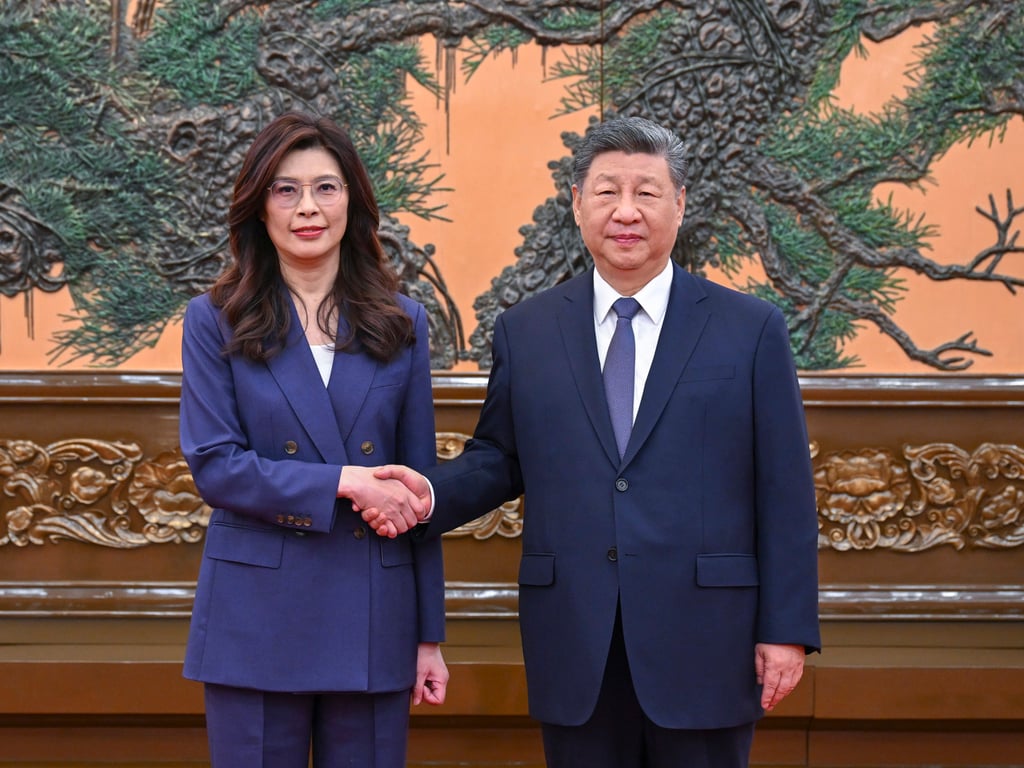
How do you view the specific wording of “promoting national reunification” mentioned by Xi in his congratulatory telegram on your election? During your visit to the mainland, Xi suggested that the KMT and the Communist Party should consolidate mutual political trust and unite compatriots to work towards the reunification of the motherland and national rejuvenation. How do you respond?
This visit to the mainland and my talks with General Secretary Xi exceeded everyone’s expectations. There was a much greater release of emotion and goodwill than anticipated. In many of our conversations, the tone was not nearly as targeted or hostile – certainly not the “drawn swords and bent bows” atmosphere some might have imagined. This was obvious. This reinforces what the mainland has consistently emphasised: their focus is on opposing “Taiwan independence”. As long as we return to the 1992 consensus and maintain that opposition, then “the sea is wide and the sky is high” – limitless possibilities open up and issues become much easier to discuss.
Mainland China’s ultimate goal is well known; it isn’t news. However, as I noted, the biggest takeaway from this meeting was the sheer sincerity shown by the mainland. They expressed that since we both accept the 1992 consensus and oppose Taiwan independence, we are essentially “one family”. [On that basis] they are willing to exercise the utmost patience and perseverance to resolve the existing differences between the two sides.
To me, this opening of space, this emotional connection, and this display of goodwill were the most significant aspects of the trip. It demonstrates that as long as both sides remain on this path, there is immense room for peace. That is truly the most important point.
During your meeting with Xi, was there any discussion regarding how the two parties might work together to promote reunification?
No, not at all. Everything we discussed has been made public in our news releases; my records of the meeting are very complete. Even when he spoke off-script I took extensive notes, and his comments were limited to the points I’ve already mentioned.
But “Point 4” of Beijing’s official statement states that Xi hoped that the two parties would work together to promote reunification?
That was just a single sentence in the official release. In his actual off-script remarks to me, that was nothing like that at all.
So he didn’t say it to you personally; it only appeared in the official release?
Correct. Exactly.
Your visit to the mainland yielded significant results, including the establishment of an institutionalised platform between the KMT and the Communist Party. Does this imply that communications and exchanges between the two parties will be conducted primarily through this platform?
Yes, it will continue. These exchanges, including various forums, will proceed in a continuous and institutionalised manner.
Some critics – including officials from [Taiwan’s] Mainland Affairs Council – have argued that since the KMT is not the governing party, it has no mandate to represent Taiwan in talks with the mainland. How can the KMT improve cross-strait relations while in opposition?
That is by winning the presidency in 2028. Both we and the mainland are fully aware that as an opposition party, we cannot formally represent the government in official negotiations. We also know – as does the mainland – that no matter what goodwill they extend, the DPP will reflexively refuse to cooperate. They will oppose, reject and boycott any such initiatives; everyone knows this is their playbook.
However, many industries in Taiwan have suffered tremendously over the past few years – especially tourism and travel – due to the impact of the DPP’s cross-strait policies. These sectors have high expectations for the 10 major measures. Yet, they also recognise that the DPP government will inevitably block them.
In reality, there is a widespread understanding that a true, comprehensive opening and a meaningful expansion of exchange can only happen with a change of government in 2028. That year is approaching quickly – it’s only two years away. Ultimately, the implementation of lasting cross-strait peace and exchange depends entirely on the party alternation in 2028. Everyone involved understands this.
The fundamental issue with the NT$1.25 trillion budget is its lack of substance – there is no concrete detail. We cannot provide “blanket authorisation” or give the DPP a blank cheque to spend however they see fit. Moreover, the DPP is effectively “credit-bankrupt”; we have zero trust in them. Without oversight, there is a serious risk of corruption and misappropriation, which is why we cannot support the NT$1.25 trillion figure as proposed.
In reality, the KMT has been the true backbone of Taiwan’s defence since the end of the second world war. For decades, the majority of our arms purchases from the US were initiated and managed under KMT administrations. We have a long-standing history of supporting and executing these defence acquisitions from the US.
This naturally causes the public to doubt the acquisition process. People are asking: Is the pricing unfair? Are we actually getting the weapons Taiwan truly needs? And when will these items actually arrive? These are the questions that will hang over all future US arms purchases until they are resolved.
To be clear: we support arms purchases and we support Taiwan having a sufficient defence capability. But because this is the people’s money, every cent must be spent on the “blade of the knife” [where it matters most] – truly strengthening our defence rather than pouring massive amounts of money into a vacuum with no guaranteed hardware in return.
Currently, the only official, concrete figures we have seen are the “letters of offer and acceptance” (LOA) issued by the US for roughly US$11 billion.
This is why the KMT’s version of the budget covers approximately NT$380 billion. Everything beyond that is a total blank. No responsible parliament in the world would grant blank-cheque authorisation for such vast sums without documentation.
The DPP is simply [shifting the blame], framing [the KMT] and misleading the public. In truth, it is the DPP’s own policies that are undermining Taiwan’s defence. Theirs is a black-box operation. Furthermore, the issue isn’t just about hardware; it’s about our professional soldiers. No one is willing to serve as a professional soldier because the DPP has spent years belittling our military and failing to improve pay and dignity. If you ask me, the real obstacles to Taiwan’s defence are the DPP’s failed policies, not the KMT.
You plan to visit the US in early June for two weeks, right?
Yes, that is correct.
Will your itinerary include major cities such as New York and Boston?
Yes, I will be visiting several major cities on both the east and west coasts.
Is it to explain the KMT’s position on budget, defence and cross-strait ties?
Of course, definitely.
The US has consistently emphasised that Taiwan must raise its defence spending and pass the NT$1.25 trillion special budget proposed by the DPP administration. How do you plan to persuade the US to accept what you consider a more reasonable budget?
First, it is an established fact that Taiwan’s defence budget is increasing year by year. However, defence capability is not just about a raw number on a page; a high spending figure does not automatically translate into sufficient or effective defence power. My repeated emphasis is that we must pragmatically and scientifically evaluate whether this expenditure actually secures the specific, effective defensive force Taiwan truly needs. We cannot simply spend massive amounts of money only to find that our defence remains riddled with serious gaps and loopholes. This isn’t a simple equation where more money spent inevitably equals more power.
Therefore, for me, there is a need to look at this matter pragmatically and scientifically. Because Taiwan’s security is so critical, we cannot allow the discussion to be simplified into “how much are you spending?” While we want our defence capability to grow, we must ensure that every cent is effectively strengthening our posture. In the past, massive expenditures have been met with serious questions: exactly what weapons were bought? The money was spent, but the hardware was nowhere to be seen.
Furthermore, were the items we did receive actually useful or what we needed? These issues have been under scrutiny for a long time. In this regard, we have a duty to exercise strict oversight.
When you speak to the US side and present the NT$380 billion figure, do you think they will accept it?
Their initial reaction may be that it isn’t enough. But it’s important to understand our “NT$380 billion plus N” formula – it isn’t a hard cap at NT$380 billion. We are acting with full sincerity and we are [keeping our word]. I refuse to offer a collection of empty cheques – extravagant promises that can never be fulfilled. It is far better to be substantial and credible. In international diplomacy, credibility is everything.
Today, the KMT says what it means and does what it says. I will not engage in flowery talk or offer blank-cheque promises that we cannot honour. Why would we do that? We have committed to NT$380 billion for currently approved items; as soon as new arms purchases are formalised via LOAs, we will immediately handle the corresponding N [additional funding]. What I cannot do is give the DPP a blank cheque for unspecified projects.
[After the interview with Cheng, the KMT and the smaller opposition Taiwan People’s Party passed a NT$780 billion special budget in a legislative meeting on Friday.]
How do you view the coming summit between Xi and US President Donald Trump scheduled for this month? Chinese Foreign Minister Wang Yi recently spoke with US Secretary of State Marco Rubio, urging the US to honour its commitments and make the “right choice”. Do you support China and the US reaching a specific consensus on opposing Taiwan independence?
Just as I felt during my visit to Beijing to meet with Xi Jinping, we certainly welcome such a meeting. Any form of peaceful exchange, dialogue or high-level summit is a positive development – especially between the leaders of the US and China. This has a profound impact on the global situation, and we hope a face-to-face meeting will foster better mutual communication and understanding.
I truly look forward to the US and China building a deep friendship, much like what we hope for between the two sides of the strait. Their relationship should be cooperative, peaceful and friendly, rather than confrontational. If these two superpowers are in conflict, it is bad news for the entire world. Generally speaking, we support this engagement and believe it facilitates vital dialogue.
On a deeper level, many are watching to see if there will be any negotiations regarding the Taiwan issue. My fundamental position is clear: Taiwan must not become a bargaining chip in the games of great powers. This is why Taiwan must maintain its own voice and agency – which is exactly why I actively sought a meeting with Xi Jinping. It shows that Taiwan can take the initiative and have a say in its own future. Taiwan’s attitude can determine whether there is peace or war; we shouldn’t simply let others decide our fate. At any rate, I do not hope Taiwan becomes a chip in the game of great powers.
Regarding the mainland’s view, the Taiwan issue is a “matter of principle”, not a “matter of transaction”. If you want to engage with the mainland, this is a principle you cannot violate. That principle is that both sides [accept] the 1992 consensus and oppose Taiwan independence. The 1992 consensus means both sides belong to one China.
So, what is the fundamental principle between the mainland and the current international community? It is the one-China policy. So, the US has its one-China policy, and a core principle of that is that the US does not support Taiwan independence. This is a matter of principle, not something to be traded. On the basis of this principle, everyone can be friends. If you pursue Taiwan independence or oppose “one China”, the mainland simply will not engage with you.
This principle is recognised and accepted globally. It is the same foundation I have repeatedly emphasised: “both sides belong to one China and oppose Taiwan independence”. This is the bedrock of cross-strait reconciliation and peace. I am glad to see this principle upheld; as long as it is not provoked or challenged, conflict and war can be avoided.
For us, the foundation is the 1992 consensus; for the world, it is the one-China policy and opposition to Taiwan independence. While the US has historically used the phrase “does not support” Taiwan independence, rather than “opposes” it – and there is a difference in the strength of those terms – the KMT’s policy has always been one of clear opposition to Taiwan independence.
Therefore, a consensus on this point is not an issue for me; I accept it as an essential political principle. It is the necessary foundation for exchange and friendship with mainland China. As long as this foundation is reaffirmed, we have no problem. My priority is ensuring this political foundation remains consistent with our stance and that Taiwan is never used as a chip to be traded in great-power power plays.
As for whether there is anything else [in their meeting], I don’t know; that depends on the two of them. So, my principle is confirming such a political foundation, and our position is consistent; there is no problem.
What are your views on the local elections scheduled for the end of this year? Some observers believe that your cross-strait stance, your political philosophy and your support for the 1992 consensus and the “both sides as one China” framework might be at odds with the rise in “Taiwanese consciousness”. Will these positions negatively affect the KMT’s performance?
The overall political environment remains relatively favourable for us. Of course, elections are inherently complex, and success or failure depends on many variables. Because the DPP is currently in power, they control the state apparatus and vast resources; they have even shown a willingness to use the judiciary to pressure the opposition. Consequently, the pressure on us is real, but I remain cautiously optimistic. We performed exceptionally well in the last election cycle, and many believe that simply maintaining those results would be a significant success.
However, our goal is not just to hold our ground, but to expand our gains. With more than six months until the [local elections in November], there is still plenty of time for the landscape to shift. Regarding cross-strait relations, there is a profound global concern, shared by the people of Taiwan, about the possibility of war. Given the current turbulence and instability of the international situation, the people of Taiwan have absolutely no desire to become the “next Ukraine”.
Therefore, the choice between war and peace will be a defining factor as we move towards the 2028 general election. I am very confident in the KMT’s cross-strait road map because it is designed to ensure peace and avoid conflict. This is what truly reflects the mainstream public opinion in Taiwan. I have successfully demonstrated that our approach is not just wishful thinking; we have secured goodwill and affirmation from General Secretary Xi that this path to peace is truly viable.
This will be a major “bonus” for our candidates. At the end of the day, the vast majority of people do not want war. When they see that an opening for peace and dialogue exists, they welcome it. In fact, since my visit to the mainland, we have seen a very positive trend in public opinion, including growing support for the 1992 consensus.
Furthermore, numerous industries – along with our agricultural and fisheries sectors – have suffered serious impacts over the last decade of deteriorating relations. They very much look forward to the improvement and easing of cross-strait relations. These “peace dividends” are something Taiwan’s voters have anticipated for a long time, and they have high expectations. From every perspective, this will be a significant advantage in the elections.
If the KMT cannot give the people of Taiwan confidence that we can deliver peace and stabilise cross-strait relations, then winning the 2028 general election will be a difficult task. Improving these relations is a necessary condition for the KMT to return to power. Without it, we may not be able to win back the mandate to govern.
Further reading
Jeff J. Brown’s ever-expanding collection of living libraries and catalogues. Many years and 1,000s of hours of writing+podcasting. Take advantage of them. Radio Sinoland 2026 Year of the Fire Horse!
Taiwan Province Library
Living library on Judaism. Continually updated. With image texts and video transcripts to easily copy for your use, and for translating them and this webpage in all available languages!
https://radiosinoland.com/2025/01/23/judaism/
Go Russia GO!
Go Iran GO!
Go China GO!
Go DPRK GO!
Go “RICK”! Go Asian Quad!
KICK JUDEO-TALMUD-TANAKH ASS!!!
Support, donations and contributions for my work here, any amount, one time or monthly,
A to Z support. Thank you in advance, Jeff
Checks or cash: mail to: Jeff J. Brown, 7 rue du Général de Gaulle, Équeurdreville 50120, France
Donorbox: www.donorbox.com, find China Rising Radio Sinoland
Euro bank wires: 44 Days Publishing, Bank: TransferWise, IBAN: BE70 9672 2959 5225
FundRazr: https://fundrazr.com/CRRS_2021_fundraiser?ref=ab_78aX23
Patreon: https://www.patreon.com/China_Rising_Radio_Sinoland OR https://www.patreon.com/China_Tech_News_Flash
Paypal: https://www.paypal.me/ChinaRisingRadioSino
Stripe US$/ApplePay: https://buy.stripe.com/14k8zl5tp5mVeT66op
Stripe Euros/ApplePay: https://buy.stripe.com/fZe02P8FB9DbcKY28a
US bank wires: Jeff J. Brown, Bank of Oklahoma, Routing Number/ABA: 103900036, Account: 592243855
WeChat and Alipay:

Books by Mike Palecek
“The Truth is Here”
Mike Palecek writes with passion, wit, and always
with a strong social conscience.
— Howard Zinn
 https://mikepalecek.substack.com/p/common-sense-6df
Paid Advertisement
Further study
The China Trilogy is an honorary degree in Chinese Studies. Don’t miss out!
https://www.amazon.com/stores/author/B00TX0TDDI/allbooks and
Jeff J. Brown’s libraries and catalogues A-Z: 1,000s of hours of research, writing, editing and podcasting.
Do yourself, your friends, family and colleagues a favor, to make sure all of you are Sino-smart:
Google ebooks (Epub) and audiobooks:
44 Days Backpacking in China: The Middle Kingdom in the 21st Century, with the United States, Europe and the Fate of the World in Its Looking Glass https://play.google.com/store/books/details?id=YBKHEAAAQBAJ
https://play.google.com/store/audiobooks/details?id=AQAAAECCkQXRlM
China Rising: Capitalist Roads, Socialist Destinations https://play.google.com/store/books/details?id=YNmLEAAAQBAJ
https://play.google.com/store/audiobooks/details?id=AQAAAECCfHo86M
BIG Red Book on China: Chinese History, Culture and Revolution
https://play.google.com/store/books/details?id=6Wl4EAAAQBAJ
https://play.google.com/store/audiobooks/details?id=AQAAAECCfHo86M
Amazon print and ebooks (Kindle):
44 Days Backpacking in China: The Middle Kingdom in the 21st Century, with the United States, Europe and the Fate of the World in Its Looking Glass
https://www.amazon.com/gp/product/1484939999/
China Rising: Capitalist Roads, Socialist Destinations
https://www.amazon.com/China-Rising-Capitalist-Socialist-Destinations/dp/0996487042
BIG Red Book on China: Chinese History, Culture and Revolution
https://www.amazon.com/BIG-Red-Book-China/dp/1673322719/
Author page:
https://www.amazon.com/Mr.-Jeff-J.-Brown/e/B00TX0TDDI
Praise for The China Trilogy:
Why and How China works: With a Mirror to Our Own History


JEFF J. BROWN, Editor, China Rising, and Senior Editor & China Correspondent, Dispatch from Beijing, The Greanville Post
Jeff J. Brown is a geopolitical analyst, journalist, lecturer and the author of The China Trilogy. It consists of 44 Days Backpacking in China – The Middle Kingdom in the 21st Century, with the United States, Europe and the Fate of the World in Its Looking Glass (2013); Punto Press released China Rising – Capitalist Roads, Socialist Destinations (2016); and BIG Red Book on China (2020). As well, he published a textbook, Doctor WriteRead’s Treasure Trove to Great English (2015). Jeff is a Senior Editor & China Correspondent for The Greanville Post, where he keeps a column, Dispatch from Beijing and is a Global Opinion Leader at 21st Century. He also writes a column for The Saker, called the Moscow-Beijing Express. Jeff writes, interviews and podcasts on his own program, China Rising Radio Sinoland, which is also available on YouTube, Stitcher Radio, iTunes, Ivoox and RUvid. Guests have included Ramsey Clark, James Bradley, Moti Nissani, Godfree Roberts, Hiroyuki Hamada, The Saker and many others. [/su_spoiler]
Jeff can be reached at China Rising, [email protected], Facebook, Twitter, Wechat (+86-19806711824/Mr_Professor_Brown, and Line/Telegram/Whatsapp: +33-612458821.
Read it in your language • Lealo en su idioma • Lisez-le dans votre langue • Lies es in deniner Sprache • Прочитайте это на вашем языке • 用你的语言阅读
[google-translator]
Wechat group: search the phone number +8619806711824 or my ID, Mr_Professor_Brown, friend request and ask Jeff to join the China Rising Radio Sinoland Wechat group. He will add you as a member, so you can join in the ongoing discussion.
 I contribute to