Shenzhen
Note: I lived and worked in Shenzhen, 2016-2019. Amazing place!
Guangdong (Canton – the old name), Chaoshan = restaurant
Photo #1: this is a typical mom & pop restaurant. Nothing fancy, with decor and presentation not a top priority. The focus is on the food and for added income, they will sell cigarettes, liquor and cold beverages. You can see the cigarette stand behind the counter. The liquor is above the cigarettes. A big, convenience store refrigerator is out of the picture to my right, full of beer, soft drinks, mineral water and tea. The lit, orange sign is their very simple menu to order from.
They are almost always clean and friendly.
That’s the mother of family cleaning dishes. She, her husband and mother-in-law play their parts. Mom and Dad cook and clean. Dad’s mom serves customers and cleans up tables. She used to run a convenience store here, that took up about half the space. They told me she got too old to keep it going, so they refurbished the whole place and expanded the restaurant with tables inside. Even their two grade school sons help out and work after doing their homework. The sons walk to the restaurant after school to do their homework and eat dinner.Towards closing time at 21:00, their mom takes boys home on an electric scooter, while dad and his mom close up for the night.
This family is from Chaoshan, Guangdong, one of the great Guangdong (Canton) cuisines. Like all mom & pop eateries, they are very proud of their local cuisine and like to show it off.
To wit, on the right wall below the clock are three traditional sifters that farmers use to glean rice, corn and sorghum. They have been decorated in 3D to extol the virtues of Chaoshan cuisine and culture.
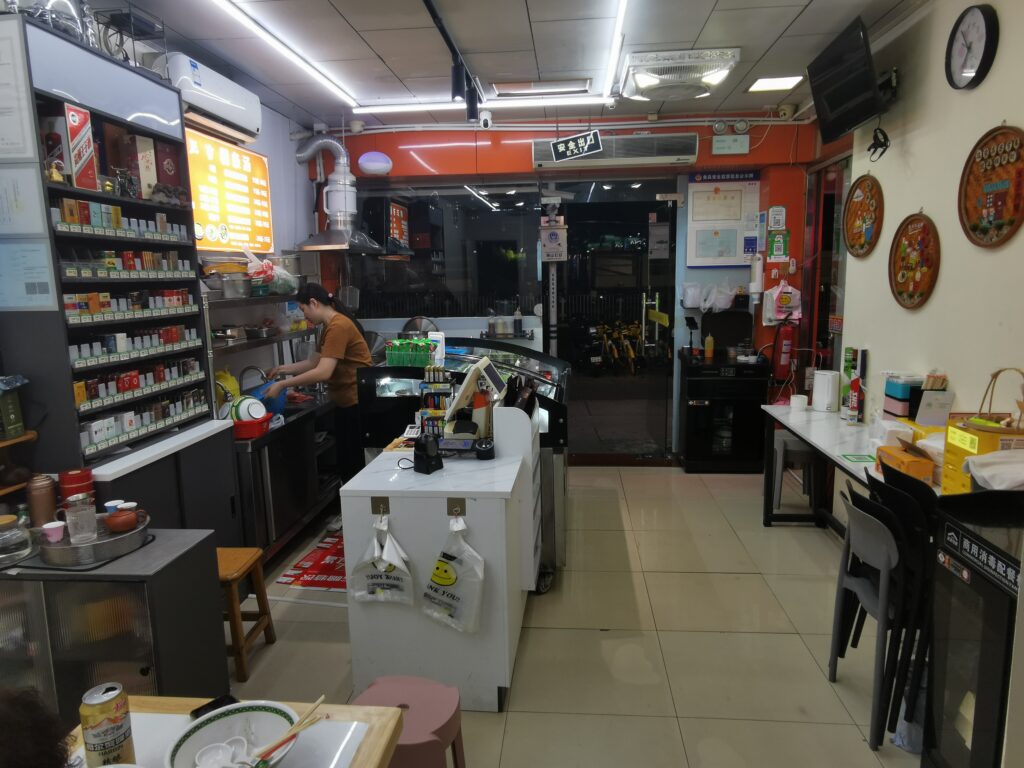
Photo #2: in addition to the three decorated grain sifters, they have a big poster vaunting Chaoshan Cuisine, which is what the four big characters say. Notice how it ties into ancient China, with the people portrayed in traditional dress, going back to at least the Qing Dynasty (1644-1911), since the male cook is sporting a pigtail.
In fact, each city ranks restaurants with a grade of A, B, C or D. One of the criteria is prominently displaying Chinese cuisine history, place and their connection to national culture, thus you can see some really cool posters and promotion in most restaurants, all thumping their chests about their local/regional cooking styles.
Unfortunately, Chinese are very undisciplined about smoking in restaurants, in spite of the posted signs. When they light up, I go over and say quietly and politely, “I’ll wait outside until you finish smoking”, and then step out onto the sidewalk. They almost always take one or two more puffs and then put them out!
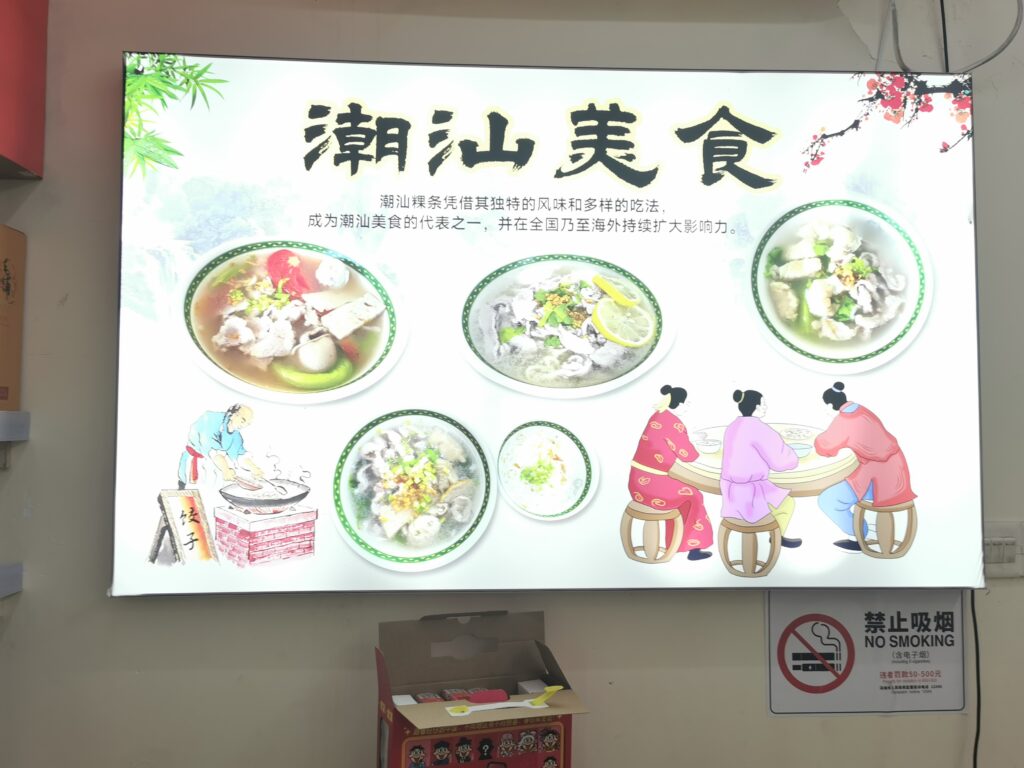
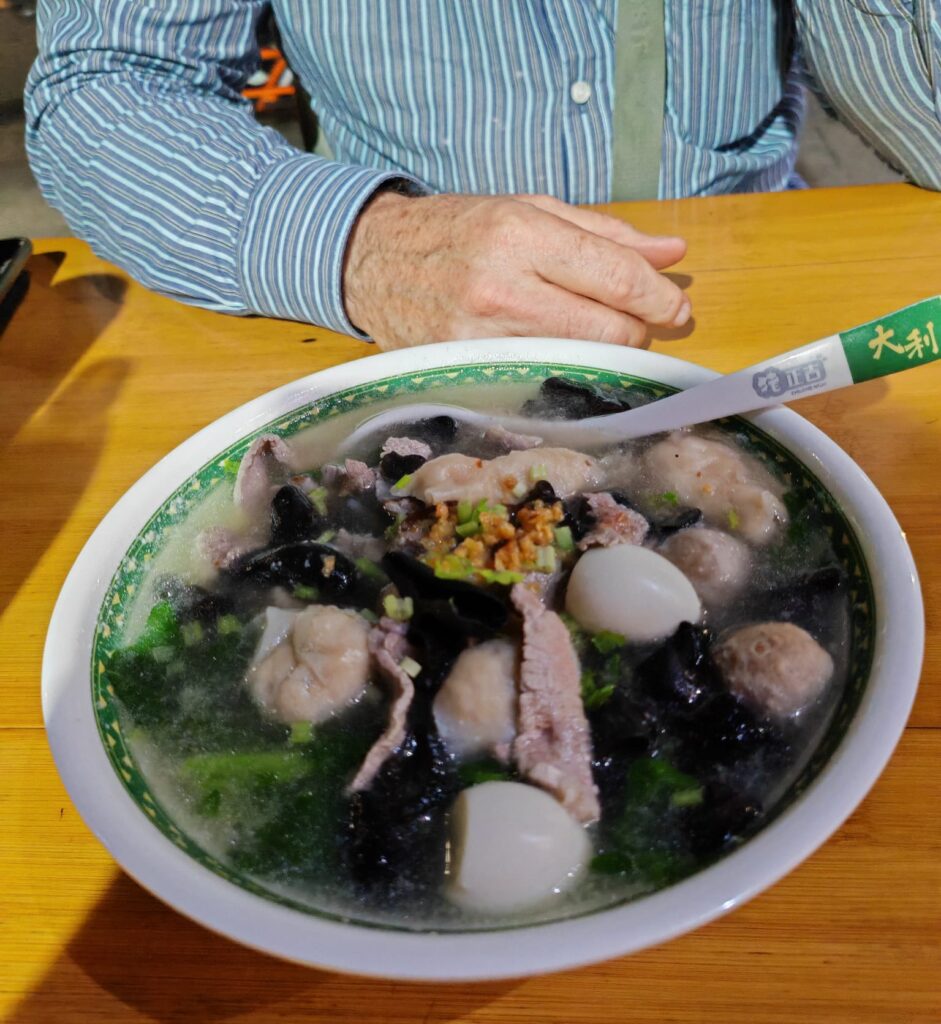
Photo #3: most mom & pop restaurants have a fixed menu of dishes, listed by category on a big wall poster. Some have modest menus and other have extensive ones. This one is a buffet to choose your ingredients to put in your bowl, with one of two kinds of noodles lower right: fresh rice noodles shaped like linguini and the other like spaghetti. There are three kinds of meat, pork blood and oysters on the lower left. Upper left are several kinds of tofu. Middle left are three kinds of meat balls, quail eggs, pig liver, mushrooms, and three kinds of dumplings. On the right are four kinds of fresh vegetables. What a feast! Take your pick. Whatever fits in the bowl.
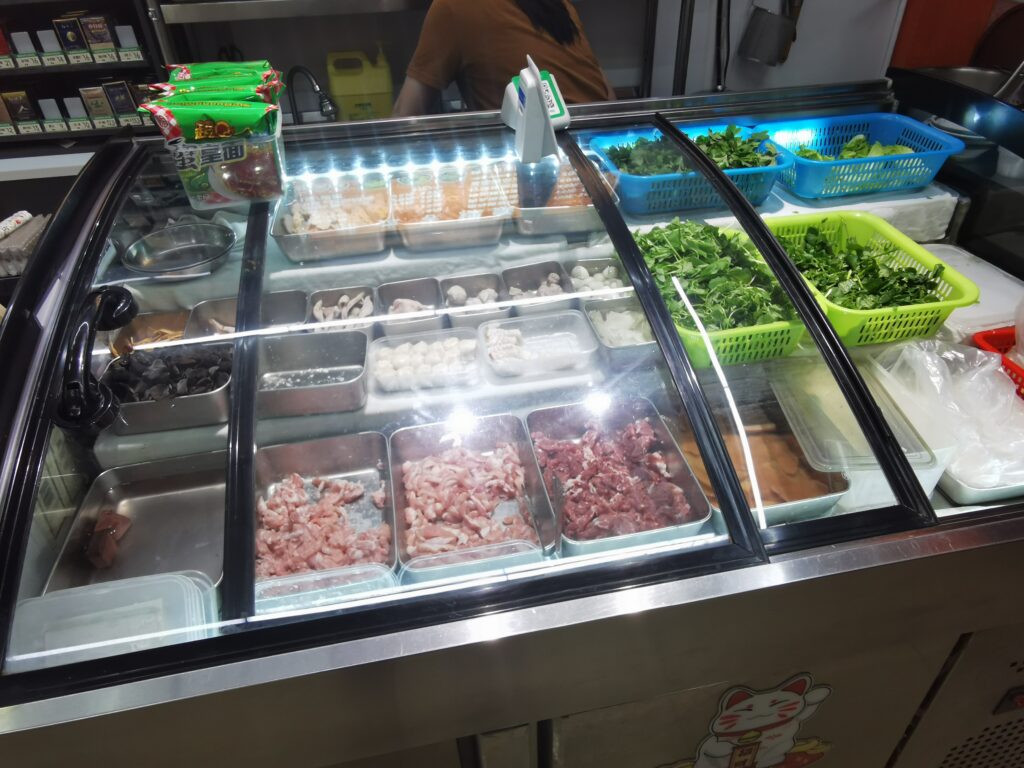
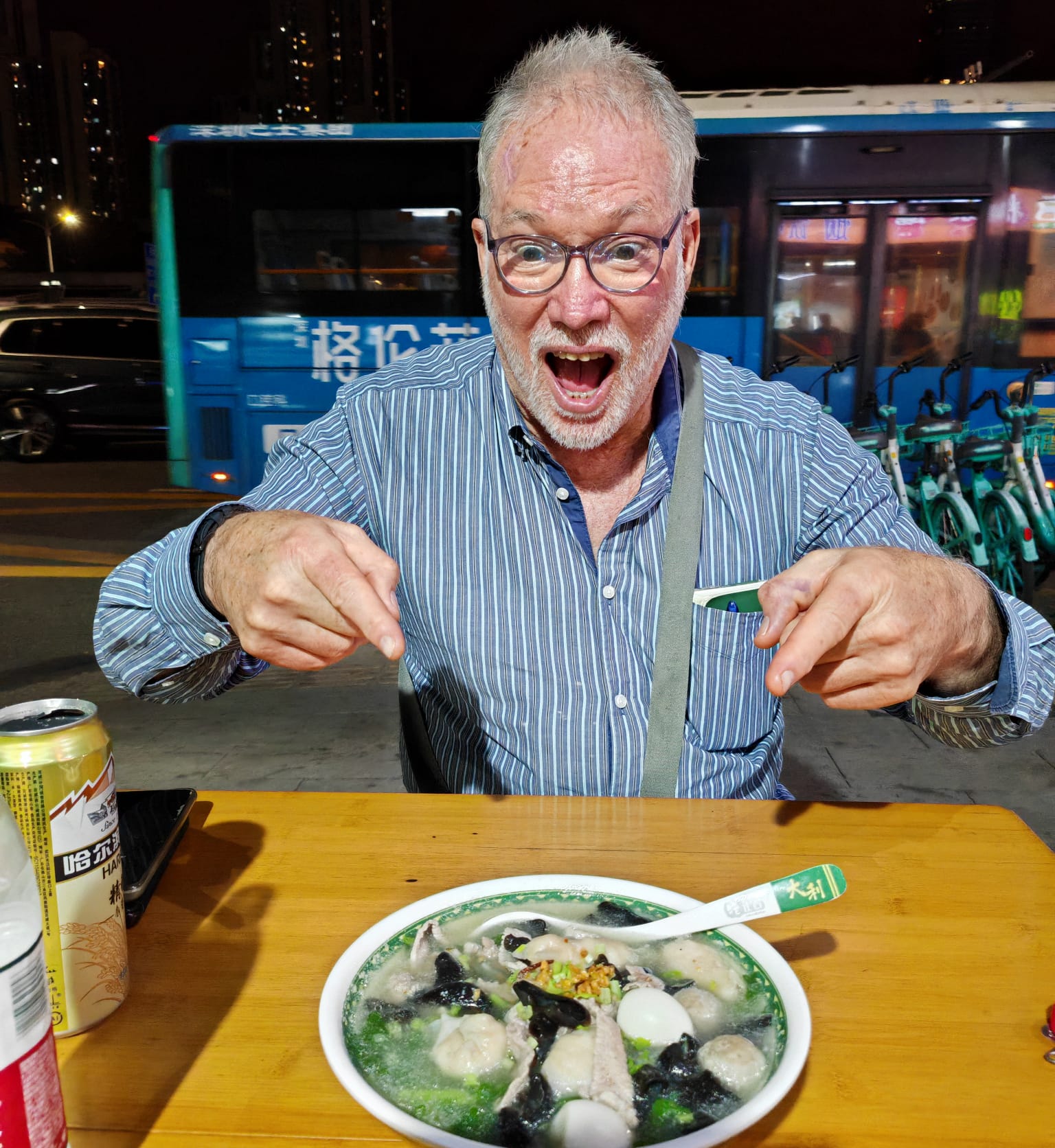
Photo #4a: I got an ice cold 500ml can of Harbin beer and Evelyne got a bottle of mineral water. After they put all the ingredients we chose into soup broth to cook, along with the fresh noodles, they garnish each bowl with spring onions and roasted garlic. You can see I am ready to tuck into a great Chaoshan meal!
Outside, you can see a Shenzhen public bus. All 15,680 big buses, 2,157 small buses, all running on 901 bus lines are all-electric, not even hybrid. I wrote a humorous post about New York City bragging it has the biggest public bus system in the world, when Shenzhen has almost four times as many buses,
Empire is #1 in everything, including public bus systems, right? China Rising Radio Sinoland 170928
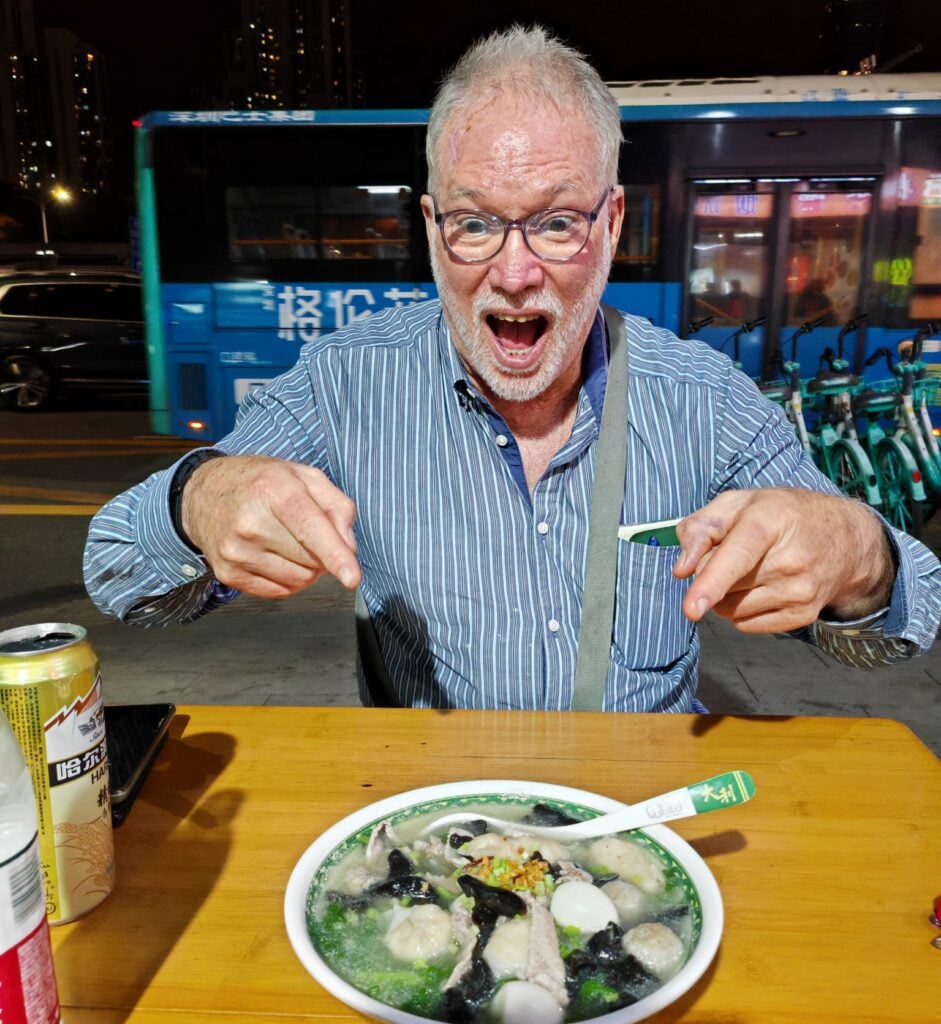
Photo #4b: Y-U-M-M-Y! Off to the side is a condiment station. Evelyne likes to add vinegar and some soy sauce to her noodles. The vinegar here makes the best Western food varieties taste like lemon juice. There are as many kinds of vinegar as there are kinds of wine in France. Smooth, tasty and aromatic. Nothing compares. The vinegar brand we buy back home in Taiwan Province is the best we’ve ever tasted.
The cost? Each big bowl stuffed with ingredients cost ¥35 (€4.23). My half liter of beer was ¥5 (€0.60) and Evelyne’s 600ml of mineral water was ¥2 (€0.24). Total cost: ¥77 (€9.31).
During one of our previous trips, Evelyne and I visited Chaozhou, the capital of Chaoshan region. It is a UNESCO World Heritage Site, as the origin of classic tea culture, going back millennia. We took an amazing one month trip from Shenzhen, north to Guangzhou, the provincial capital; to Lianzhou, then east to Shaoguan, over to Meizhou, Chaozhou and Shantou, flying back to Taiwan Province from there. The massive delta is the Pearl River. The whole area is very beautiful and deeply cultural.
Here is a map of Guangdong Province, whose outdated name is Canton.
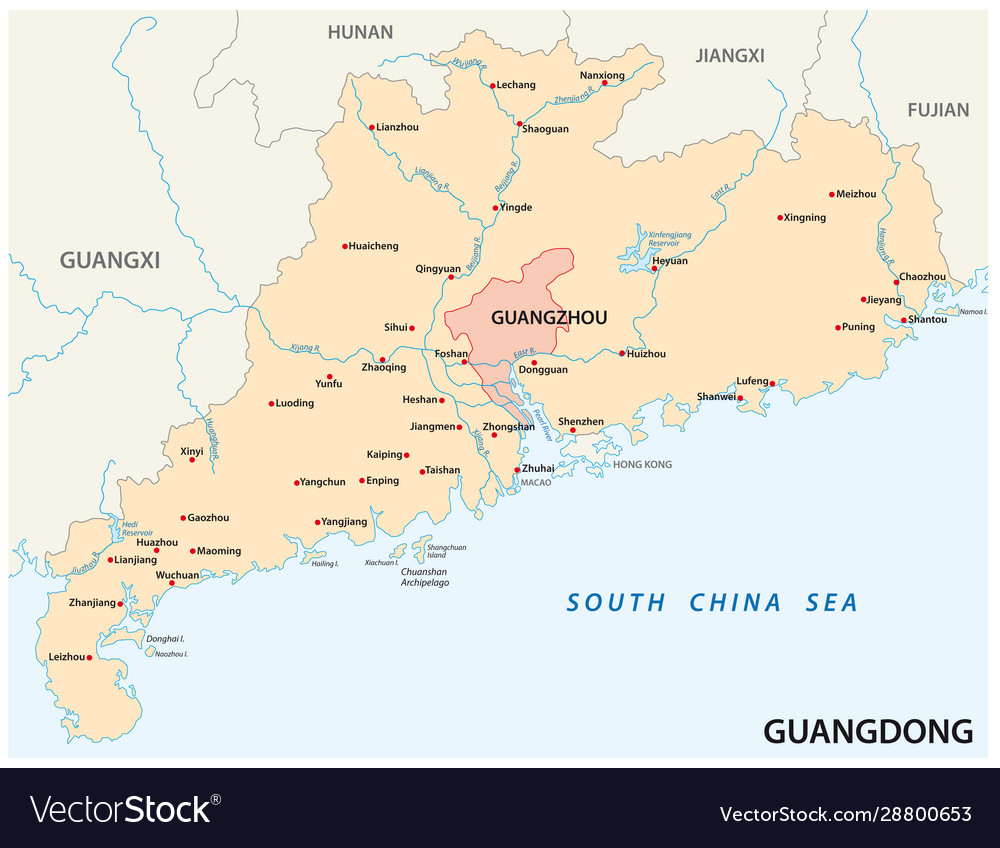
Map of the southern Chinese province of Guangdong with the most important cities
Video with a look back at our trip to Chaoshan…
https://open.substack.com/pub/jeffjbrown/p/jeff-serves-tea-and-a-little-mao
Video: Chaozhou, Guangdong is called the World Tea Culture Capital. In the east of the province, it is close to the borders of Fujian and Jiangxi Provinces, making a trio of fabulous tea growing regions, with Hunan further north and Guangxi bordering to the West. Everywhere we walked, we saw people in shops hand-sorting teas leaves on low, flat tables, as you can see here. This shop, called Wenxiang (闻香 = Smell the Fragrance) has won many awards and you can see the beautiful solid jade stone tea service on the main table, for customers to taste the wares. Don’t ask how much it cost!
Different varieties and harvest-years age are in huge steel barrels. Like wine and liquor, tea gets better over time. We bought two varieties of oolong, the region’s “champagne” of teas, for our friends in Paris. While there, we spent an hour talking with this shop’s lady worker and the owner, who arrived just after the video was taken.
He proudly referred to the statue saying, “Mao Zedong is our leader!”. There is no contradiction with Mao and capitalists. Mao is all about the people succeeding. The founder of Huawei, Ren Zhengfei calls Mao his mentor. Many others do too (https://chinarising.puntopress.com/2020/05/14/ren-zhengfei-founder-of-huawei-says-my-mentor-is-chairman-mao-zedong-im-not-surprised-are-you-china-rising-radio-sinoland-200515/).
Above Mao is a classic poem, written in his easily recognizable calligraphy style, using raised, 3-D characters,
沏一壶好茶,焚一封好香,在袅袅青烟与幽幽茶香中,调息精神,享受诗意生活.
Brew a pot of good tea, burn good incense, (then) in the curl of smoke and faint tea fragrance, breath (in) the spirit, and enjoy a poetic life.
Poems like this are frequently found in scholars’ studies, to grace the tea service.
Source: https://x.com/44_Days/status/1800515359490871683/
###
Other series by boots-on-the-ground travelers reporting on real China and real Chinese people!
Stay caught up with Amir&Jeff’s Amazing Adventure, journeying through the wilds of inner China, where foreigners don’t go! Short videos, captioned photos, articles, critical commentary.
State of the Chinese Union 2025: based on five months recently journeying across the country’s backwoods + 16 years living there. Speech given to Samui Real, Thailand, 13 August 2025
ADVENTURES WITH LADYB, FASHU, LAOLAO & GONGGONG
https://radiosinoland.com/search/?q=ladyb
My many articles about Taiwan Province
And a brand new series just started
Evelyne&Jeff’s Excellent China Adventures #1. Months already traveling here. Our first official post: just arrived to Shenzhen. 20 photos in 10 vignettes of life on the streets, to start your China day!
###
 I contribute to