Evelyne&Jeff’s Excellent China Adventure Series. Months spent traveling the back roads of China. Short videos with transcripts, captioned photos, articles and critical commentary. The REAL Chinese people you do not know!
All about Chinese liquor with some great anecdotal stories told…
What is Maotai?
Chinese like to drink Western liquor, like whiskey and cognac. But, the vast bulk of the popular market is dominated by their national drink called Maotai, or Moutai. Like German beer, it has hundreds of different local brands made by independent distilleries down to the village level. China has thousands of local and regional brands of Maotai. This is not to mention all the home-brewed stuff that makes the rounds.
Scotch comes from barley, whiskey from corn, vodka has its potatoes, rum uses cane sugar, tequila gets it energy from blue agave and Maotai is distilled from sorghum. I am not a great fan of any hard liquor, but the Chinese love their national drink. The standard strength is 42% alcohol, but can rang from 38-80%.
Later in our trip on the Tibetan Plateau, we visited a family-owned distillery. At 4,000-5,000 meters above sea level, the only grain that can survive is alpine barley. Thus, China has barley booze as well, it’s low-altitude cousin of course being used to make malt to ferment beer.
Rice is the carbohydrate substrate for sake. It is not distilled, but brewed like beer and is usually around 15-20% ethanol. Interestingly, sake was developed by the Chinese, who didn’t like it, trade brought it to the Japanese loved it and sake became their national drink.
Here is an excerpt from Robert Temple’s majestic book, which i highly recommend you read and which you can download for free below,
Strong Beer (Sake)
(Tenth Century bc)
Many Westerners are familiar with Japanese sake, but few will know that it represents a type of alcoholic drink which has only ever been made in China and Japan (where it was introduced from China). Sake is neither a wine nor a spirit. Some sake made today has been strengthened with spirit, but sake itself is a type of alcohol known in China as chin, of which a very rough translation is ‘strong beer’.
Ordinary beer, with an alcohol content reaching perhaps 4 or 5 per cent, has been made throughout the world for thousands of years. It was known to the Egyptians and Babylonians, and mention of it as an offering to the spirits in sacrifices occurs in early bone inscriptions in China dated about 1500 bc. There were many different kinds of this ordinary beer, with varying ingredients, from assorted regions.
By 1000 bc at the latest, and perhaps centuries earlier, the fermentation process was well established in China for the making of chin. It was at least three times as strong as ordinary beers. Whereas in the West no beverage attained an alcohol content of more than about 11 per cent (achieved by some wines) before distilled alcohol appeared, this ‘strong beer’ in China is thought to have had a substantially higher alcohol content. Poems surviving from 800 bc or earlier describe people getting tipsy on this heady brew.
You can download Temple’s book for free here, as well as a bilingual table I created, suitable for framing, that summarizes his amazing research,
Rice is also used to distill, like corn, sorghum, etc. Called Mijiu (米酒), meaning “rice alcohol”, it’s content is usually lower than the others, 25-50%. Mijiu is very popular in Taiwan Province and has a solid following on the Mainland too. Like everyday Maotai, Mijiu is low-priced for the masses.
The ins and outs of buying Maotai
As you can see in the photos, traditional Maotai is sold out of large earthenware or ceramic containers. They differ in locale, age, taste and aroma. Like expert wine drinkers, connoisseurs know the difference. Buying it this way, you come to the store with your own bottle or jug, and they fill it up from a spigot or by the measured ladle. Buying in bulk like this makes the cost a little cheaper and the experience more ritualistic, with rituals being an essential ingredient in Chinese civilization
Traditions and rituals of drinking Maotai
It is not uncommon to see diners show up in a restaurant with their own bottles of hootch. If it is a bigger group with 16-40 persons (eight per table), they will bring a 3- to 5-liter plastic jerry can of the stuff!
If it is a more expensive brand, the shot glasses can be quite small, down to 10ml. That way, each toast can be savored. Otherwise, they can be the standard 30ml shots, all the way up to guys pouring a full 250ml glass!
You can see younger and older men come to a restaurant with their Maotai supply for the evening. They clearly want to get buzzed and will down a number of rounds in close succession, each table mate making a toast. Like around the world, there are Chinese drinking games with dice, cards and the like, where the loser of that round (go on, twist my arm!) has to stand up and gulp down an extra round.
It’s not just Europeans who like to drink alcohol – East Asians are right up there
While Europeans have a reputation for drinking a lot of alcohol, East Asians – Chinese, Koreans and Japanese – can meet the challenge. Like cigarettes (unfortunately), hard alcohol is a ritual of buddy bonding, friendship and doing business together. Want to make East Asian friends? Get drunk as a skunk with them!
Two funny and revealing booze stories to paint the picture…
China
When I was in the grain trade business in 1990s China, my head office routinely sent out consultants to work with my Chinese partners. At big banquets in our honor, with 5-10 tables of eight, the ritual is for us to go each table to toast that group, then all the other tables would come to ours to do the same. It adds up to a lot of juice!
What I learned is that the drunker my consultants got with my Chinese partners, the more they were liked and respected. Having a consultant (in spite of my frequent during-dinner warnings about how strong Maotai is) get so bombed, that they had to be helped – even carried back – to their hotel room increased the project’s chances for success.
Korea
Vomiting is an ultimate buddy-bonding experience. A friend of mine worked in Korea, who was the guest of honor, sitting on the right side of the big cheese. Koreans like to crack a raw egg into the shot glass, before filling it up with soju, their version of Maotai. After several of those, my friend was quite drunk and with all those raw eggs sloshing in his belly, started to feel queasy. Head spinning, after the following round, he was talking to Mr. Big and suddenly barfed all over his lap!
Was that a problem? Hell no! For the rest of his stay, he was a foreign hero, loved and admired by all, having bravely gone mano-à-mano with the best of his local hosts.
My secret survival idea to avoid becoming an alcoholic…to this day
How did I solve this problem? To refuse to toast at all is a bit of a loss of face for the Chinese After my first six months in China in 1990 and as the host and guest of many big banquets, I knew I was not doing my body and brain any favors, and couldn’t keep it up. I got the bright idea to replace the Maotai with beer, which is only 3-4% alcohol. I could do beer shots all night, while my Chinese partners swilled the hard stuff. I respected the ritual, gained their respect and kept my health.
I wrote about this in colorful, humorous detail in The China Trilogy (https://www.amazon.com/stores/author/B00TX0TDDI/allbooks).
Maotai is cheap for the masses
Compared to other foreign liquors, Maotai is low cost, although some high-end brands can go for thousands of yuan a bottle (hundreds of euros). Much of it is sold in 150ml bottles, which people will buy to drink with their evening meals. Amir Khan, my travel partner, of which our one-month journey spawned a series of its own to follow, often does this with dinner (https://radiosinoland.com/2025/07/27/amirjeffs-excellent-china-adventure-series-2025-hunan-jiangxi-fujian-and-shaanxi-provinces-red-tour-short-videos-captioned-photos-articles-and-commentary-the-real-chinese-people-you-don/).
GANBEI in Chinese, CHEERS in English!
Photos
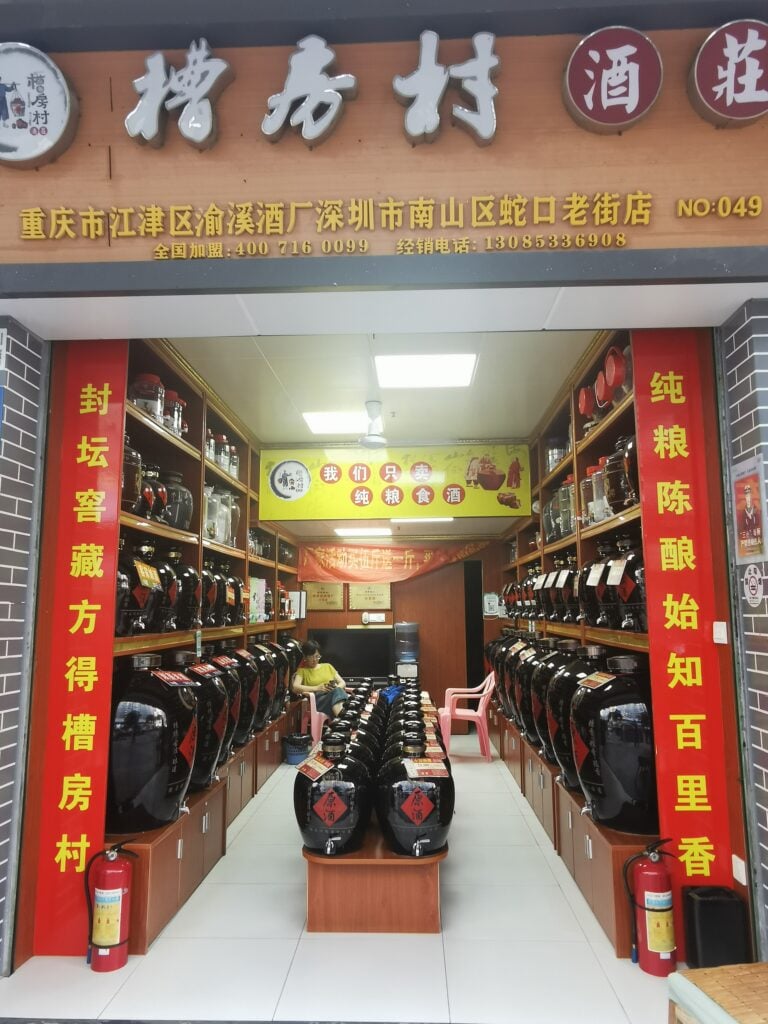
#1 a typical Chinese Maotai store. The source, age and price are usually marked on each container. This photo is from Chongqing, where Evelyne and I traveled later on during this trip.
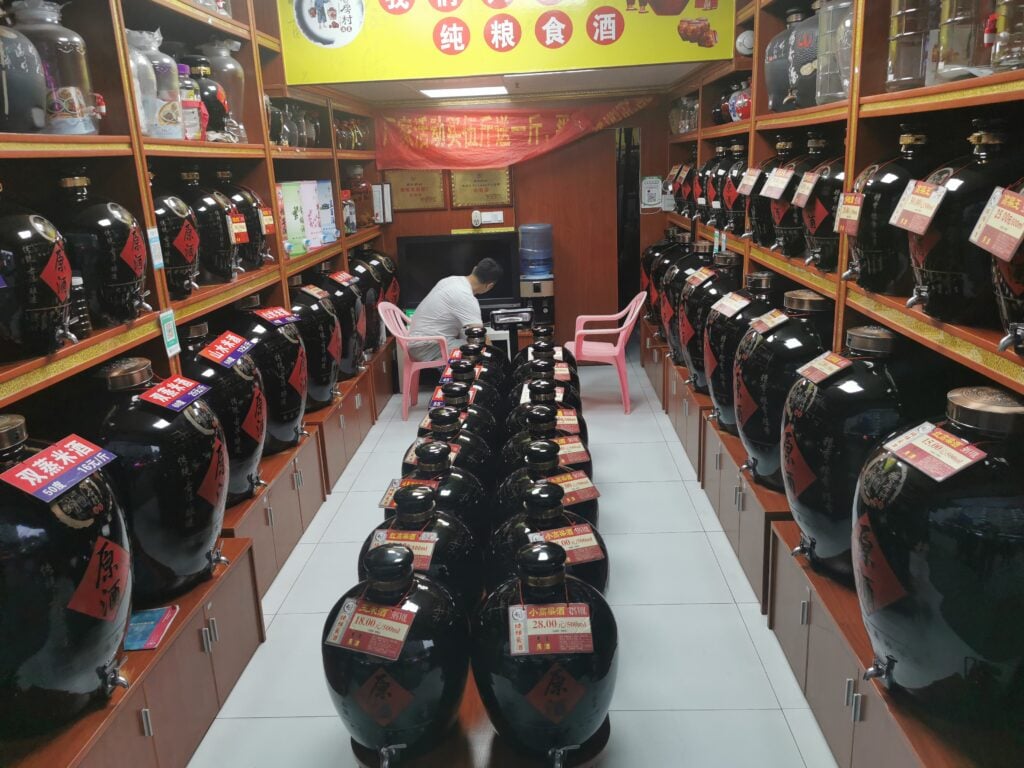
#2: a close-up look in the same store. To make them more attractive, they have catchy commercial names. the big container on the left is called “Double Sparrow Rice Liquor”, is 50% alcohol and costs ¥16 (€1.95) for 500 grams, or about a half a liter, which is really low cost.
I’m not a hard liquor drinker, but will have the occasional whiskey or cognac, especially around holidays. Maotai does not sit well in my gut. I can have shot of rice liquor, but they all tend to give me headache, as do white and rosé wines, the latter two which can give me cramps in my calves, believe it or not! An ice-cold Chinese beer or a glass of French red wine suits me just fine.
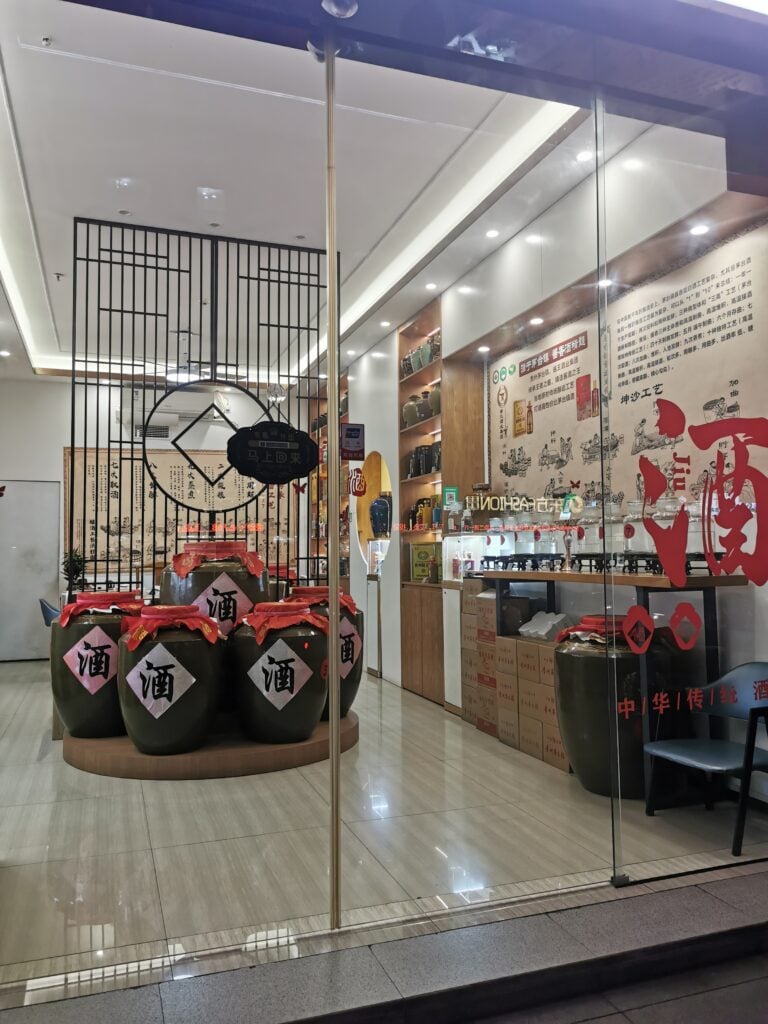
#3: some shopkeepers find a niche market by selling higher quality, more expensive Maotai, in a more upscale store environment, like this store in Shenzhen. The character on each container is 酒 = jiu, which simply means “alcohol”.
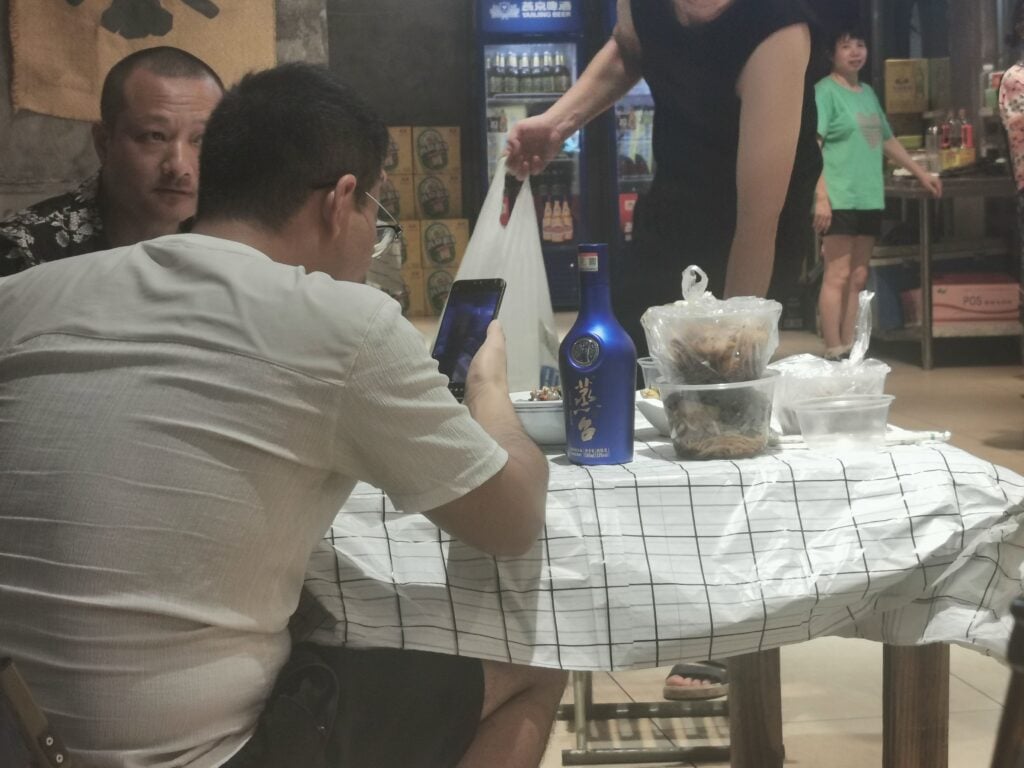
#4: here are three buddies bringing a 700ml bottle of Maotai to the restaurant, where Amir Khan and I ate in Hengyang, Hunan Province this last summer. To stand out, Maotai distillers offer their products in a rainbow of colors and bottle shapes. Hence, the fancy gold script on a cerulean-colored bottle above.
Notice that they are also bringing in outside food, with three big carry-out bowls next to the Maotai. The friend standing has also brought a sack with a six-pack of beer, which he put on the floor after I took this shot.
The Chinese people demanded that the government pass laws making this acceptable, where the restaurant cannot complain or charge a fee. Nor can they charge a “bottle/cork” fee for outside beverages. The only stipulation is the customer has to order something from the restaurant.
In China, Baba Beijing listens to and follows up with the masses’ wishes and concerns. It’s called consensual, participatory, real people’s democracy, something I’ve written much about (https://radiosinoland.com/2021/10/04/from-mao-to-xi-and-zhou-to-li-the-communist-party-of-china-cpc-offers-its-1-4-billion-citizens-real-peoples-democracy-leading-with-the-motto-serve-the-people-china-ris/ AND https://radiosinoland.com/2023/12/17/chinas-public-social-credit-system-versus-the-wests-secret-panopticon-by-jeff-j-brown-on-the-greanville-post/.
Don’t believe me? Just ask the Chinese and they will tell you,
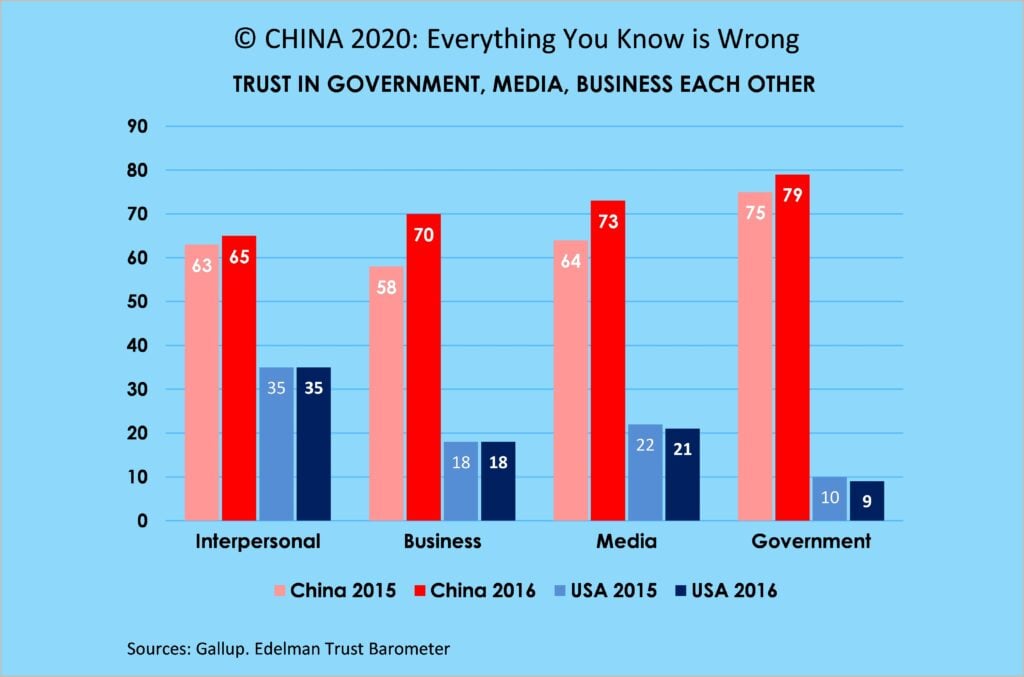
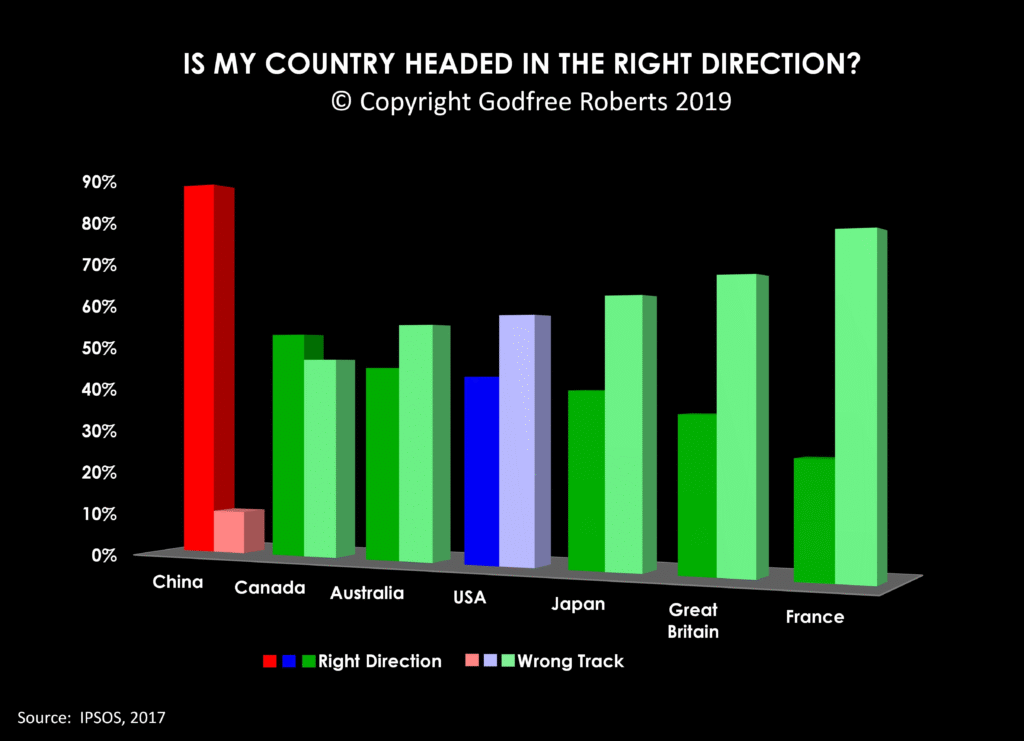
Note: notice that these are international polling companies, Gallup, Edelman and IPSOS, not Chinese ones. They can hardly be accused of pro-Chinese bias.
These graphs also demonstrate that in the West, autocratic, kakocratic leaders contemptuously treat their citizens like undeserving children, who have to be told what to do and kept in their inferior place,
Shut up and be thankful for what we allow you to have. You are lucky you don’t live in that hellhole called China!
Did you know that there are 300-500 public protest A DAY in China? No one gets hurt, no one gets arrested, no one loses their job, no one is deported. Baba Beijing encourages them to address the people’s needs and concerns, like local corruption, pollution, problems with public services, repairs, infrastructure, etc. Read below.
Not the same systems. Definitely not like in the Judeo-West!
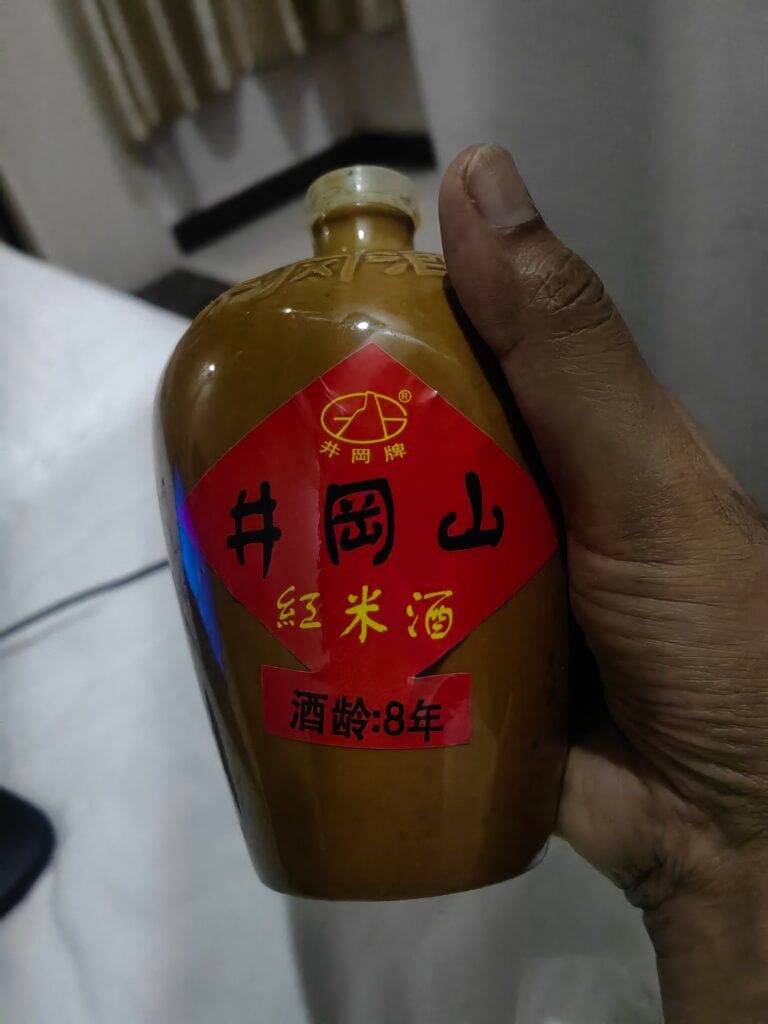
#5: here is a 150ml of Maotai that Amir bought, in a ceramic bottle. It was good quality, having been aged eight years. To give any products an air of sophistication, labels will often be written in traditional characters, not the usual simplified ones. That is the case above.
Conclusion
You can understand a lot about the Chinese people, by learning about booze with Evelyne&Jeff!
###
Other series by boots-on-the-ground China Writer travelers reporting on real China and real Chinese people!
Stay caught up with Amir&Jeff’s Amazing Adventure, journeying through the wilds of inner China, where foreigners don’t go! Short videos, captioned photos, articles, critical commentary.
State of the Chinese Union 2025: based on five months recently journeying across the country’s backwoods + 16 years living there. Speech given to Samui Real, Thailand, 13 August 2025
ADVENTURES IN ASIA WITH LADYB, FASHU, LAOLAO AND GONGGONG Series (focused on Taiwan Province and the rest of Asia)
Jeff’s many articles about Taiwan Province
Evelyne&Jeff’s Excellent China Adventure Series. Months spent traveling the back roads of China. Short videos with transcripts, captioned photos, articles and critical commentary. The REAL Chinese people you do not know!
Frans Vandenbosch: Final reflections on an extraordinary voyage
https://yellowlion.org/asia-trip-2025-part-11/
###
 I contribute to