TRANSLATION MENU: LOOK UPPER RIGHT BELOW THE SOCIAL MEDIA ICONS.
IT OFFERS EVERY LANGUAGE AVAILABLE AROUND THE WORLD!
ALSO, SOCIAL MEDIA AND PRINT ICONS ARE AT THE BOTTOM OF THIS POST!
Sixteen years on the streets, living and working with the people of China, Jeff
For donations, print books, ebooks and audiobooks, please see at the bottom of this post.
Text and audiovisual.
Downloadable audio podcast at the bottom of this page, Brighteon, iVoox, RuVid, as well as being syndicated on iTunes, Stitcher Radio and Reason.fm (links below),
Brighteon Video Channel: https://www.brighteon.com/channels/jeffjbrown
Brighteon video. Be sure to subscribe while watching,
Audio (download at the bottom of this page),
Before we get started…
1-Tom’s website:
Website: www.thomaspowellsculptor.com
2-Where to buy the print or ebook of “The Secret Ugly” and “General Sams’ Bubonic Plague Ship”:
https://www.amazon.com/Secret-Ugly-Hidden-History-Korea/dp/0926664069/
https://www.amazon.com/General-Sams-Bubonic-Plague-Discovered/dp/0926664778/
3-Tom has been here several times before, all worth looking at:
https://radiosinoland.com/search/?q=powell
4-Tom’s recommended books on Japanese BW:
Peter Williams and David Wallace, Unit 731: The Japanese Army Secret of Secrets, Hodder & Stoughton, London, 1989. (DO NOT read the US print. A key chapter on US BW use in Korea is censored in this version!).
Daniel Barenblatt, A Plague Upon Humanity: The Secret Genocide of Axis Japan’s Germ Warfare Operation, Harper Collins, New York, 2004,
5-Tom’s recommended books on US BW:
Stephen Endicott and Edward Hagerman, The United States and Biological Warfare: Secrets from the Early Cold War and Korea, Indiana University Press, Bloomington, 1988.
Dave Chaddock, This Must Be the Place: How the U.S. Waged Germ Warfare in the Korean War and Denied It Ever Since, Bennett and Hastings Publishing, Seattle, 2013.
6-Tom’s recommended book on counterfactual propaganda to deny US BW use:
Ed Regis, The Biology of Doom: the History of America’s Secret Germ Warfare Project, Henry Holt & Co., New York, 1999.
Quick recap
The meeting focused on discussing Thomas Powell’s recent discovery of a ship, LCI1091, which played a significant role in U.S. biological warfare activities during the Korean War. Jeff interviewed Tom about his new book detailing the ship’s history and its involvement in spreading diseases among prisoners and testing for bubonic plague. They also discussed the broader context of U.S. bioweapons programs and the historical cover-ups surrounding them. The conversation touched on the transfer of Japanese bioweapons scientists to the U.S. after World War II and the ongoing denial and obfuscation of these activities by Western powers. Tom shared his insights on the Korean War’s origins and the roles of key figures in precipitating the conflict. The conversation ended with a discussion about China’s rapid urbanization and development, highlighting its contrast with the West’s approach to urban planning and economic development.
Summary
Technical Audio Communication Failure
Thomas Powell attempted to communicate with Jeff but experienced technical difficulties, as he could not hear Jeff’s audio.
China’s Economic and Social Model
Jeff and Thomas Powell discussed their recent trip to China, where Jeff described the country’s advanced infrastructure, lack of poverty, and efficient government compared to Western systems. They explored the topic of China’s economic and social model, with Jeff emphasizing that China’s success is due to its communist and socialist principles rather than capitalism. The conversation concluded with Jeff introducing Thomas Powell’s work on exposing U.S. bioweapon use during the Korean War, highlighting his book “The Secret Ugly” and his contributions to the Bioweapon Truth Commission.
LCI1091: Bioweapons Transfer Vessel
Tom Powell discussed his discovery of the LCI1091 ship, which he found to be the vessel used by General Sam to transport Japanese bioweapon scientists to the United States after World War II. He explained that these scientists, including Ishii, Kitano, and Wakamasu, had been involved in developing biological weapons for Japan and were later brought to Fort Detrick, Maryland, where their research was incorporated into the U.S. biological weapons program. Jeff encouraged everyone to read Powell’s book about this discovery, describing it as a fun and revealing read that exposes the U.S.’s use of bioweapons.
US Bioweapons Program History
The United States had an extensive bioweapons program that began in the early 1940s, led by a scientist who established a facility at Fort Detrick. The program included multiple sites for research and testing, including Horn Island, Pine Bluff, and Utah, as well as Plum Island, which became a veterinary center for testing. Jeff and Thomas discussed the development of Lyme disease, which escaped from Plum Island, and mentioned an interview with a scientist who expressed regret for creating the disease.
Chinese Pandemic Casualty Evidence
Jeff and Thomas discussed the Chinese casualties from a recent event, estimating around 400,000 based on Daniel Berend’s research. They talked about disinformation specialists Milton Leitenberg and Catherine Wethersby, who have been less active in recent years but previously worked to deny or downplay evidence related to the pandemic and other incidents. Jeff mentioned that his colleague Jeffrey Kay’s research, including CIA documents uploaded to the Bioweapon Truth Commission, along with other evidence such as pilot confessions and scientific reports, has largely debunked previous denials and provided overwhelming proof of the situation.
Academic Challenges and Truth Commission
Thomas Powell and Jeff discussed the challenges of getting academic journals to publish articles exposing empire’s war crimes, noting that Chinese authorities may eventually make the information public with sufficient evidence. Jeff mentioned the International Scientific Research Commission Report from 1953 by Dr. Joseph Needham, available in multiple languages, and highlighted the work of Godfrey Roberts in compiling and publishing the report. They also discussed the need to reorganize the Bioweapon Truth Commission’s library, which currently lacks a librarian and proper organization by topic, with Jeff offering to pay for help.
Korean War Insights and Parallels
Thomas discussed his book about General Sam’s boat, which played a significant role in the Korean War. He revealed that the boat was involved in spreading diseases among prisoners and potentially spreading smallpox among Chinese soldiers. Thomas also shared his insights on the causes of the Korean War, attributing it to four key individuals who wanted war. He plans to focus on lesser-known stories in his book, including the prison uprising at Koji Island and the reasons behind the Cold War and U.S. involvement in Korea. Jeff and Thomas agreed on the parallels between the Korean War and the situation in Ukraine, highlighting the role of capitalism and perpetual war.
Tom’s Book Promotion and Insights
Jeff and Tom discussed promoting Tom’s book, with Jeff agreeing to add links to Amazon and Tom’s website on his platform. They also talked about Tom’s son taking over his role at Kukui, and Jeff shared insights about China’s urbanization and carbon neutrality efforts. Jeff suggested Tom’s son visit Xiong’an, a 22nd-century carbon-neutral city southeast of Beijing, and Shenzhen, a city near Hong Kong with visa-free access for 30 days.
Transcript
Jeff J. Brown: How’s it going in beautiful California?
Tom Powell: It’s a rainy, cold day. Nice to be indoors. You look like you shed a couple of years after your trip to the mainland. You look all relaxed.
Jeff J. Brown: Oh, Tom, you have no idea. If you and Linda want to come travel with us in China, we’ll show you around for a couple of weeks. It’s unbelievable. People have no idea what’s going on there. It’s like the 22nd century—so relaxing, the people are so honest, and it’s clean and organized. Anyway, it’s just unbelievable. There are no beggars, no homeless people, no tent cities, no drugs, no poverty. The infrastructure is incredible. China is the future of the world. And I’m not saying that because I’m a panda hugger. I’m saying it because it’s the damn truth. Of course, what people don’t want to admit is that all China is achieving—succeeding for its people, making them prosperous, richer, happier, and giving them a better life—is because they’re communist socialists, not capitalists. That’s what people can’t bring themselves to admit. It sticks in their craws that China is communist and socialist, so they deny it and call it capitalist. But capitalism can’t do what China is doing for its people. It can’t mobilize the productive forces, resources, organization, planning, and long-term planning that only communism and socialism can. So anyway, if you and Linda want to come visit.
Tom Powell: Okay, well, thanks for the invitation. Who knows? We may show up with our suitcases.
Jeff J. Brown: It’s fucking unbelievable. Every time we go, we come back with our jaws dropping. Anyway.
Tom Powell: They’re not skimming. You don’t have a capitalist class skimming.
Jeff J. Brown: Skimming? You mean the top 50% off the top or more?
Tom Powell: Exactly.
Jeff J. Brown: Plus, they print their own money. The People’s Bank of China is actually owned by the people, not by the City of London. So they don’t have to pay interest on money the government borrows internally. It’s a whole new world. As long as the PLA (People’s Liberation Army), the people, and the party lock arms together—stay united and keep rooting out corruption—it will go on for a long time. The two biggest weak links for China right now are that they have to keep weeding out corruption, which they have been doing since 2012, especially in the military. And they have to fight apathy and a sense of self-satisfaction. They need to stay hungry. If they do that, they’ll last as long as previous imperial dynasties.
Jeff J. Brown: To let you all know how important Thomas Powell’s work is in the field of Western bioweapons—this will be the ninth time he has graced the pages of Radio Sinoland. I can’t think of anyone who has done more to expose the lies of the United States, in particular, and the West in general, about their use of bioweapons on their perceived enemies. Tom has written several very important scholarly articles about US bioweapon use, especially during the Korean War. He wrote the book The Secret Ugly: The Hidden History of US Germ War in Korea, where he definitively proves this fact despite all official lies and cover-ups. He is a co-founder of the Bioweapon Truth Commission and was a key catalyst in establishing it and its online library. The library is free to the world and the largest repository of global bioweapon movies, books, articles, interviews, and images on the web. I will post all of the previous eight segments on this interview page. So it’s really great to have such an eminent truth-teller back on the show today. Thank you for being here, Tom.
Tom Powell: Well, thank you for that introduction, Jeff.
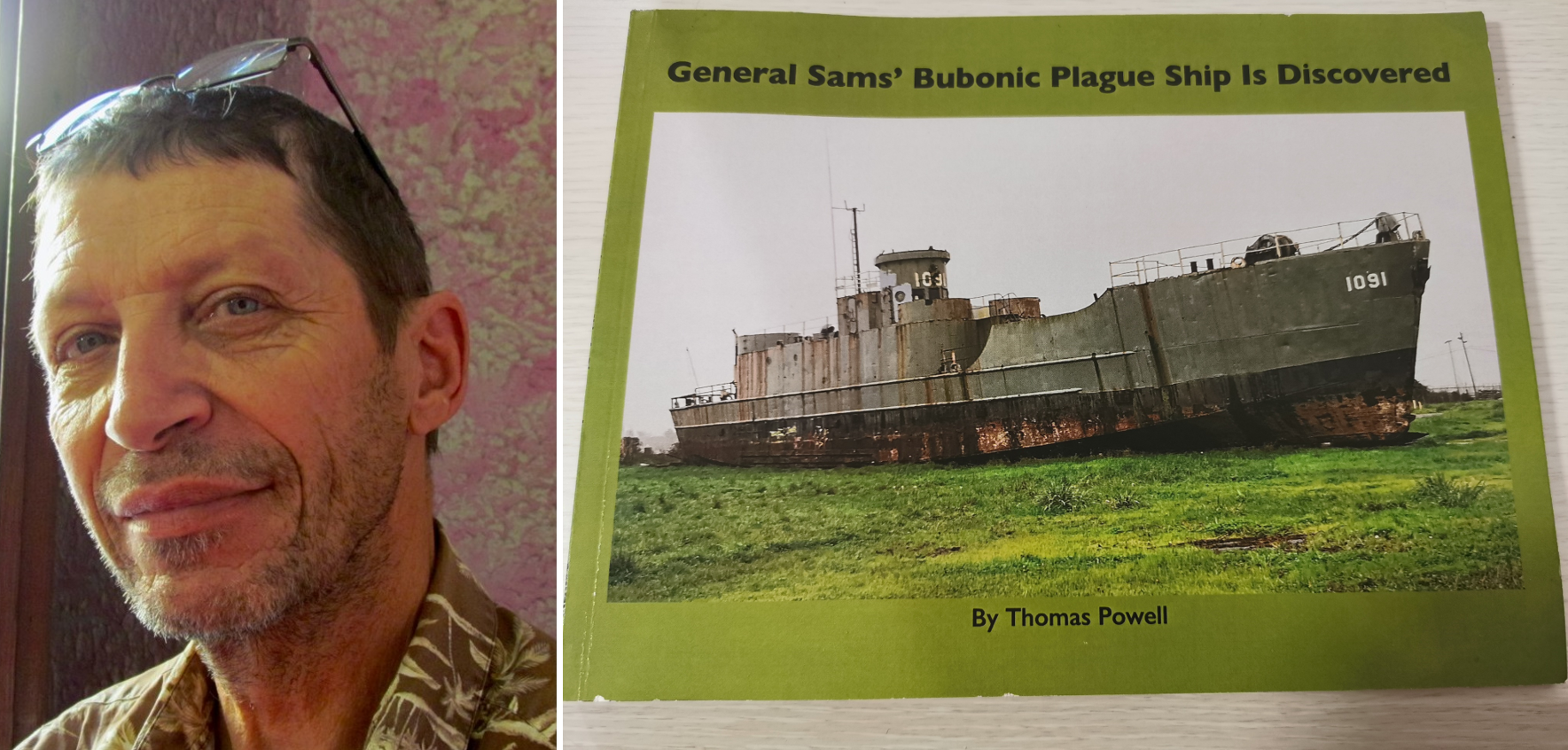
Jeff J. Brown: Tom, finding General Sam’s Bubonic Plague Ship was one of the greatest truth-telling discoveries about the US’s blatant use of bioweapons in modern history. I found out about it either last year or January of this year, when Tom discovered it. As a result of his excellent research and detective work, he has published a new book about General Sam’s Bubonic Plague Ship, which I have read and can show you. It’s short, full of photos, and a fun, revealing read. I’ll show it to everyone right here—there it is. It’s really great. Everyone should buy it, and everyone should buy The Secret Ugly too. Because this is foundational history about Western, especially American, bioweapon use. Tom, please show us your copy of The Secret Ugly—mine’s in storage back in France. There it is. Everyone should buy it. It’s an incredible read, like a detective story. I really hope everyone buys his two books. And if you don’t have the money, ask your library to buy them—libraries love when people request books for their local collections. So Tom, tell us about your new book. I’m all ears and eyes.
Tom Powell: Well, it was quite a find to discover this boat, LCI 1091. I read about it—it’s quite well known—and I just started doing some online searching and found out, lo and behold, that the boat still existed. It was somewhere up in Humboldt Bay in northern California, in the harbor there. I did a Google search and found it on Samoa Island, pulled out of the water, as you see in the photo on the cover of the book, sitting in a sea of green grass. It’s a very rusty, ugly-looking ship. By design alone, it has no masts or outside gangways, and the house is covered with armor plate. It’s just a very homely and ugly thing to look at. But I got ahold of a couple of retired Navy sailors who had custody of it, and they invited me to come up and take a look. I went and visited them, got the tour, and talked to them about it. They knew some of its history, but certainly not the censored parts.
Jeff J. Brown: And you got a phone call.
Tom Powell: I’m sorry, I shut it off. Anyway, I got to see it, go inside, and down into a hole. I even performed an exorcism to try to gather the ghosts of Ishii, Wakamatsu, and Kitano and take them off the boat. It was quite an adventure. I’ve been struggling to write a history of the Korean War, and I needed this interruption—something short and sweet and fun to write—to give me a break from that long task.
Jeff J. Brown: You just mentioned three Japanese bioweapons scientists that most people won’t know. Just give us a quick rundown on Ishii and his two accomplices.
Tom Powell: These were three generals of the Japanese Imperial Army. Ishii is kind of the godfather of the entire Japanese bioweapons industry and their war effort during World War II. He set up a couple of different sites in Manchuria, which the Japanese called Manchukuo. The first was Zhongmei Prison, where he ran a factory. It was a bit too close to population centers—the screams of torture victims could be heard outside the prison walls—and there was a mass escape during a Japanese New Year’s celebration. So they closed that facility, and he secured funding to build another large facility called Unit 731. It was outside the city, quite isolated, and became a huge compound about 6 or 7 square miles. It was extensive, with orchards, and they were largely self-sustaining, growing their own produce and raising farm animals. There are many books written about Unit 731—your listeners will have no trouble finding references and histories about it—but essentially, it was a torture facility to figure out how to kill people with various diseases.
Tom Powell: That was Ishii’s specialty. What he proposed to the Imperial Japanese Army for the war effort appealed to them because they were up against much more populous countries. They knew they would have to kill a lot of people to prevail against the US, China, Great Britain, and other countries for colonial power in the Pacific. That’s who Ishii was. Then there was Kitano, who was Ishii’s replacement. After setting up the death camp at Unit 731 in Harbin, Ishii had to return to Tokyo to teach at the military college—a requirement for promotion to general. He was allowed to build a second facility there, and Kitano took over Unit 731, running it from around 1943 to 1945. Wakamatsu was a veterinarian and in charge of Unit 100, which focused primarily on developing plant and livestock diseases. That’s who these guys were.
Jeff J. Brown: This has all been so obfuscated, hidden, denied, and lied about in the official mass media. Tell us how these guys ended up connected to Fort Detrick, Maryland, in the United States.
Tom Powell: Well, their work ended up there. It’s rumored that Ishii actually visited Fort Detrick—he might have come to the US twice. I don’t think Wakamatsu or Kitano ever came to the US, but their work certainly did. As the war was winding down and the Russians were about to invade Manchuria and enter the Pacific War, Ishii ordered the destruction of the Harbin facility. They took some files and many samples, destroyed the factory, murdered and incinerated the prisoners they had been experimenting on, blew up the facility, then took a boat to Japan and tried to hide in the Tokyo area. This was Ishii and his top medical staff who had been conducting the experiments—most of them got out. That’s when the Americans found them. MacArthur had heard about them and Unit 731, and he wanted to find these men and acquire their biological weapons arsenal. They searched for them, found them, and brought over scientists from Fort Detrick to interview them and assess the quality of their information.
Tom Powell: The interviewers reported that this was top-level information—nothing to dismiss, something the US needed for its own arsenal. So MacArthur essentially granted Ishii, Wakamatsu, and about 30 other Japanese war criminals a free pass. They squashed any inquiry into this at the Tokyo War Crimes Trial and brought these men under the US umbrella. That’s where General Sams came in—his job was to find work for these men, and he did. He needed administrators and top-level educated scientists and medical staff, as Sams was in charge of the entire social service sector of the occupation army in Japan at the end of the war. All these people divulged detailed confessions and explanations of their work, which were written down and sent to Fort Detrick, where they became part of the library and arsenal of the US biowarfare program.
Jeff J. Brown: Did the United States have a bioweapons program before MacArthur and company brought in the Japanese—with the 8,000 microscope slides and thousands of pages of documents I’ve heard about?
Tom Powell: Yes, the US had quite an extensive program. They started in the early 1940s as soon as the war broke out. I forget the individual’s name, but they recruited a top scientist from the Midwest who had been involved in plant disease research and biochemistry to set it up. He found the location at Fort Detrick, a small airfield not far from Washington, D.C., with a lot of farmland around it. Over three or four years, he built it up into a sizable facility with several buildings and extensive living quarters for staff. He recruited dozens of top scientists in disease pathology and a whole range of bioweapons research. They conducted experiments and set up subsidiary sites as well—one on Horn Island off Mississippi, one in Pine Bluff, Arkansas, and eventually testing grounds in Utah. There were many other laboratories set up for bioweapons research.
Jeff J. Brown: Also Plum Island in New York?
Tom Powell: Plum Island, New York, became a veterinary testing center.
Jeff J. Brown: That’s where the tick-borne disease—what’s it called? Lyme disease.
Tom Powell: Lyme disease? Yeah.
Jeff J. Brown: Lyme disease was developed by the US bioweapons program.
Tom Powell: Yeah, it escaped from Horn Island or Plum Island.
Jeff J. Brown: Plum Island? Yes. In New York, you and I actually did an interview with Kevin Barrett, and he interviewed the scientist who developed Lyme disease. The scientist tearfully admitted he had developed it, felt horrible, offered a mea culpa, and asked for forgiveness. It was very powerful. Folks, I’m really sorry—I took some Chinese traditional medicine, and it’s stuck in my throat. I apologize to Tom and the audience. I’ve heard all kinds of estimates—300,000 to 800,000—of Chinese, Russians, Americans, and anyone else they could get their hands on that the Japanese experimented on and bombed. How many people do you think the Japanese actually killed through their Unit 731 program?
Tom Powell: I don’t have a definite number, Jeff. The Chinese haven’t released official figures, and it’s hard to say. 400,000 is a good round number—Daniel Barenboim, who I think is quite knowledgeable on this, uses that. It might be higher, but you generally have to underestimate casualties to avoid being discredited. That’s just how it goes.
Jeff J. Brown: Tell us about the Big Lie Propaganda Machine. There’s this vast mainstream denial—the greatest weapon against the truth is to deny, deny, deny, which the United States has done extensively. There are two figures: Milton Leitenberg and Kathryn Weathersby at the Woodrow Wilson Institute. Tell us a bit about them and how they operate. And my follow-up question: have they been active in recent years, or have they crawled under their rocks and stayed quiet?
Tom Powell: Leitenberg surfaces from time to time. I don’t like to use the word “liar” in academia—it’s not respectful—so I prefer to call him a disinformation specialist. His profession is to hide the facts and come up with fraudulent but plausible explanations. He surfaced to blame China for the COVID-19 pandemic; he was the first American academic to write an article, published in the Bulletin of Atomic Scientists, blaming Wuhan, the institute there, and its scientists for sloppy work that allowed the disease to leak from the laboratory. That’s the last I’ve heard of him. I understand he’s quite elderly—maybe retired, maybe not. Either way, I don’t spend much time on him. He’s been shown to be an unreliable source not just on this issue, but also on the supposed Soviet submarine attacks on Sweden in the 1980s during the Carter administration. He wrote a whole book on that which was complete misinformation, so he’s pretty much discredited. Weathersby is also long past retirement age and not particularly active as far as I know. The evidence is now out there—both my research and Jeffrey Kaye’s have pretty much demolished any counterarguments. We’ve dug deep and have two smoking guns: the boat I discovered, LCI 1091, with its rat cages and everything—you couldn’t have better evidence than that—and Jeff also found these CIA documents.
Jeff J. Brown: Which, by the way, are uploaded on the Bioweapon Truth Commission. All of that material.
Tom Powell: Yes. Thank you for doing that. Between those two and all the other prior evidence everyone else has dug up—the committee reports, the scientists’ reports, the lawyers’ reports, the pilots’ confessions—it’s just too overwhelming. There are no lies or falsehoods that are even conceivably believable anymore.
Jeff J. Brown: Yeah, absolutely.
Tom Powell: It’s just hard to get this into the mainstream. I’ve struggled to get mainstream academic journals to publish my articles, and they generally won’t.
Jeff J. Brown: Of course—this exposes the war crimes of the empire.
Tom Powell: Well, they get their grants and funding through these agencies, and this upsets the status quo. They prefer to just not say anything, ignore it, and hope it goes away. But I think at some point, the Chinese will feel they’re in a strong enough position to make this information public. When they do, they’ll have all the sufficient evidence, scientific data, and analysis—and it won’t be deniable anymore.
Jeff J. Brown: Well, the Chinese have actually taken a big step. We have the International Scientific Research Commission report on the Bioweapon Truth Commission—from 1953, right?
Tom Powell: Yes.
Jeff J. Brown: By Joseph Needham.
Tom Powell: Joseph Needham, the author.
Jeff J. Brown: We have it in Russian, Chinese, and English. I actually have the French version, but I haven’t been able to get it scanned to upload. I’ve been trying to get the Korean version too, since that’s another language it was published in, but I haven’t succeeded. I don’t know anyone in Korea willing to do the detective work to dig it up.
Tom Powell: Well, Godfrey Roberts collected the commission’s report, put it together in a book, and published it—it’s available on Amazon as a Kindle download. Any of your viewers who want to read it can search for it there. I also found out that this evidence was simultaneously published in the December 1953 issue of the Chinese Medical Journal. Not all 700 pages of the evidence, but about 300 pages are in that medical journal.
Jeff J. Brown: I’d like to point out that Tom is not just a founding member of the Bioweapon Truth Commission—Jeffrey Kaye and Godfrey Roberts are too. They’ve provided a lot of very useful material.
Tom Powell: And yourself, Jeff. We’ve all been doing due diligence here.
Jeff J. Brown: Anyway, I’ll definitely put that web link on the page. Everyone should take a look at it. I’ve tried to find people to clean it up—I have hundreds of articles to upload, but I don’t have time and can’t find anyone to do it for me. Tom even offered to pay $300, and we still can’t find anyone willing. It’s crazy.
Tom Powell: Let’s just say we’re hiring and put the word out.
Jeff J. Brown: If you want to reorganize it—I did my best, but I’m not a librarian. Librarianship is a science. I organized it roughly by medium: videos, written materials, interviews, books, etc. Now I realize that was a mistake. It should be organized by topic, with videos, interviews, images, and books all in one place, like a real library. I messed up, but I did the best I could. Even so, it’s still the largest repository of bioweapons documentation on the internet, and it’s free for everyone. So everyone should definitely check it out. Tom, before we wrap up, tell us about your book on Korea.
Tom Powell: Sure. Before I get to that, let me talk a bit about General Sams and this boat—my new book is actually about the boat, with General Sams as the main character. It has a lot of good pictures. This boat is the most unheralded warship in U.S. history. It’s been involved in so many clandestine missions and nasty stuff, and the fact that it still exists—wasn’t scuttled in 1955—is remarkable. Sams acquired this boat after it was involved in the invasion of Okinawa. Then it was converted into a drone aircraft carrier for the Korean War, and after that, it was back in Japan. Sams got ahold of it and converted it again into a laboratory ship. We know of two specific things they did with it. First, with Wakamatsu and Kitano on board, the ship was sent to Koji Island—a big prison camp near Pusan during the Korean War. The island already had 100,000 residents, but the U.S. took control and built an enormous prison city that housed another 100,000 prisoners (and probably more). A cholera epidemic broke out there, and from January to May 1951, there were 96,000 recorded cases of dysentery. 19,000 of those prisoners had to be hospitalized, with a 9% mortality rate. You don’t get this kind of pandemic in a small, localized community unless someone is intentionally injecting people with dysentery and cholera to start it. So we know for sure this boat was involved in spreading the pandemic among the prisoners and killing them off.
Jeff J. Brown: 9% of 96,000 is almost 9,000 people dead. That’s more war crimes.
Tom Powell: Yeah, it’s shocking. The other incident we know of: Sams, along with his buddy Ishii Shiro, flew from Tokyo to Pusan, went to Koji Island, boarded the ship, and sailed up the coast on a mission. They’d heard there was bubonic plague in North Korea. Since there’s bubonic plague in China, he wanted to check if Chinese soldiers had brought it into Korea—Korea had no history of bubonic plague for centuries, if ever. He had these three bioweapons generals as his guests on the boat. They sailed a few hundred miles up the coast and landed at Wonsan Harbor. Also with them was the Navy’s top commando team—three guys, whose photo is in the book. Eugene Clark, who looks like a normal athletic guy, but he’s an amazing killer involved in all kinds of escapades. His two Korean colleagues: Colonel K Eng Joo and Lieutenant Commander Eun Jung. The three of them had been involved in numerous behind-enemy-lines exploits, including turning on the lighthouse signal at Incheon Harbor the evening of MacArthur’s landing there. They’d spent a week on the islands organizing resistance crews. Anyway, they accompanied Sams on this mission to find a sick Chinese soldier they could kidnap and take back to the boat to test for bubonic plague. To do this, they came to a village with three sentries. The three commandos snuck up and killed them—probably with knives to keep it quiet. Then Sams found an informant who worked in a communist field hospital. He interviewed him and discovered what they had was an advanced form of smallpox with symptoms similar to bubonic plague. With that information, they turned around and went back to the boat—no need to kidnap anyone, he had enough to go on. He was concerned because if the Chinese soldiers had plague, he’d have to inoculate the entire U.S. Army and its allies, which would be a huge, expensive project. What’s interesting is that when the Chinese entered the war, they drove the U.S. out of North Korea. The U.S. had first invaded South Korea, then North Korea, and gone all the way to the Yalu River. The Chinese pushed them back past the 38th parallel into South Korea. On the retreat, the U.S. spread smallpox using feathers—a weapon Ishii had devised, attaching smallpox bacteria to chicken feathers. They took bags of chicken feathers and spread them in villagers’ homes as they retreated. This likely caused the sickness among the soldiers. My father found out about this epidemic and published figures in his newspaper: 3,500 cases of smallpox that occurred very rapidly in specific areas where the U.S. had retreated, with a 10% mortality rate. I don’t have all the evidence yet—I’m still digging—but I think Sams’ boat, LCI 1091, was the support vessel off the coast that allowed them to land, unload jeeps and sacks of feathers, drive into towns, spread the infected feathers in people’s homes, and quickly escape back to sea. I think this is another area that needs more research, but it seems to fit.
Jeff J. Brown: Absolutely—war crime after war crime.
Tom Powell: Yeah, it’s a bottomless pit, and it continues to this very day.
Jeff J. Brown: The United States is a nation of war crimes. Unbelievable. Well, Tom, tell us about your book on Korea before we say goodbye. I know it’s a labor of love.
Tom Powell: Okay. It’s been difficult. Even though the Korean War was short, there are endless stories and details to cover. I realized there are already plenty of good histories of the war out there, so I don’t need to write another full history. Writing this book on Sams and the bubonic plague ship gave me the distance I needed to take a hatchet to what I’d already written and pare it down. I’m going to focus on stories that haven’t really been told yet: the prison uprising at Koji Island, the pilots’ confessions, how the war started, how the Cold War started, why the U.S. entered the Korean War in the first place. Not many academics have analyzed that—most explanations boil down to “fear of communism.” But when you read people like I.F. Stone and his history of the Korean War, you start to realize the war was a setup. They created the conditions for the North to attack the South, allowing the U.S. to then counter-invade. That’s what I want to write about—the things that haven’t been discussed previously.
Jeff J. Brown: Yeah. I know you mentioned in your book that North Korea invaded South Korea, but what people don’t know is they really had no choice. They were literally pushed into it. The South was baiting them, making incursions into North Korea, firing across the border. It was the South that wanted war. What was his name? Park… Park Kyung-hee? I can’t remember.
Tom Powell: No, that’s a different person. It was…
Jeff J. Brown: The original leader of South Korea—a brutal dictator.
Tom Powell: Yeah.
Jeff J. Brown: He wanted war, and he got it. But it was basically the South that created the conditions for it, as you said.
Tom Powell: That was Syngman Rhee.
Jeff J. Brown: Yeah, Syngman Rhee—educated in the U.S., a Christian.
Tom Powell: There are four people who were really instrumental in making the war happen: Syngman Rhee, MacArthur, John Foster Dulles (who established South Korea at the United Nations), and Harry Truman. These four all wanted war, and they made it happen. Everyone else just joined the bandwagon. That’s another thing I want to talk about.
Jeff J. Brown: We have a similar parallel in Ukraine. NATO pushed and pushed Russia to the point where they had to launch their special military operation to protect their flank. It seems like the West’s middle names are “war” and “war crimes.” Unbelievable.
Tom Powell: Well, it’s capitalism, Jeff. It can’t exist without perpetual war. It’s shocking, and it’s time to move on.
Jeff J. Brown: Yeah, absolutely. Tom and I met back in 2019. I also met Jeffrey Kaye and Frank Scott—we had lunch together in San Francisco on the Bay when I was back for my mother’s funeral. I took a couple of days to go to San Francisco and meet some people I really admire and respect. Tom and I stay in regular touch. Tom met my wife—he and his wife Linda met my wife and some friends in Normandy. I wasn’t there unfortunately, but they had a nice lunch. We’re good friends and fellow colleagues, and I truly admire and respect Tom for all his amazing work. He inspires me to be a better researcher and writer. Thank you, Tom.
Tom Powell: You’re welcome, Jeff. Thanks for the kind words.
Jeff J. Brown: Alright, this is Jeff J. Brown from Radio Sinoland, hailing from Taiwan Province, China. Tom and his wife Linda have an open invitation to come here, or we can meet on the mainland—both are fabulous. I hope everyone has a merry Christmas and a happy New Year. I don’t know if you can see, but Evelyn made that beautiful hanging ornament. There’s our Christmas tree in the distance, and the little white thing in the right-hand corner is the nativity scene. We’re ready for Christmas Eve tomorrow and Christmas after that. Thanks again, Tom. We’ll talk soon.
Tom Powell: Alrighty.
Jeff J. Brown: When this episode comes out, hopefully you can promote it on your end.
Tom Powell: I will indeed. Great. Thank you, Jeff. Bye-bye.
###
MPORTANT NOTICE: techofascism is already here! I’ve been de-platformed by StumbleUpon (now Mix) and Reddit. I am being heavily censored by Facebook, Twitter, SoundCloud and YouTube. It’s only a matter of time before they de-platform me too. Please start using Brighteon for my videos, then connect with me via other social media listed below, especially VK, Telegram, Signal, Parler, Gettr, Gab and WeChat, which are not part of the West’s Big Lie Propaganda Machine (BLPM).
I will post EVERYTHING I produce on my Twitter and Telegram channels, including useful news and information you may not come across, so subscribe for FREE, for the most frequent updates,
Daily news: https://twitter.com/44_Days
Daily news: https://t.me/jeffjbrown
I also write shorter pieces on Seek Truth From Facts,
https://seektruthfromfacts.org/category/cwg/
And edit STFF’s Guest Submissions,
https://seektruthfromfacts.org/guess-submissions/
Also, sign up for my FREE email newsletter…
Support, donations and contributions for my work here, any amount, one time or monthly,
A to Z support. Thank you in advance, Jeff
Alipay and WeChat: Chinese phone number: +86-19806711824
Checks or cash: mail to: Jeff J. Brown, 75 rue Surcouf, Cherbourg 14117, France
Donorbox: www.donorbox.com, find China Rising Radio Sinoland
Euro bank wires: 44 Days Publishing, Bank: TransferWise, IBAN: BE70 9672 2959 5225
FundRazr: https://fundrazr.com/CRRS_2021_fundraiser?ref=ab_78aX23
Patreon: https://www.patreon.com/China_Rising_Radio_Sinoland or https://www.patreon.com/China_Tech_News_Flash
Payoneer: www.payoneer.com, Jeffrey Jennings Brown, Account Number: 4023795169624
Paypal: https://www.paypal.me/ChinaRisingRadioSino
Stripe US$/ApplePay: https://buy.stripe.com/14k8zl5tp5mVeT66op
Stripe Euros/ApplePay: https://buy.stripe.com/fZe02P8FB9DbcKY28a
US bank wires: Jeff J. Brown, Bank of Oklahoma, Routing Number/ABA: 103900036, Account: 309163695
Do yourself, your friends, family and colleagues a favor, to make sure all of you are Sino-smart:
Google ebooks (Epub) and audiobooks:
44 Days Backpacking in China: The Middle Kingdom in the 21st Century, with the United States, Europe and the Fate of the World in Its Looking Glass https://play.google.com/store/books/details?id=YBKHEAAAQBAJ
https://play.google.com/store/audiobooks/details?id=AQAAAECCkQXRlM
China Rising: Capitalist Roads, Socialist Destinations https://play.google.com/store/books/details?id=YNmLEAAAQBAJ
https://play.google.com/store/audiobooks/details?id=AQAAAECCfHo86M
BIG Red Book on China: Chinese History, Culture and Revolution
https://play.google.com/store/books/details?id=6Wl4EAAAQBAJ
https://play.google.com/store/audiobooks/details?id=AQAAAECCfHo86M
Amazon print and ebooks (Kindle):
44 Days Backpacking in China: The Middle Kingdom in the 21st Century, with the United States, Europe and the Fate of the World in Its Looking Glass
https://www.amazon.com/gp/product/1484939999/
China Rising: Capitalist Roads, Socialist Destinations
https://www.amazon.com/China-Rising-Capitalist-Socialist-Destinations/dp/0996487042
BIG Red Book on China: Chinese History, Culture and Revolution
https://www.amazon.com/BIG-Red-Book-China/dp/1673322719/
Author page:
https://www.amazon.com/Mr.-Jeff-J.-Brown/e/B00TX0TDDI
Praise for The China Trilogy:
Why and How China works: With a Mirror to Our Own History



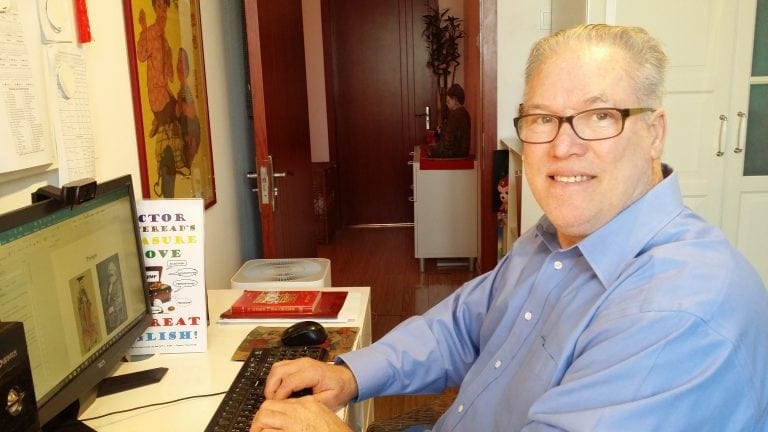
JEFF J. BROWN, Editor, China Rising, and Senior Editor & China Correspondent, Dispatch from Beijing, The Greanville Post
Jeff J. Brown is a geopolitical analyst, journalist, lecturer and the author of The China Trilogy. It consists of 44 Days Backpacking in China – The Middle Kingdom in the 21st Century, with the United States, Europe and the Fate of the World in Its Looking Glass (2013); Punto Press released China Rising – Capitalist Roads, Socialist Destinations (2016); and BIG Red Book on China (2020). As well, he published a textbook, Doctor WriteRead’s Treasure Trove to Great English (2015). Jeff is a Senior Editor & China Correspondent for The Greanville Post, where he keeps a column, Dispatch from Beijing and is a Global Opinion Leader at 21st Century. He also writes a column for The Saker, called the Moscow-Beijing Express. Jeff writes, interviews and podcasts on his own program, China Rising Radio Sinoland, which is also available on YouTube, Stitcher Radio, iTunes, Ivoox and RUvid. Guests have included Ramsey Clark, James Bradley, Moti Nissani, Godfree Roberts, Hiroyuki Hamada, The Saker and many others. [/su_spoiler]
Jeff can be reached at China Rising, [email protected], Facebook, Twitter, Wechat (+86-19806711824/Mr_Professor_Brown, and Line/Signal/Telegram/Whatsapp: +33-612458821.
Read it in your language • Lealo en su idioma • Lisez-le dans votre langue • Lies es in deniner Sprache • Прочитайте это на вашем языке • 用你的语言阅读
[google-translator]
Wechat group: search the phone number +8619806711824 or my ID, Mr_Professor_Brown, friend request and ask Jeff to join the China Rising Radio Sinoland Wechat group. He will add you as a member, so you can join in the ongoing discussion.
 I contribute to