TRANSLATION MENU: LOOK UPPER RIGHT BELOW THE SOCIAL MEDIA ICONS.
IT OFFERS EVERY LANGUAGE AVAILABLE AROUND THE WORLD!
ALSO, SOCIAL MEDIA AND PRINT ICONS ARE AT THE BOTTOM OF THIS POST!
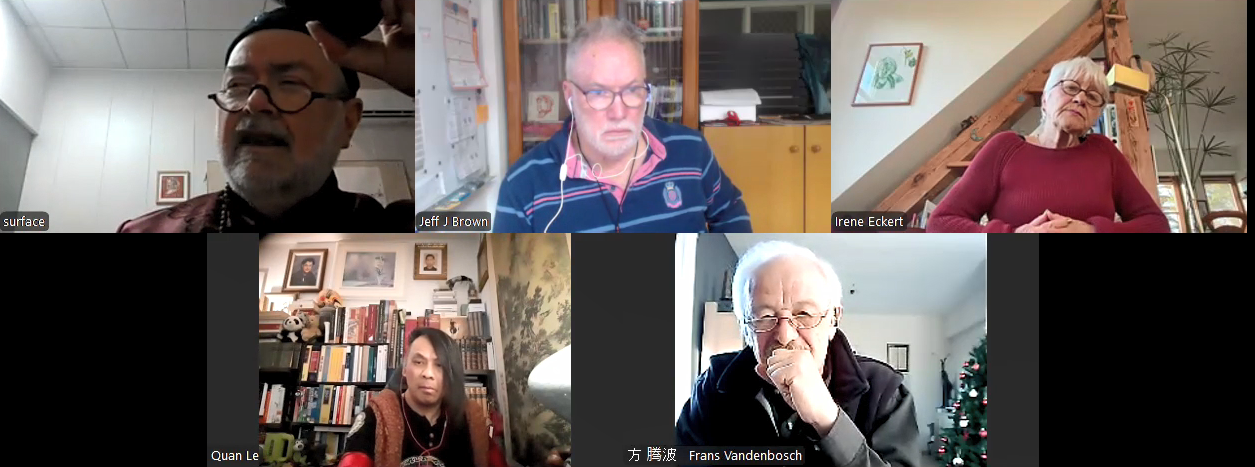
Pictured above: an evening with China Writers’ Group. It’s over two hours of thought provoking discussion, so break it up into smaller doses.
Sixteen years on the streets, living and working with the people of China, Jeff
For donations, print books, ebooks and audiobooks, please see at the bottom of this post.
Video
Audio
Quick recap
This wide-ranging geopolitical discussion features Jeff J. Brown hosting Thomas Wilkinson (T.P.), Kwan, Frans Vandenbosch, and Irene Eckert in a year-end 2025 conversation. The panelists examine China’s rise as a global power, Western attempts to contain it through the Rumsfeld-Cebrowski doctrine, the influence of Western education on Chinese elites, the role of AI in China versus the West, and the struggle between competing civilizational models. Kwan provides a month-by-month review of 2025’s key events demonstrating China’s technological and economic advances. The discussion also covers Japan’s subordinate status, Africa’s strategic importance, the limitations of Western institutional religion versus Chinese civilizational confidence, and the Anglo-American establishment’s final window of opportunity to disrupt China’s historical mission of bringing development to all humanity.
- China’s technological and economic advances
- The influence of Western education on Chinese elites
- AI’s different roles in China vs. the West
- The COVID-19 strategy analysis
- China’s civilizational resilience
- The alternative financial system
- Japan’s subordinate status
- The Rumsfeld-Cebrowski doctrine
- Africa’s strategic importance
- The “final window of opportunity” for Western powers
15-Point Summary
- China’s Hypersonic Missile Advantage: China produces hypersonic missiles for $99,000 each, dramatically cheaper than Russia’s $3-4 million or Iran’s $200,000-300,000 conventional missiles, giving China the capability to produce tens of thousands to counter any nuclear threats from Japan or the United States.
- Chinese AI Concerns: Frans criticizes Chinese AI systems (DeepSeek, Qwen) for being overly pro-Western, using American English standards, and refusing to answer questions about Chinese leaders, paradoxically making them worse than Western AI for objective geopolitical analysis.
- Western Education’s Influence: The panelists identify how Chinese operational management educated at Western institutions (Oxford, Cambridge, Yale, Harvard) has been socialized into Western thinking, though they distinguish this from China’s top leadership which remains firmly Chinese in orientation.
- AI as Productive vs. Propaganda Tool: China uses AI primarily for industrial production and open-source development, while the West employs it more for influence operations and propaganda, representing fundamentally different approaches to technology.
- COVID-19 as Dual Strategy: Kwan argues COVID served two purposes: testing Western population compliance for oligarchic control (successfully), and attempting to destroy China’s economy (failed due to China’s 2012-2020 robotization of production lines).
- Chinese Civilizational Resilience: China’s ability to absorb foreign ideas (like Buddhism) while maintaining core civilizational identity protected it from Christian colonization attempts and allows it to use Western methods without losing its cultural foundation.
- Mao-Deng-Xi Continuity: The panelists emphasize that Deng Xiaoping’s reforms were a continuation of Mao’s establishment of national sovereignty, not a repudiation, with Deng personally chosen by Mao and the economic foundation laid during the Mao era.
- English as Operational Language: Kwan argues China doesn’t mind English remaining the global lingua franca because soft power follows hard power—as China’s military and economic power grows, Chinese language and culture will naturally become more influential.
- Alternative Financial System Established: By March 2025, China’s digital yuan and CIPS system covers 40% of international trade, including all ASEAN countries and six Middle Eastern nations, providing two-second transaction times versus SWIFT’s 2-5 days with outdated 1970s technology.
- Japan’s Subordinate Status: Victor Gao has stated clearly that Japan, having surrendered unconditionally in 1945, remains subordinate to China under international law, and any attempt to develop nuclear weapons or cause chaos would justify China’s military response without UN consultation.
- BlackRock Port Seizure Blocked: In April 2025, China prevented BlackRock from purchasing 46 vital international ports from Hutchison for a “grotesque” $23 billion, stopping a geopolitical maneuver disguised as business that would have disrupted the Belt and Road Initiative.
- 2025 Year of Advances: Kwan’s monthly review highlights China’s technological breakthroughs including: DeepSeek’s release, Made in China 2025 achieving 90% targets (57 of 63 technologies), thorium reactor deployment (40,000 years of reserves), EUV lithography prototype, and $1 trillion trade surplus despite tariffs.
- Rumsfeld-Cebrowski Doctrine: Thomas Wilkinson describes the American strategy as “if we don’t lose, we win”—not about defeating China or Russia directly, but maintaining capacity to disrupt through terrorism, preventing stabilization and development, particularly in Africa.
- Africa’s Strategic Importance: The panelists lament how Africa—with 1.4 billion people (equal to China’s population) and land area equal to China, Canada, and the US combined—is ignored in geopolitical discussions despite being central to the West’s containment strategy and China’s development mission.
- Final Window of Opportunity: The AESIL (Anglo-American Establishment) has roughly 10-20 years maximum to disrupt China’s rise through their BUMP system (Bullying, Utter Predation, and Murder); after this window closes, China and Russia will likely be dominant powers for decades or centuries, with China’s mission being to extend development to 90% of humanity.
Transcript
Jeff: What are some topics you all would like to talk about?
T.P.: Well, since you mentioned Japan already, I think that’s a very hot topic in this part of the world. The introduction of a Margaret Thatcher in Tokyo.
Jeff: Yeah, that’s a good analogy. That’s a good analogy for all. For those of you who don’t know, Thomas is in Anqing in Anhui province. Are you still in Anqing Thomas? Okay, So, he’s in Anqing in Anhui province, which is south of. I think you’re even further south than the Yellow Mountains, aren’t you? Are the Yellow Mountains north of you?
T.P.: They’re actually more or less parallel. Parallel on the north bank of the Yangtze.
Jeff: On the north bank of the Yangtze. Okay. All right. Kwan, what’s on your mind?
Kwan: One of the things that I would like to offer is a list of a major event per month in 2025.
Jeff: Okay.
Kwan: Yeah.
Jeff: 2025 calendar. A monthly calendar.
Kwan: Yeah.
Jeff: And. Okay.
Kwan: A glorious year, of course.
Jeff: Mr. Vandenbosch, what do you want to talk about?
Frans: I just wrote an article about the disgusting influence of American English in China, and I am actually angry almost every day. I have a quarrel with them about all kinds of things. Of course, in geopolitics issues, they are terribly pro United States, that’s one thing. But also, they are using American English as a standard all the time. I see them writing about inches and feet and things like that, which the rest of the world doesn’t understand what it is.
Jeff: It’s hard to…
Frans: Believe all these local American. I have that issue with them every day.
Jeff: All right. And last but not least, Miss Eckert, what do you want to talk about?
Irene: Actually, I’m very concerned about the general geopolitical situation. I just read an article posted by the Duran by George Orman, and he spoke about the danger. The issue that hit me most was the danger that China could be choked off energy if the present political power of the still overarching empire continues its policy with countries like Venezuela, the Middle East, Iran and So, on. I would be very interested if those of you who know a lot about China could speak about this overhanging shadow—the last hope that China will prevail together with Russia and eventually lead us to another geopolitical situation and the survival of humanity in general.
Jeff: I duly noted. And I would like to thank Thomas. He sent me a little blurb on WeChat about Ursula von der Leyen. And I found a ten-minute video about the fact that Hungary’s leader—Is he president or premier? I think he’s Premier. I think they have a parliamentary form of government. Anyway, he has 15TB of encrypted information that was leaked to him by the inner circle in Brussels. And he has proof that she stole €4.2 billion and shipped it off to Delaware, where one of her relatives is working for the company that she sent the money to. So, I think that’s really amazing news. And of course, it’s completely blocked out in the mainstream media. I mean, I had a hard time finding any information about it. I found this one ten-minute video and published it about an hour ago.
Jeff: And I think, if that could actually get exposed, it would radically change the dynamics of Europe. Three of us—Irene, Franz and I—and Thomas. You’re the outlier, Kwan. You’re Canadian, but Thomas is German, I’m French, Irene is German, and Franz is Belgian. So, the four of us have a very strong interest in this story because we all kind of knew it, but the fact that he has proof—he even gave the number of the bank wire at the European Union parliament. He even read out the bank wire number and she just stood up and walked out. So, those are the topics. Well, listen, let’s just go in that order. Thomas, tell us about Japan.
T.P.: Well, I’m no expert on Japan. I just think it’s conspicuous that in this year where lots of commemoration of the atrocities of Japan in China are officially recognized, the words you hear here are very cautious and clear. But there’s one Chinese commentator—I don’t know his name, he appears several times in clips on WeChat—who said very clearly what people are probably thinking: the idea that Japan should have its own nuclear deterrent comes pretty close to a declaration of war.
Kwan: Yeah.
T.P.: So, I don’t believe that politics is entirely rational, and therefore I don’t follow people like Mearsheimer who try to make excuses for these politicians by saying that if they only knew their true interests, they would act differently. I think they know exactly their interests and are acting in accordance with them. The thing that is hard for me to estimate, and I only get it from ordinary conversations here, is the sense that the Chinese economy is definitely feeling the restraints in international trade. People talk here about the number of people who get laid off on account of contraction in that sector. There are lots of ambivalent statements which do not really promote an optimistic view of the relationships in this region, especially if you take into account the unexplained but explicable violence between Cambodia and Thailand and the attempts to destabilize the western borders of China. Taken together with these loud and unrepentant pronouncements from the Japanese government, it’s really quite difficult to see what China’s real scope of action will be in the next year.
Jeff: Good points. I will just point out. Does everybody know that the previous prime minister of Cambodia was a real Socialist? Han Sen or Something like that. Do you remember Kwan? Anyway, he was a real Socialist. Guess where the current Prime Minister of Cambodia went to college? West Point.
Kwan: West Point? Yeah.
Jeff: He went to West Point. So, guess whose pocket he’s in. He’s there to fuck up the good relations that China has with Thailand, Laos and Cambodia. And I’m sure they’ll probably try to drag Vietnam into it. So, that’s the answer for Cambodia. Until he’s out of office, that’s going to be a thorn in China’s side. Any other comments? You mentioned Something else, Thomas, and I was going to write it down but forgot. Anyway, any other comments about the Japan issue?
Irene: Japan? Well, yeah. It’s frightening all around. Pakistan, I read, has now moved closer to the Western hegemons’ chain of influence after the So-called settling of the Pakistani-Indian conflict by Trump. Pakistan was supposedly quite friendly towards China before. And it goes on and on—Venezuela’s oil is supposedly the property of the US, and Iran is still heavily threatened by Israel. I find it hard to get a clearer picture that gives me Some hope for the year to come. I would be very happy if at least one of you could spread a circle of hope.
Jeff: I have one more bad news and then I’ll get quiet. A lot of people don’t know that when MacArthur colonized Japan after 1945, the CIA or the OSS at that time—when it made the shift from OSS to the CIA—they installed kill switches on Japan’s electrical grid. That means if the Prime minister gets feisty or the diet tries to pass a law that’s going to upset Uncle Sam, they get a phone call saying, “Hey, do you really want Tokyo to have its lights shut out this weekend? Do you really want the electricity to be cut off in Tokyo?” So, Japan is totally—they have absolutely no.
T.P.: You have to add to that, Jeff, that the financial crash Japan experienced a decade ago was engineered in Washington, of course.
Jeff: Absolutely. The 1988 crash.
T.P.: Yeah.
Jeff: The 1988 crash. Yeah, I remember that. And the crash for the Asian Tigers was also, managed by the City of London. To harvest all the wealth that Taiwan, Malaysia and other countries had built up.
T.P.: Well, that also, means that China’s other trading partners, to the extent that they are not independent of this US-dominated international financial order, can be blocked from trading effectively with China.
Jeff: Yeah. Yeah.
T.P.: So, it’s often said by the Chinese government that the United States is not really the most important export market anymore. That’s valid as long as there is a means of settling trade with all other countries. But if nothing is done to change the control over payment flows, then it doesn’t matter whether the US restricts trade—they can restrict other traders too.
Jeff: Kwan or Frans. What do you know about— I keep seeing headlines that China is now using the digital yuan and national currencies in trade. When China gets paid in RMB by Pakistan, or when Pakistan sells Something to China in rupees and gets paid in rupees, does that go through Swift? Does that go through the Bank of International Settlements?
T.P.: Yes. Can you do Something about your microphone? I can hardly hear you.
Jeff: Okay, I’ll move closer. There’s Something about Zoom—this is the only platform where my volume is terrible. I apologize. I’ll reorient my camera towards my face. Anyway, when they’re doing cross-border trade in national currencies, do they have to go through Swift or are they using another platform?
Kwan: No.
Jeff: No.
Kwan: I would like to say Something important about the international payment system.
T.P.: Can you also put your microphone closer? I can hardly hear you.
Kwan: Okay. Now, do you hear me better?
T.P.: It’s a little bit better.
Kwan: Okay. China doesn’t need the Swift system right now because when China launched the global digital yuan system, which is intimately related to CIPS (Cross-border Interbank Payment System), on March 17th this year (2025), this system already covers practically 40% of international trade and is increasing. All ASEAN countries are participating, as well as six Middle Eastern countries that are important in international commerce. Finally, Russia and China have a special linked system. So, if there’s one thing to stress in 2025, it’s that we already have an alternative international financial system. I would like to inform our audience that the Swift system is outdated 1970s technology. With the Chinese system, you get your payment in two seconds, while with Swift, it takes two to five days.
T.P.: I noticed that getting money from Portugal to China took me a week.
Jeff: Yeah, and they’re earning interest on it the whole time.
T.P.: Yeah, I know how the game works. It’s just disgusting. This is 1970s technology.
Kwan: So, I don’t see things negatively. And I would like to make a segue. It’s normal that the US would increase military tensions within what I call the Rumsfeld-Cebrowski doctrine—trying to create as much chaos and disorder across the world because they are truly at the end of their game. This also, allows me to segue back to Japan. Victor Kao, who is probably the Chinese commentator you referred to 15 minutes ago, has stated very clearly many times that Japan is a subordinate country because Japan surrendered unconditionally to China in 1945. That means if Japan is stupid enough to participate as a major player in the Rumsfeld-Cebrowski doctrine—causing chaos in the Asia-Pacific region—China will not hesitate for half a second to nuke Japan a second time. According to international law, China has the right as one of the five major victors of 1945 to destroy Japan without consulting anyone and without a mandate from the United Nations. Because Japan is a loser and subordinate nation from 1945, it still has to maintain peace to continue enjoying peace.
Jeff: I didn’t know that. That’s really interesting.
T.P.: But the same thing applies to Germany with respect to Russia.
Kwan: Exactly. And these people have to know. I also want to tone down my speech a little. I understand that they are victims of the US and Western imperialism—like the excellent example Jeff gave about the kill switches. It’s not only that; there are many ways the US has them by the cojones. I understand that perfectly, but at the same time, maybe the most dangerous and perfidious tool through which Western imperialism holds Japan and Germany is precisely through their completely inadequate traitors—the degenerate So-called elites in Japan and Germany who obviously do not work for their people but are simply bourgeois compradors. I want to be polite here, So, I’ll use the more polite term “bourgeois compradors” instead of another h-word.
Jeff: Frans, we haven’t heard from you. Give us your two cents.
Frans: About this subject in general, I’m trying to focus on China and stay away from the United States, Israel, Ukraine and all these other big issues. I want to keep focusing on China and more particularly on the Chinese people. I tried but failed to write an article about how happy the Chinese people are. I don’t know very well how to approach that. Of course, I have a dozen or So, technical arguments—things I can see that show they are happy and have every reason to be happy—but how to express that, how to convince my readers, how to show people who have never been to China the happiness of the Chinese people? I need Some ideas. Some people told me I shouldn’t do it in such a general way; I should write about one particular person—how they live every day, get up, go to sleep, work—and do it that way. But that’s not my style. I don’t like to write romantic stories. I like the scientific approach. What do you think about that?
Jeff: Well, I don’t— Go ahead, Thomas.
T.P.: My impression on this point, which I think is very interesting, comes from a comment by a friend of mine who spent April in China with his Chinese wife, visiting her family and traveling around the country before returning to the United States. He said, “When I opened the newspaper or watched television in the United States, they always say Chinese people don’t have enough to eat. But I couldn’t believe the amount of food I had to refuse when I was in China. The Chinese eat all the time. If they didn’t have food, what would they be eating?” I have the same experience. I can eat about one meal a day here without being completely overwhelmed—there’s food everywhere. This is not what people associate with China of the 1920s, 1930s and 1940s. Compared to the United States or even Europe, food is scarce and expensive. You have to work hard to afford food there. In France, I recently invited 12 or 13 people who had been helping me to dinner. We had more than we could eat, consumed at least two or three bottles of baijiu, and the whole bill was €170. You can’t feed two people in Europe for €170.
T.P.: I fed 13 people a luxurious meal—we had lobster and things I normally can’t afford anywhere else.
Jeff: Frans, I don’t know if you want to take the time to look at my latest project, where I try to really show the lives of the Chinese people. I just published—well, I have two projects. One about Taiwan called “LadyB”, where Evelyne and I have these little stuffed animals; we take pictures of ourselves with them. But look at my series called “Evelyne&Jeff’s Amazing China Adventures”. I think one thing that could really help you is using photographs. People love them, and as the old adage goes, a picture’s worth a thousand words. It also cuts down on writing time because all I have to do is write a caption for each photo and an introduction.
Frans: I know. I’ve seen your previous travel reports, except for the last one which I haven’t read yet.
Jeff: Okay.
Frans: Yes, yes, yes.
Jeff: I think they give foreigners a good feel for daily life in China—the fact that people are happy, prosperous and healthy.
Frans: I’ve been trying to do that in my travel reports from September to November—weekly reports with lots of photos. But what I want to express is that every time I arrive in China, even before the airplane touches the ground, I already get this special feeling of happiness. When I open the airport door and get in a taxi, it’s a completely different life. How to express that feeling, how to convey it to my readers? I don’t know how to start.
T.P.: Well, I think it’s really a religious problem because.
Frans: Yeah, maybe religious. Yes.
T.P.: The conviction in the West and all the countries I’ve lived in is that what they consider quality of life is very abstract. They only talk about what they could do, not what they actually do. They can’t imagine a system where people actually do what they say they want to do, where they actually live the way they want to live. They don’t talk about what heaven will be like or how it would be if they could become rich. They talk about money a lot and work a lot, but not in the sense of wanting to be Warren Buffett or Bill Gates. It’s everyday work, and you see people actually succeeding. Even people who don’t succeed lead a very concrete kind of life. That’s Something the West doesn’t have. It’s So, religious in the West that people don’t see their own reality because they prefer to believe in the fantasy propagated by the media every single day. So, it’s a real problem to convince people that their belief system shapes how they interpret facts. Science doesn’t work because science is not really part of Western thinking, despite their claims to the contrary. They fundamentally believe what they are taught as a religious faith, then squeeze whatever facts they have into that faith. Anything that doesn’t fit, they simply don’t accept as facts.
Jeff: That brings up.
Frans: I agree. It’s a religion, and it’s very hard to destroy that kind of religion. During my lectures, people who oppose me—often during the question-and-answer session—have this kind of religious way of thinking. They believe in Something, and I can’t succeed in destroying that belief.
T.P.: Let me tell you two anecdotes from my time in Anqing that show how this works in another context. I have a good friend who, when I first met her, mentioned in an aside that she’s Christian and deeply unhappy and dissatisfied with her life. Another friend of mine is not religious at all. He went to a school for ethnic minorities, graduated, then went to university, and they founded a WeChat group for alumni. The biggest ethnic minority in our region is the Hui, who are predominantly Muslim. He said, “In this alumni chat room, where I’m one of the few non-Muslims, all they talk about is Islam. They don’t talk about anything going on in real life.” This shows how pernicious these monotheistic religions are in shaping what people consider important in their daily lives. They lose the ability to talk about things as they are, if they ever had it. When you find people susceptible to missionary influence or involved in these religious circles, it actually eats away their brains. So, even in China, you can find dissatisfied people, and almost all the really dissatisfied people I’ve met have Some connection to Western religion.
T.P.: Even if they are not explicitly religious—God-fearing, church-going or mosque-going people—this framework shapes their negative perceptions or their inability to see concrete events that don’t fit into their religious salvation model, where the world will Somehow be better after they die.
Jeff: I did want to bring up that you mentioned how Americans are always thinking, “I’m going to get rich, I’m going to get rich.” John Steinbeck, the great California writer who wrote The Grapes of Wrath and Cannery Row, has a famous quote: “The poor people in the United States consider themselves to be just temporarily embarrassed millionaires.” So, that’s part of the illusion, isn’t it? Alright.
Irene: I’d like to comment on Frans’ and Thomas’s analysis or view on the situation, at least in Europe. First of all, I want to thank Frans for his articles and reports.
Jeff: Really good.
Irene: I find them very good, very helpful, very well done.
Jeff: Well done, Frans. I agree. I try to leave comments when I have time.
Frans: Yeah, yeah.
Irene: But as far as your view on religion being a major factor, I tend to see it exactly the opposite. The lack of any kind of religious belief in my part of the world explains the negativity and pessimism, and also, why people feel helpless with the kind of leadership—or lack of leadership—we have, or the incompetence at the top of our Societies. This is felt by everybody I talk to, no matter their political tendency. People just feel there is nothing one can do. With Christmas just behind us, I was fortunate enough to be with my family in a Berlin church with small children. We were lucky there was a Christmas play that told the Christmas story according to the Bible. But apart from that, you normally couldn’t even find Christmas cards with original Christmas motifs in recent years. I am not a very religious person, but I really do feel that people who still adhere to Some kind of religious conviction—which to my understanding basically means having faith in Something beyond your egotistic, everyday objectives, like belief in justice, peace, and joy for everybody on earth.
Irene: That was Jesus’ message. It is also, the basis of Islam. Islam is a religion very dedicated to justice, for example, and even Judaism—in its essence, which is not Zionism—has a positive message for those who stick to the original message. I find that in our Western Societies, we are So, materialistic in the most negative sense of the word. This also, makes people unhappy because a human being wants to strive for Something beyond itself. I may not express myself clearly, but I think you understand. The lack of happiness doesn’t have much to do with the loss of material wealth, which we also experience every day. In Berlin, you can see material decadence: people hanging around hungry and without shelter, even in this still relatively wealthy part of the world. But people can see we are heading down the wrong path. This religious or idealistic approach to ideals is what’s being lost. And that’s what makes life worthwhile, isn’t it? Brotherly coming together.
T.P.: I would rephrase this: what’s actually been abandoned is humanism.
Irene: Yes, yes, yes.
T.P.: Humanism is not tied to a particular salvation model. It’s tied to the hope of being human. And that’s disappeared; that’s being destroyed. We have transhumanism, not humanism. There’s a very clear strategy to destroy the very idea that humans are innately valuable. The whole point of transhumanism—and transgenderism as a subset of it—is to ideologically undermine the idea that there’s Something special about being human. Once you can say anything you make can be human or human-like, you lose everything that is human. This is an intentional development, and I think organized religion has promoted this since the Middle Ages.
Irene: But in a positive way? Or maybe I don’t understand exactly what you mean.
Jeff: In a positive way.
T.P.: What I mean is that if we talk about Christianity in a positive sense—essentially primitive Christianity, which has nothing to do with what Christianity became after the Roman Catholic Church gained supremacy—the West was really destroyed by the Roman Catholic Church. Attempts to recover through humanism, through various efforts to first abandon institutional forms of religion and return to individual human life as the basis of religion, have been constantly under attack. This attack has intensified. What’s clear to me is that there’s a kind of faith in China and among Chinese people that it’s worthwhile to be Chinese, worthwhile to be in China. But you can’t claim to be worthwhile as a German or European because there’s no ideological or faith base for these assertions. All you’re left with are the skeletons of medieval churches, including reformed churches, which have been abSo,rbed by the system. These institutional frameworks cannot deliver anything antithetical to their very existence—namely, challenging existing power structures.
T.P.: You can go to church and be privately religious, but the church itself won’t support you. We saw this in the 80s, when attempts to return to humanistic, human-centered religion in Latin America and to Some extent in Europe were brutally crushed by institutional religions. I spent a good ten years studying this process: assassinations and terror implemented across Latin America to destroy liberation theology, the marginalization of those who understood these principles—even in Germany, I think specifically of Someone I knew, Dorothea Ursula. These people were driven out of the public eye by every means possible, driven out of the churches they were raised in, and their leadership was decapitated. You’re left with an atomized form of religion that has no material base. And I don’t believe any humanistic religion can survive without a material base.
Jeff: I think there’s a concerted effort to destroy Western civilization, which is based on Christianity.
T.P.: If there ever was a Western civilization.
Jeff: Well, you know what? Yeah, I know. But there is a very concerted effort to destroy Western civilization and Christian culture. In France, for example, most TV and radio stations are state-controlled. There are only one or two privately owned radio stations and TV news outlets that can say what they want. But on all state-controlled TV and radio stations, you can’t say “Christmas” in public anymore. In French, it’s “Noël,” but now it’s just “winter holiday.” This deracination of Christianity is very planned and deliberate. It’s been going on for decades.
T.P.: We shouldn’t forget that privatization is a done deal now. What’s called state media isn’t publicly owned; it’s corporate owned. This applies to France too. Who controls the French government? French corporations.
Jeff: Yeah.
T.P.: The same as in Germany. You can’t say anything against the general corporate agenda.
Jeff: Yeah, yeah, yeah.
T.P.: This is enforced through the state because all these institutions have been forced to operate according to corporate processes, financial processes, and ideology. The state has no other function than to fulfill these objectives.
Jeff: Yeah.
Jeff: Well, that’s correct.
Jeff: I always say they all get their orders from the City of London. They’re told what to say, what to do, how to say it, and where to say it. The City of London is the snake’s head, the viper’s head.
T.P.: It’s really hard for people to see they no longer own their countries—if they ever did.
Jeff: Yes, exactly. They never did.
Kwan: Okay. I would like to give a long speech on the question of transcendence and self-confidence. I don’t know if Thomas has finished, but I’d like to speak on that.
Irene: Go ahead, piece by piece.
Jeff: Go ahead.
Irene: Go ahead.
Kwan: What’s been said in the last 15 minutes is very interesting to me because I’m thinking: what is the Source of self-confidence, faith, and drive that pushes us to work not only for the future but also, for the present? The future isn’t here yet. The only way to change the future is to work in the present. What brings us that drive, that inner flame that gives us the confidence to envision the future and the energy to work in the present is precisely what Thomas called humanism. The fact that we feel lucky to be human, and on a second level, to be a particular kind of human—a French human, a German human, a Chinese human. We all share humanity, but that humanity is expressed uniquely in France, Germany, China, Japan, and So, on. There’s a difference here, though not absolute. In the past, Westerners, Europeans, and Americans also, had this civilizational framework that saw transcendence through universal history. But universal history was embodied in their land, in their specific culture. What happened in China is that even during the century of humiliation, the elite—and even Some non-elite people—still believed in the glory of Chinese civilization and in participating in the great universal history of all mankind.
Kwan: I would suggest this is much more important than religion, because religious factors don’t play a major role in China’s drive. Or, if you prefer, the Chinese religion is Chinese history and civilization. Of course, many Chinese are Buddhist, Taoist, Confucian, and communism is also, a kind of faith. But if I had to choose one “religion” for the Chinese people, it’s Chinese civilization. Within Chinese civilization, you find communism, Buddhism, Taoism, and Confucianism. What’s truly harmful to Europeans now—maybe from my Asian perspective, which sees religion not as the central factor of transcendence but rather universal history and the history of a particular nation embodying a specific case of universal history—is that Westerners are disconnected from their past. Without a past, you have no future, and no drive to work in the present to build a better future. I’d like to end with a perhaps unpleasant note about what I call the colonial project. There is true transcendence in the West, but institutional religion has been So, closely associated with 19th and 20th century colonial projects that the Chinese government has felt compelled to establish institutions called National Religious Affairs Associations.
Kwan: These institutions supervise Christian religions—different branches of Christianity—not as a transcendental drive for Western people, but as a machine for making “house niggers,” as we discussed last time. I’d go So, far as to say institutional religion is not only a machine for making “house niggers” abroad but also, within the West. Because—
T.P.: Definitely. Exactly.
Kwan: Because if we—okay, go ahead.
T.P.: I couldn’t agree more. I’d add that the very foundations of the American religious system are powerful in this regard. They are deeply anti-historical and narcissistic. And because of the implicit and explicit principle that they are the one true faith, they rely on the destruction of other civilizations to survive. This means they also rely on destroying civilization in their own countries. The entire marketing apparatus driving the United States internally and externally is based on erasing history and erasing all categories that could root people in their past and allow them to assess their current situation.
Jeff: Yeah, I call that—
T.P.: Time and again, you talk to Americans and Europeans influenced by Americans who say the last century is irrelevant, that it’s over. But the last century was the most important in terms of the machinery of consciousness manipulation. That’s the world’s major industry—not oil, not even weapons, but consciousness. This is now a fully industrialized and digitalized process. Americans are subjected to it to an unimaginable degree.
Jeff: Yeah. And it’s going to get worse with Palantir collecting all this information on us.
T.P.: Artificial intelligence is driving this too.
Irene: But what is needed? I completely agree with what you’re saying about institutionalized religion. But you still need faith in Something beyond yourself. You need a collective belief in Something bigger than yourself. You also, need to connect with the historical achievements of your own Society. In Western Societies, many of these achievements are extremely negative because of colonial projects and major wars that started here. But we also, have a classical tradition of civilizing projects—our classical music, literature, and So, on—that transcend national borders while retaining the characteristics of each country. Every country has these classical contributions to human Society. I agree with Thomas that narrative production, the brainwashing machinery—especially with AI—is a major destructive force. But it can also be a major creative force. I think we need to focus more on that aspect.
Irene: We have to find countermeasures to limit the influence of the brainwashing machinery. Our options are limited, but in the end, Thomas, isn’t it all about energy and oil? After all, if China can be choked by cutting off its energy supplies, what then? My question to the three of you again is: do you see China’s efforts to develop alternative energy supplies as strong and fast enough to continue its progressive contributions to making its own Society viable—which is of course also, an important aspect of making its people happy? I fully agree about their civilizational achievements, but the fact that China lifted 800 million people out of extreme poverty is Something the entire Chinese population can be proud of. It makes them happy to no longer suffer from hunger and extreme poverty. You know what I mean? This balance between—
T.P.: The—
Jeff: The thing that’s—
Irene: And materialism also needs to be taken into account.
T.P.: Two things strike me about this. This attempt to gain a future perspective rooted in the present. A commentator—one of you surely knows their name, but I can’t remember names well anymore—said, “China can look back on 5000 years; the United States looks back on 250.” From that perspective, what’s missing in the West is that it has nothing in its common traditions to compare. I’m currently reading A Brief History of China. When you think about everything China has endured in 5000 years, nothing today compares. No other country has been through So, much and still exists. I Sometimes feel optimistic, thinking 250 years is a blip. Against my own rational instincts, the idea that a 250-year-old country can strangle a 5000-year-old civilization just doesn’t add up. I don’t think China is vulnerable to that kind of strangulation.
Jeff: Well, there’s also,—
T.P.: When you think about this year’s anniversary of the Nanjing Massacre, all the things done to this country, and it’s still here, even stronger than ever. What can a country on the other side of the Pacific, with 250 years of experience, do to strangle a country that has survived 5000 years? I just don’t see the logic.
Jeff: Irene, I don’t know how much you know about China, but China is the world’s leader in electricity production. It’s the world’s leader in wind and Solar energy. Canada might be bigger in hydro, I’m not sure, but China is near the top. Regarding nuclear energy, they’re building the cleanest nuclear plants possible. They’ve installed scrubbers and carbon sequestration systems on coal plants to capture carbon dioxide. China will be carbon neutral by 2050 or 2060, and no other country is on track to do that.
Frans: They have five years of oil independence, I know. They have reserves for five years.
Jeff: Yeah, five years of independence.
Irene: Taking all this into account, is it incorrect to say China still relies on Middle Eastern oil, even with Russian oil insufficient to meet all its industrial needs? If that’s the case, and if those Middle Eastern supplies are cut off, can Chinese Society still prosper as it has in the last couple of decades? Please correct me if I’m wrong.
Kwan: I’d like to give two specific numbers. Let’s take a practical example: Venezuela currently accounts for about 10% of China’s oil consumption. I agree with everything my colleagues have said. China has enough thorium reserves to meet its energy needs for 40,000 years with current technology. Of course, China has only just started building its first thorium power plant, but I see thorium as the long-term Solution for China’s energy needs—not short-term, but medium-term. We all know fusion research is the long-term goal, but we don’t know if fusion will be achievable in 30 or 300 years. That’s still uncertain. But back to the present: Irene’s question is very relevant because before China builds 100 to 150 thorium reactors, it will still need oil and gas. And before I forget, China currently produces 2.5 times more electricity than the United States. We need to keep that in mind: much more energy is produced in China than in the United States and Europe combined.
Jeff: And Europe too, exactly.
Kwan: Exactly. But returning to the practical point Irene emphasized: the Anglo-American establishment can disrupt energy flows for the next 10, 15, or 20 years. This won’t destroy China, but it will cause setbacks and problems. I insist on this because it’s part of the Rumsfeld-Cebrowski doctrine I always mention. This is their last window of opportunity to destroy China—or at least, since I don’t believe they can destroy China, to prevent it from playing its global role as an engine for development for all peoples of the planet. That’s China’s glorious, grand role in the 21st century. The Anglo-American establishment will never destroy China, but they can destroy or delay China’s ability to do good for the planet. That’s certain. The next 10 to 20 years are their last window. In 20 years, if trends continue, China will be So, powerful—forgive my grand wording—that it will be unstoppable, and it will be too late. That’s why there are So, many attacks on China now: trying to cut off energy supplies, trying to cause local chaos like the conflicts between Thailand and Cambodia.
Kwan: You know perfectly well that when they decided to attack Russia in Ukraine in 2014, they were preparing to attack China later. But the Russian leadership was smart enough to counterattack in 2024 because they had to destroy Russia first before attacking China. You understand this perfectly, Irene. Russia is a major energy supplier to China. They couldn’t start with China because attacking China would have disrupted their own economy. That’s why Chinese ambassadors in many countries and at the United Nations always repeat: China will never let Russia lose in Ukraine. Most likely, Russia won’t need China’s help because they are natural warriors. But if Russia is overwhelmed for Some reason, China will intervene militarily to ensure Russia’s territorial integrity. All the tricks the Anglo-American establishment is playing now are part of the Ramstein doctrine—their last window of opportunity. If they fail, to put it grandly, China and Russia will dominate for decades, if not centuries.
Irene: But what about nuclear weapons in that context?
Kwan: Regarding nuclear weapons—maybe I’m ignorant or too flippant—but we will take them out with hypersonic missiles before they can use nuclear weapons. I’m sure they are crazy enough to use atomic bombs. That’s why Victor Cao—a former Chinese translator for Deng Xiaoping and a major Chinese academic in the West now—is giving very forceful, assertive speeches. He says: if Japan tries to acquire nuclear weapons, we will destroy Japan. We are fully aware the Anglo-American establishment has this last window of opportunity. To be generous, I’ll say 20 years, but I think it’s more like 10. If they try anything, they will be finished by hypersonic missiles. I’d like to mention China is currently producing hypersonic missiles for $99,000 each. That’s incredibly cheap, even for Chinese production. Russian hypersonic missiles cost around $3 to $4 million each. Iranians can make missiles, but not hypersonic ones, for $200,000 to $300,000. China’s ability to make hypersonic missiles for $99,000 means they can produce tens of thousands. These missiles will rain down on Tokyo, Kyoto, or even Washington, D.C., if necessary. We are fully aware of the Anglo-American establishment’s desperation. They are not low-IQ; they’re bastards, for sure, but not stupid. They understand this is their last 10-year window. We all know China is very restrained, polite, and never violent. But this time, we will be violent because we know it’s either us or them. If it’s them, it will mean global slavery for humanity for a thousand years.
Jeff: Hey, Frans, I wanted to ask you a question. You just spent a long time in China and are now back in Belgium. Irene brought up AI—artificial intelligence. Do you consider AI evil or bad in China? How does that compare to AI in Belgium? Do you see AI as evil, bad, or good there? Can you compare and contrast AI in China and the West?
Frans: I use AI—both DeepSeek and Cloud—almost every day, mostly for technical things. Like, I have questions about Wi-Fi router interference, or chemical questions—what’s the exact chemical composition of floor paint, that kind of thing. Sometimes also, about geopolitics. I end up in heated disagreements with DeepSeek almost every conversation, for various reasons. First of all, DeepSeek refuses to answer questions about Xi Jinping, Deng Xiaoping, and all the other—
Frans: Even Mao Zedong.
Jeff: Yeah. That’s right.
Frans: Now. Uh, anything like that?
Jeff: Yeah.
Frans: DeepSeek is the worst I use, Kwan, more than I use DeepSeek? I think maybe a little bit better.
Jeff: Yeah, I’ve been trying Quinn for Some time. Um, it’s also, very pro-Western, and I don’t understand how the Chinese government allows that. It’s in every single answer that they provide you with the Western viewpoint. And even if I insist that they have to search only in Chinese Sources, even then, I still can’t eliminate these Western viewpoints in between. And also, I’m European, I prefer British English. Why they are So, standardized on American English. It’s terrible. It’s in every single sentence that DeepSeek is producing that I see “anxious” or “Miles” or whatever. And the structure of the sentence—American English again. I can see it. It’s everywhere. Uh, it’s simply terrible. If I have a list of maybe more than 20 requirements, which I should give him before I ask a question, how to structure a sentence, and So, on. But even then, I get American style, and it’s every day. How does the Chinese government allow that? I cannot understand.
T.P.: Well, well, one thing I.
Frans: And they are worse. They are worse than ChatGPT or Claude or other Western AI. This is influencing not just me as a Westerner, but also, Chinese people. They should serve China and the Chinese people instead of the West. Uh, I don’t understand how that is possible.
T.P.: Well, well, one thing I think can’t be too easily dismissed is. And there are two incidents that exemplify this rather well. The economist Michael Hudson, uh, who’s gone to China several times and taught as a visiting lecturer and everything. He said, you know, I have enormous problems talking to Chinese people because they’re practically all trained in American business schools, even at very high levels. And this chapter I’ve mentioned several times in one of his recent comments, he’s explaining this thing about 5000-year civilization, and then he makes this very kind comment about his friends from Yale, from his years at Yale. I mean, we’re talking about an elite which has enormous numbers of people who have been through Oxford, Cambridge, Yale, Harvard, Columbia, Princeton. And these institutions are not educational institutions. They’re Social networking institutions. And these people go into high office because they have high qualifications from Western institutions, and they become high-level functionaries, and they’re not going to, as far as I can tell. And whenever I meet these people, I notice it. They’re not willing to abandon that subtle Socialization that they get at American and British universities, which tells them that really, that’s their culture in terms of academic and scientific attitude, whatever nationality they may have.
T.P.: The Indians are even worse. Um, they are just So, thankful that they could go to those schools. This Sort of attitude they exude all the time. And So, if they’ve got this in their blood, as it were, whenever they work, they’re going to refer to and draw on that Socialization. And I think that this is meanwhile So, high-level that it’s not even conscious. Just go back to the Covid emergency. The head of the Chinese CDC was a Yale graduate, right? Did all of his essential work. And then he went to the Wellcome Foundation. Right. So, it’s no surprise that he recommended to the Chinese government all of the criminal processes and regulations that were used to destroy the SME sector in the West. And, you know, as long as these people are proud to wear Harvard and Yale t-shirts in their spare time and meet together and chum along with all of their colleagues from the same institutions. Uh, there’s going to be a limit to how far they go to being authentic in their own context. I think that cannot be underestimated. That’s the way the system was built.
Frans: Yes. I meet these people too.
T.P.: I think also that there are a couple of people that Jeff recommended to me and that may be known, probably are known here, who wrote critical books about the way the Cultural Revolution was treated and about the way the situation era was treated. I had a very funny experience this week. I was at a reception for foreign scholars or for foreign high-value people in Lansing. Now, I’m not here in the framework of any of those programs. There was Someone from Pakistan, Egypt, Zimbabwe, and 1 or 2 other countries. We are a small group, and I was just invited because I know Somebody who knows Somebody said you should go to this. So, I was talking about the problem of urban small urban development or rural development compared to these mega cities where So, many people leave their home to go and work and make careers. And Some of my friends here are trying to draw back the young people and say, look, there’s a future in these small cities if you don’t abandon them. And I explained how I knew how this worked in the West and throughout Latin America and Africa and that this was a very destructive process. And the woman who was from the Foreign Affairs Office, and she didn’t answer the question or respond to it, she started reciting to me about the opening of the Deng era, which had absolutely nothing to do with what I was talking about. But the Deng era is the benchmark for the political interpretation, the economic interpretation of Chinese policy still. Uh, and that is a definitely pro-Western orientation, if only for economic opportunism. But it produced meanwhile two generations of scholars and officials who would never, ever do anything, say anything about Mao or about the other ways that China could develop except to say, well, Deng solved the problems Mao created, which is a distortion of history.
Frans: Yeah, yeah, yeah. Yes. I see these people at Fudan University, at Nanjing. There are a lot of these people who are defending Western viewpoints and so on. But I also noticed very recently there’s a small counter movement going on against all these Western-educated scholars in Shanghai, at Fudan, and in Nanjing at Ananda. Uh, very slowly, a few professors who say, hey, watch out! Don’t bring your Western ideas to our universities. But it’s very embryonic; it has to grow. Uh, for example, there’s a professor who wrote an important article about it, and I discussed that in November, I think, with the China Academy in Shanghai. Uh, and I said, that’s a very important development that gradually China is going away from these Western professors. Uh, they refused to publish it. I said, you can contact this professor at Fudan University and republish his article. They refused that. They didn’t want to do that. The three ladies of the China Academy—well, it will need some time, but it is going on gradually.
T.P.: Well, I had.
Frans: To confirm.
T.P.: Something about that at a very low level. I had an experience in October when I had a picture exhibition. A police officer came in to see the exhibition, and he sat down and talked to me. And we talked about a number of different things. But one of the things he said to me inside is that, you know, the spirit of Mao is still alive in the PLA.
Jeff: Um.
Frans: I’m not So, sure about that. I have a good friend in Nanjing who is in the PLA. Yeah. And he is, in my opinion, too westernized. He’s adoring American weapon systems and So, many other things. Uh, I’m not So, sure.
T.P.: What I think is that this is a grassroots kind of thing. This is certainly not part of the upper echelons. But that means that people in the PLA, in the rank and file, are aware of the conflict, and they’re aware of it in their own lives. And they haven’t forgotten what it meant to be Chinese under Mao.
Frans: I hope so. Okay.
T.P.: Well, you said embryonic. I’m only suggesting that there are a few embryos floating around.
Jeff: Supposedly. Go ahead, Frans. Go ahead.
Frans: I think the CPC representatives at these universities, both at Fudan and at Ananda, they count on the fact that this generation, which is educated in the United States and So, on, will gradually fade away. Um, they don’t take too many actions against them. Yeah. Because they know that it will be the past and it will pass. But I want to come back to my daily fights with DeepSeek. Yeah. I still cannot comprehend how they allow that. They have taken such strong actions against Jack Ma, Alibaba, because he was.
Jeff: Well, we lost Frans. He’s frozen up on me. I don’t know about you all, but he’s frozen up.
Frans: It’s disgusting.
Jeff: Okay, here we go.
Frans: Uh, I cannot comprehend it. How? How they allow that. There are certainly people who have noticed that within the Party. Why don’t they do Something about that? Well, it’s a big problem, a big issue. And it’s not just DeepSeek It’s all Chinese AI. So, to answer the question of Irene, yes, yes, Chinese AI is worse than Western AI. Sometimes I get much more objective answers on geopolitics from Western AI, much more balanced than from DeepSeek.
Irene: Uh, I’m sorry, but I understood Jeff’s question on a deeper level. I mean, generally speaking, is AI, as it is being used in China, considered to be a productive force? And is it used in the same way in the West? And. Yeah, my very, very superficial understanding is that generally speaking, I see that in the People’s Republic of China, AI is being used for industrial productivity and is profoundly different than in the West. Can you comment? Can any of you?
Frans: Yes, definitely. Yes. You’re right. Uh, China’s AI systems, by the way, are open Source. And I think that is the future. Western AI is not open Source; it’s closed Source. Uh, which has, in my opinion, no future. There’s only a future for open Source. Uh, and I expect that Western AI will turn to open Source too. Because otherwise their future is blocked. And yes, you are right. In China, AI is much more used for industrial production. I have used it myself in Wuxi, in our factory there. So, yes, much more practical than in the West, where it is much more used for influencing and propaganda. Yes.
Kwan: Yes.
Jeff: I’ll be right back. You guys go on. I need to go to the boys’ room. I’ll be right back.
Kwan: Okay. Uh, have you finished, Frans?
Frans: Yes.
Kwan: Okay. Um, I would like to say the following thing concerning AI and industrialization and robotization in general, because I would like to come back to three major points. Uh, the influence of Western culture on middle management. Because what Thomas described is not the true upper class of China. It’s the middle management that has been created by people who got a Western education in the last 30 years. That’s one.
T.P.: Point. Before you go on, let me say that’s who I’m talking about. The operational management, not the highest policy-making, but the operational management.
Kwan: Okay. Uh, if you say operational management, I would agree with you, but I would like to bring Some nuances to this. But first, I want to start with the Covid crisis. Okay. Because there is an intersection with the Covid crisis, robotization, and the Cebrowski doctrine.
T.P.: Right.
Kwan: Because the Covid crisis, for me, had two goals. The first goal was in the West: trying to test to what extent the Western population would be obedient. Okay. Because the oligarchs, before achieving their dream or nightmare of a Palantir-like Panopticon, needed a Social engineering event like Covid to test to what extent the Western population would be obedient to the orders, to the commands of the governments controlled by the oligarchs. And I think they got the answer. The answer is yes. Most of the Western population is quite compliant to the government’s instructions. The other goal of the Covid crisis was to destroy the Chinese economy. And when Thomas was referring to the guy from Yale recommending to the Chinese government measures that would have destroyed the Chinese SME sector, you’re perfectly right. But the Western oligarchs did not take into account one major factor: that the decision-making echelon, okay, the true rulers in China, had decided on the complete robotization of major industry starting in 2012. And when the Covid crisis started in 2020, the Chinese production lines were ready to operate without human workers or with fewer human workers. So, because of that, I don’t know how to say it.
Kwan: In geopolitics, there is a factor of luck, and of planning too, because I don’t want to downplay the planning and thinking from the people in positions of power. But there’s a factor of luck too, because of that eight-year gap during which automation was achieved in China. Uh, the attempt to destroy the Chinese economy by the Covid crisis did not succeed. That’s one. Two. Um, I would use Thomas’s expression of operational management. There has been a lot of formatting—let’s say instead of brainwashing, depending on the person—in the West, but I would like to introduce, maybe from my understanding, a psychological perspective. The Chinese people or Chinese civilization has always been characterized by the fact that there is always a core of Chinese values or reality or attributes from which we can learn a lot from abroad, from foreigners, and make it our own with time. Okay. And I’ll give a religious example. Buddhism, which initially was an Indian religion and entered China about 2000 years ago, was a kind of intellectual play or intellectual game for the Chinese upper class during the first 3 or 4 centuries of Buddhist presence in China, but became utterly Chinese by the seventh century.
Kwan: Uh, because the Chinese are a people capable of absorbing what they see as strong points from others, but not letting those technical strong points wash away our identity, our civilizational identity. So, that’s why when I said that Chinese religion is Chinese history, uh, because that’s why if we look at the planet right now, China is one of the rare major countries that has not been really affected by the Christian attempt at colonization and brainwashing during the 19th and 20th centuries. And God knows—and I use God here on purpose—God knows that there were many attempts to transform the Chinese people into Christians. Well, it failed because precisely of that civilizational identity that cannot be eroded, especially in the upper class, through Chinese aristocratic education. Coming back to Mao, Deng, and Xi. Okay, let’s take that trio. It is clear to the Chinese rulers that Mao ensured national sovereignty. And if there had not been that national Sovereignty, economic reforms and industrialization by Deng would not have been possible.
Kwan: Deng was chosen by Mao. Okay? Because before dying, Mao asked the commander of the Praetorian Guards, Wang Dongxing, to protect Deng. And he also asked Marshal Ye to protect Deng. And let’s not forget that because Deng was a small man, most people don’t know that Deng was a warrior. Deng was a major general who was the achiever of the last victory for the Communist Party of China in taking back China. Okay. That’s what they call the Huaihai Campaign, which happened in 1948 and 1949. So, that westernized or distorted speech from Some people who say Deng repaired the supposed disaster that Mao provoked in the first 30 years of the PRC is completely wrong. Because in the minds of the rulers and true intellectuals, they understand perfectly that Deng is a continuation of Mao, and that the rate of economic production and achievement during the Mao era was in the order of, I think, 40% per ten years. Okay. Notwithstanding the political dramas that happened during that time. Of course, China started from a very low level in 1949. But notwithstanding those factors, what happened economically under Mao was preparation for the expansion of the Chinese economy under Deng.
Kwan: And it is in no way a disruption, but rather a continuation, expansion, and improvement in terms of technological gains, let’s say. Hu Jintao, who is the number three of the Chinese Communist Party right now, of the Standing Committee of the Politburo of the Chinese Communist Party—to say it in a long way—wrote a book in 1991, published in Shanghai, and there’s an English translation called “America Against America.” He analyzed what was happening in the US in the 1990s and predicted exactly what is happening right now. And because of that, when he came back to China and was invited by Jiang Zemin to be part of the rulers, he did everything possible to ensure that China would not be a copy of the US. So, I’m very grateful to you, Thomas, when you said maybe ten minutes ago that we have to distinguish between operational management, which has a certain Americanization—that’s for sure—but the level of the rulers is certainly not Americanized. And I also want to say that that Americanization is not necessarily a disaster for me, because there are good things coming from the US. And if the middle and upper operational management are using Some methods from the US, it would be easy for them to connect to the rest of the world, because the world is still largely under US influence for now. For me, it’s not a big deal because as long as the political center is not Americanized.
Kwan: So, what? Okay, I’ll give you a very simple example from my perspective and that of many Chinese people. We don’t mind that English remains the lingua franca for the rest of the century, or even longer. Because as long as there’s a strong Chinese culture, why not use English as an operational language or a language with practical utility? And I would say that’s also part of self-confidence. And if China truly becomes an empire in the next 30 years, over time, Chinese will become important. Uh, Some things cannot be forced, because one of the constants in my speeches is that Soft power is a result of hard power. English is the lingua franca right now, not because people love English literature or English poetry—and I have nothing against English literature or poetry, and I’m not saying that in a bad way—but because of the military and economic power of the British Empire and the American Empire. So, Soft power is always a consequence of hard power, and hard power is not necessarily a bad thing. Okay. China developed her military and economy to play her role as the center of development for all the rest of the planet. That is her overarching historic mission. Because if we take the last two centuries of Western colonization, it was to create the So-called golden billion.
Kwan: Okay. The billion or So, people who have a certain level of development. China’s historical mission is to bring that economic, technological, and human development to the rest of mankind. And if the Anglo-American establishment is not able to bring her down to prevent her from playing that historic role, well, she will succeed. And during her three, four, five, six centuries of empire, the rest of the planet will develop and enjoy happiness. And Chinese culture, civilization, and language will naturally become preeminent. Why I’m giving this long speech is because right now, China is in the phase of developing and exerting her hard power. Okay, military, economy, technology—and Soft power will come after. It doesn’t mean that we completely ignore the dimension of Soft power in 2025, 2035, 2045. But China is not yet at her manifestation as a great power. Not yet at that level of glory. Okay, I’ll use that grand word. She’s not yet at that level of glory. She’s only in the inchoate phase, at the beginning of the manifestation of her glory. And if the Chinese rulers and the Chinese people are capable of manifesting their destiny, it is precisely to bring technology, economic development, and human development to all mankind. And if China succeeds in that, she will be the most glorious civilization on earth forever. I’ll stop here my speech in defense of China.
Jeff: Folks, we’ve been going for two hours. Do we want to continue? Uh, we have not done Kwan’s 2025 calendar, which Sounds substantial. I think we pretty well covered Irene’s question about the Empire choking off China. Um, and Frans about American English in China. I think we just discussed that. I think we covered Japan. My European topic. Anyway, everyone needs to know that I’ll send the link. I just published it. I found, thanks to Thomas, this ten-minute video by Someone, and it’s only gotten 171 views, if you can believe YouTube. And of course, all those numbers are algorithmic, to discourage people from watching it. But I just published it. So, basically, there’s a real possibility that if they can actually corner von der Leyen and stick her with this obvious fraud and corruption, it could really, really hopefully bring down the European Union. Wouldn’t that be wonderful? And So, that’s mine. So, Kwan, how long do you think your 2025 calendar is going to take?
Kwan: A few minutes.
Jeff: Can you all hang on for another 15, 20, 30 minutes, everybody? Or do we want to call it quits and cover his calendar next time?
T.P.: I have time; I don’t have to go anywhere.
Jeff: Okay. Irene, can you hang on? And we’ll listen to Kwan’s riveting 12-month calendar? Can you do that?
Irene: I just have to go quickly, but I will be back.
Jeff: Yeah. Alright. And can you hang on, Frans?
Frans: I will, but I need to have a smoke first.
Jeff: And I bet Mrs. Vandenbosch doesn’t let you smoke in the house.
Frans: Oh, she doesn’t mind.
T.P.: Well, while they’re taking their break, I wanted to add Something to this question about the Rumsfeld strategy, the Rumsfeld doctrine. What I’ve been writing about in the last year or So, is that the American elite adopted very early, actually around the time of the Vietnam War, a kind of inverse counterinsurgency strategy. Um, and I have various names for it. But one of the things that I remember reading in a discussion of tactics and strategy, both during the Chinese War of Independence and during the Vietnam and Korean Wars—or the American wars in those countries—is the maxim: if we don’t lose, we win. And the objective of this Rumsfeld strategy, I think, is precisely that it’s not about the actual capacity to defeat China or even to defeat Russia, but to not lose and to preserve a kind of, well, what I call hedge fund terrorism—a capacity to consistently disrupt any attempts to stabilize, for instance, the conditions in Africa. I mean, this continent has been subjected to just about every conceivable crime you can imagine for 500 years. And it was certainly no accident that the attack on Iran took place almost exactly when the first trains arrived from China in Iran.
T.P.: And this Greater Israel project, which is not really about Israel, the whole system is not independent of the desire to keep China from getting any meaningful foothold in Africa. Uh, nobody expects China or Russia to do anything serious in the Western Hemisphere. But keeping Africa out of the hands of China and Russia is a major project. And it includes depopulation efforts. That includes these pseudo-terrorist organizations that are all over the place, appearing out of nowhere. Uh, the American military has never, ever defeated an armed force of equal or superior technological capacity. It always wins through terrorism. And this remains the case from its very founding onward. So, it avoids open conflict with any force that could militarily compete with it, but it has an enormous capacity to disrupt lines of communication—to use that military terminology. And that’s what the Rumsfeld strategy is based on, going back to Gene Sharp and people like that who said, well, look, if we want to defeat the Vietnamese, we have to adopt the same kind of tactics and strategy. And that is, we have to militarize the civilian population or at least subject them to strategic hamlet strategies.
T.P.: And we have to use all of the veiled hard power with deniable forces. And I think that it’s unfortunate that no matter where you listen, nobody talks seriously about Africa. You know, Somebody said recently in the context of discussing the genocide in Gaza that there’s still no serious discussion about the ongoing genocide for over 100 years in Congo. You know, everything that happens in Africa is sort of ignored by everyone in the northern hemisphere, at least in public. Now, it’s not ignored privately because there are actual things going on there. And one of the reasons I came to China was to try to tap Chinese scholarship on Africa, because it’s not accessible to anyone who doesn’t read Chinese. And I don’t read Chinese. So, I’m basically trying to organize an editorial group which will translate and transmit Some of this stuff to figure out what China’s potential is for breaking the hold that the West has on this huge continent. Uh, which, as I said, is largely ignored in all discussions of war and strategy, at least in public, no matter who you talk to.
Jeff: Well, the Sahel, uh, the three Sahelian countries uh, Mali, Burkina Faso, and Niger are kicking ass and taking names. I mean, they have completely cleaned out Western influence. And there the Chinese are there, the Russians are there. That’s there’s hope there. The Russians are in the Central African Republic in a big way. Uh, So, there that’s that, that, that, that Sahelian region is a chance for.
T.P.: Well, I mean, there are all Sorts of things going on there, but where do you find anybody discussing that as a serious global issue. Yeah. As and what is China and what is Russia, uh, doing in terms of goals? And, uh, how is that being met with, uh, by, you know, what are the points of contact in, in in Africa. I don’t see it anywhere.
Jeff: Well, I think what the Russians are doing in the Sahel right now is to make sure that their leaders don’t get assassinated.
T.P.: Well, that’s certainly, uh, you know.
T.P.: The long, long overdue.
Jeff: The French are trying really, really hard to kill Ibrahim Traore. He’s there’s been we.
T.P.: We heard that the Americans have started bombing in Nigeria. Right. Well to say that they’re bombing to kill their own terrorists is certainly camouflage.
Jeff: Yeah. Well, and also the Jewish state just recognized Somaliland, which cuts Somalia in half. And if the Jewish state…
T.P.: Yeah, that’s another issue. I mean, there are all Sorts of things going on in Africa.
Jeff: That’s bad news. If they’re involved, it’s bad news.
T.P.: Yeah. I have a friend, a Russian friend who’s organizing a conference this month. I think still this month in Somaliland, uh, dealing with some aspects of this problem. Uh, but as I said, we’re talking about China, we’re talking about Russia, we’re talking about Venezuela, but we have, uh, an entire continent, which, uh, even Jeffrey Sachs and people like that hardly waste a word on.
Jeff: Yeah.
T.P.: I mean, it’s as if it doesn’t exist.
Jeff: And it’s three times as big as the continental United States. Africa is as big as China, Canada and the United States in land area put together.
T.P.: But. But it doesn’t exist as far as most of the people we listen to or read from talk about.
Jeff: Yeah, yeah.
Kwan: And there are exactly as much Africans as there are Chinese. Yeah, there are 1.4 billion Chinese, 1.4, 1.4 billion Africans in the whole continent of Africa. They are as much people as in China.
Jeff: Yeah, I didn’t know that. But thank you.
Kwan: You, uh, Thomas, you are complaining about the absence in the media of, uh, Africa. Well, news, even critical media.
T.P.: Even critical media.
Kwan: That’s right. Yes, yes, yes. It’s a pity, but, uh, I’m very confident that China is working on a Solution. Not by intervening there or military actions or things like that. On the long term, as always, China has a plan on the long term. China has relieved 8 million people out of extreme poverty and they are doing now exactly the same in Africa. It will take a little bit more than a decade, but for sure China has a plan for Africa. And when I’m in in China, I hear a lot more talking about Africa than here in the West.
T.P.: So, I would be interested for my project if you would send me any contacts you have to people who are working specifically on Africa, because part of my work here is to find these people and to make their work known outside of China.
Kwan: I know, I know Somebody working in one of the biggest state-owned companies, building company, who is frequently in Africa to lead Some projects there. But he’s not at all in politics, of course. He’s purely in building Infrastructure, bridges and factories, things like that. I can send you his contact if you want.
T.P.: It can’t hurt. These people all know each other.
Kwan: Yes. That’s right. Yeah, yeah, yeah.
Jeff: All right. Kwan, what happened in January 2025?
Kwan: Okay, So, I made a list of 1 or 2 important events or developments for each month of 2025. Year 2025 is also, year 4723 for China. So, in January of year seven, 4723 for China. Liang one for one. Offer deep sea to the world and buy this offering of deep sea to the world. It cut completely the legs of the intention of the tech bros from the US of using that leverage for making people pay for AI services. So, once again, it’s part of the Chinese endeavor of offering technology, economic development and human development to all mankind. In February, we got the report that the project of Made in China, starting in 2015, has reached the following result that on 63 key technologies, China is either the leader or is in advanced in 57. So, 57 on 63, meaning about 90%. March 17th, 2025. The EU or the digital yuan has been started and is right now covering 40% of international trade, covering the ten countries of Asean. I don’t know is the new member. Timor-Leste, which is the 11 countries of Asean, has already been integrated in the system. Six Middle East countries. And I always take the occasion to say that between China and Russia, there is a special system of financial telecommunication. On April 2nd, 2025, China stopped the sale to Blackrock by Hutchison Hong Kong based company of the 46th international ports that are absolutely essential, if not vital, for the Chinese Maritime Ban and Road Initiative.
Kwan: And that attempt by Blackrock to of seizing the 46 international ports, which are absolutely vital for the ban and road initiative, is a perfect illustration of the Rumsfeld doctrine wanting to disrupt the present global development of China by China, but also, Russia and Iran as the three major civilizational states. So, it’s a big failure for the Anglo-American establishment that China managed to prevent Hutchinson to sell to Blackrock those 46 international ports and for a grotesque price, okay, because they would have they would have been willing to accept a grotesque 23 billion USD for the 46 ports to show you to what extent it was not a business transaction, but it was a geopolitical shenanigan and maneuver that, thanks God, Beijing managed to stop. On May 7th, 2025, Pakistan’s victory in sky combat over Kashmir against India, the vassal of the US. And it was a clear demonstration to that the Chinese military Hardware is efficient. I would like also, to mention that the first power station using MSR molten salt thorium reactor has been made at that moment. And once again, there is enough thorium in China for 40,000 years with the present technology.
Kwan: Between June 13th and June 25th, 2025, Iran was victorious against Israel and Tel Aviv was devastated. Not only was Tel Aviv devastated, but many scientific and technological uh buildings in Tel Aviv were flattened, including the headquarters of the Mossad. So, and I want to. Express my gratefulness to His Holiness the Ayatollah Ali Khamenei, who declared in the wee hours of June 13th, 2025, that Iran will never surrender because Iran, one of the three major Sovereign civilizational states, is a big piece in the Belt and Road Initiative for China, but not only for China, for Russia in the north South Transportation International Corridor. So, once again, the resoluteness of Ali Khamenei and of the Pasdaran, the guardians of the Islamic Revolution, have been absolutely vital in this fight Against the Rumsfeld doctrine from the Anglo-American establishment wanting to prevent. 88% 90% of mankind to be economically, technologically, and humanly developed. In July. China. Trade wars against the US can be considered as clearly in China advantage. And I want to jump Some month by saying that in November 2025, we got the data showing that notwithstanding the tariffs and the commercial war, China exportation showed an increase of 5%. In August. 2025, we have the Tianjin Shanghai Cooperation Organization Summit, during which the leaders of the major Sovereign countries, especially the three major Sovereign civilizations of state China, Russia, Iran had the occasion of stating very clearly their will to keep on the development of everything that will bring development to the rest of 90% of mankind.
Kwan: On September 3rd, 2025, we have the display of the new Chinese weapons during the military parade. And I just want to mention one short phrase from His Excellency President XI Jinping of China and that the Anglo-American establishment Oligarchs should try to understand, even if I know that they don’t have the epistemological development for that. But I invite them to try to understand those few words from President XI Jinping that humanity rises together or falls together. So, maybe they should reflect and meditate deeply upon that night, that idea in October 2025. This year, the Hamas chief negotiator, Khalid and Yahia produced a victory speech because, notwithstanding the staggering price paid by the Palestinian people, it was a victory for the resistance and the steadfastness, the steadfastness of the fight for all mankind. I also, want to mention Yahia on Sinwar, born in 1962 and died in 2024, who was shown on TV by the Israeli of being attacked by drones during his last moment of life.
Jeff: I saw that.
Kwan: And they thought that, yes. Then they thought they would humiliate him by showing those images. But on the contrary, it was them who were humiliated because he died with the utmost dignity as a major chief of the global resistance against the Anglo-American Establishment. And he also said one day that pride is better than a thousand. Years of living under abject occupation. So, we had many occasions to discuss about the Palestinian topic in relation to the great power. But I think that the exemplary death of Yahia and Sinwar show to what extent it won’t be the Palestinian people who will liberate themselves from the Anglo-American establishment. Even if I wish that in the future, China and Russia would be more proactive in terms of economic support, in terms of military support. But once again, the example of Yahya Sinwar show that the key solution is truly within the hands of the Palestinian people and what they decided on October 7th, 2023, when they attack with the unexplored, even if they were perfectly aware that it was a trap. But they attack anyway because it was the only solution for the Palestinian people not to get out of history because of the Abraham Accords. So, I think that from that perspective, the Palestinian people is victorious. November 2025 China achieved 1 trillion USD trade surplus. And as I mentioned earlier, Chinese exports show a 5% increase notwithstanding the tariff and the commercial war. December 2025. The Chinese people managed to create a prototype of the EUV lithography machine that is right now in development in the buildings of Huawei in Shenzhen. So, the Chinese rulers are giving a deadline that most they should be capable to start commercialization in three years in 2028. And most of the time when the Chinese promise something, it won’t happen.
Jeff: That’s for sure.
Kwan: And I want to mention two other things. For December 2025, His Excellency President Vladimir Putin said very clearly that there would be no cease fire in Ukraine, and he would solve the problem. Definitely. And I want to mention it because it’s very important. It’s related to the Rumsfeld-Cebrowski doctrine. If Russia accepts a ceasefire right now, they will only postpone the problem to two years later, to five years later, because the acyl will come back with more weapons and with more men for trying to finish Russia. Uh, we have to understand that the Asean, the Anglo-American established establishment oligarchs, are perfectly aware that they are in their last ten, 15, 20 years, maximum of window of opportunity to what Thomas said in a very clear manner. We don’t need to win, okay? We need not lose. And that is the core of the Rumsfeld doctrine. They need to break, to wreak havoc across the planet in order to prevent that expansion of economic development and of human technological development. In that sense, they are not really winning, but they are not losing. And from their perspective, they are winning because their system is what I call the bomb system, the bomb system, bomb for bullying, utter predation and murder. Okay, that bomb global system that in more fancy word we can call imperialism a system of extraction.
Kwan: And that system of extraction of enslavement can keep on only if 90% of mankind doesn’t have the technological. The epistemological and the industrial economic development So, that Rumsfeld doctrine. They know perfectly that they are in their last window of opportunity in ten, 15, 20 years. It would be too late. That is why it is absolutely vital, essential for the future of mankind, that the Russian elite refuse absolutely any proposal of lame ceasefire who can disguise itself for under different masks. But fundamentally, it won’t be a lame ceasefire. And the last thing that I would want to mention for 2025 is that China possession of the US bonds is at a historic low at 688 billion USD. Okay, 688 billion USD is nothing at all at the national level. So, and it will keep on relentlessly in the next three, four, five, six years to go to zero because those USD bonds are part of the bond bomb system. Okay. The bullying at the predation and murder system. So, I stop here and I want to say that. Nothing is 100% sure, but there are many signs that the predation system of the Isaiah will probably be dismantled in the next Glorious 20 years. I stop here.
Jeff: Thank you. Kwan. Any closing? Any closing comments? Well, we’ve been going for 2.5 hours. This has been a great conversation, lady and gentlemen.
T.P.: Well, one thing I think is would be interesting, and I don’t know how it can be effected, but we’re all, with the exception of Kwan here, I think all fairly senior persons, to put it mildly. Uh, we don’t hear very many people here and who are younger. You know, I’m very interested in how people see this, who, uh, who have not been through all the things we’ve been through.
Irene: Well, isn’t it symbolic that one gave us such a wonderful, optimistic overview of the last year and that he is Chinese. I mean, this is for me. This is enough of a juvenile point of view.
Jeff: Thank you.
Irene: Very much. Very much indeed.
Jeff: Well, thank you all. This has just been terrific. I will get it out as quickly after I digest Tom Powell’s interview that I did a couple three days ago to promote his book. I will get working on this. It’s going to be another monster, and it’s always a big project to tackle, but I’m really looking forward to it. Thank you, Irene, So, much for coming. Franz, Thomas and Kwan. It was Kwan who suggested that we do this as a year-end thing. And so, I was definitely be ready to jump on it. Thank you all. Thank you all very, very much.
###
IMPORTANT NOTICE: techofascism is already here! I’ve been de-platformed by StumbleUpon (now Mix) and Reddit. I am being heavily censored by Facebook, Instagram, Quora, SoundCloud, Substack, TikTok, X and can no longer use StumbleUpon/Mix, Tumblr and YouTube. It’s only a matter of time before they de-platform me too. Please start using Brighteon for my videos, then connect with me via other social media listed below, especially VK, Telegram, Gettr, Gab and WeChat, which are not part of the West’s Big Lie Propaganda Machine (BLPM).
Daily news: https://twitter.com/44_Days
Daily news: https://t.me/jeffjbrown
I also write shorter pieces on Seek Truth From Facts,
https://seektruthfromfacts.org/category/cwg/
And edit STFF’s Guest Submissions,
https://seektruthfromfacts.org/guess-submissions/
Also, sign up for my FREE email newsletter…
Support, donations and contributions for my work here, any amount, one time or monthly,
A to Z support. Thank you in advance, Jeff
Checks or cash: mail to: Jeff J. Brown, 7 rue du Général de Gaulle, Équeurdreville 50120, France
Donorbox: www.donorbox.com, find China Rising Radio Sinoland
Euro bank wires: 44 Days Publishing, Bank: TransferWise, IBAN: BE70 9672 2959 5225
FundRazr: https://fundrazr.com/CRRS_2021_fundraiser?ref=ab_78aX23
Patreon: https://www.patreon.com/China_Rising_Radio_Sinoland OR https://www.patreon.com/China_Tech_News_Flash
Paypal: https://www.paypal.me/ChinaRisingRadioSino
Stripe US$/ApplePay: https://buy.stripe.com/14k8zl5tp5mVeT66op
Stripe Euros/ApplePay: https://buy.stripe.com/fZe02P8FB9DbcKY28a
US bank wires: Jeff J. Brown, Bank of Oklahoma, Routing Number/ABA: 103900036, Account: 309163695
WeChat and Alipay:

Do yourself, your friends, family and colleagues a favor, to make sure all of you are Sino-smart:
Google ebooks (Epub) and audiobooks:
44 Days Backpacking in China: The Middle Kingdom in the 21st Century, with the United States, Europe and the Fate of the World in Its Looking Glass https://play.google.com/store/books/details?id=YBKHEAAAQBAJ
https://play.google.com/store/audiobooks/details?id=AQAAAECCkQXRlM
China Rising: Capitalist Roads, Socialist Destinations https://play.google.com/store/books/details?id=YNmLEAAAQBAJ
https://play.google.com/store/audiobooks/details?id=AQAAAECCfHo86M
BIG Red Book on China: Chinese History, Culture and Revolution
https://play.google.com/store/books/details?id=6Wl4EAAAQBAJ
https://play.google.com/store/audiobooks/details?id=AQAAAECCfHo86M
Amazon print and ebooks (Kindle):
44 Days Backpacking in China: The Middle Kingdom in the 21st Century, with the United States, Europe and the Fate of the World in Its Looking Glass
https://www.amazon.com/gp/product/1484939999/
China Rising: Capitalist Roads, Socialist Destinations
https://www.amazon.com/China-Rising-Capitalist-Socialist-Destinations/dp/0996487042
BIG Red Book on China: Chinese History, Culture and Revolution
https://www.amazon.com/BIG-Red-Book-China/dp/1673322719/
Author page:
https://www.amazon.com/Mr.-Jeff-J.-Brown/e/B00TX0TDDI
Praise for The China Trilogy:
Why and How China works: With a Mirror to Our Own History


ABOUT JEFF BROWN

JEFF J. BROWN, Editor, China Rising, and Senior Editor & China Correspondent, Dispatch from Beijing, The Greanville Post
Jeff J. Brown is a geopolitical analyst, journalist, lecturer and the author of The China Trilogy. It consists of 44 Days Backpacking in China – The Middle Kingdom in the 21st Century, with the United States, Europe and the Fate of the World in Its Looking Glass (2013); Punto Press released China Rising – Capitalist Roads, Socialist Destinations (2016); and BIG Red Book on China (2020). As well, he published a textbook, Doctor WriteRead’s Treasure Trove to Great English (2015). Jeff is a Senior Editor & China Correspondent for The Greanville Post, where he keeps a column, Dispatch from Beijing and is a Global Opinion Leader at 21st Century. He also writes a column for The Saker, called the Moscow-Beijing Express. Jeff writes, interviews and podcasts on his own program, China Rising Radio Sinoland, which is also available on YouTube, Stitcher Radio, iTunes, Ivoox and RUvid. Guests have included Ramsey Clark, James Bradley, Moti Nissani, Godfree Roberts, Hiroyuki Hamada, The Saker and many others. [/su_spoiler]
Jeff can be reached at China Rising, [email protected], Facebook, Twitter, Wechat (+86-19806711824/Mr_Professor_Brown, and Line/Telegram/Whatsapp: +33-612458821.
Read it in your language • Lealo en su idioma • Lisez-le dans votre langue • Lies es in deniner Sprache • Прочитайте это на вашем языке • 用你的语言阅读
[google-translator]

JEFF J. BROWN, Editor, China Rising, and Senior Editor & China Correspondent, Dispatch from Beijing, The Greanville Post
Jeff J. Brown is a geopolitical analyst, journalist, lecturer and the author of The China Trilogy. It consists of 44 Days Backpacking in China – The Middle Kingdom in the 21st Century, with the United States, Europe and the Fate of the World in Its Looking Glass (2013); Punto Press released China Rising – Capitalist Roads, Socialist Destinations (2016); and BIG Red Book on China (2020). As well, he published a textbook, Doctor WriteRead’s Treasure Trove to Great English (2015). Jeff is a Senior Editor & China Correspondent for The Greanville Post, where he keeps a column, Dispatch from Beijing and is a Global Opinion Leader at 21st Century. He also writes a column for The Saker, called the Moscow-Beijing Express. Jeff writes, interviews and podcasts on his own program, China Rising Radio Sinoland, which is also available on YouTube, Stitcher Radio, iTunes, Ivoox and RUvid. Guests have included Ramsey Clark, James Bradley, Moti Nissani, Godfree Roberts, Hiroyuki Hamada, The Saker and many others. [/su_spoiler]
Jeff can be reached at China Rising, [email protected], Facebook, Twitter, Wechat (+86-19806711824/Mr_Professor_Brown, and Line/Telegram/Whatsapp: +33-612458821.
[google-translator]
Wechat group: search the phone number +8619806711824 or my ID, Mr_Professor_Brown, friend request and ask Jeff to join the China Rising Radio Sinoland Wechat group. He will add you as a member, so you can join in the ongoing discussion.
 I contribute to