
TRANSLATION MENU: LOOK UPPER RIGHT BELOW THE SOCIAL MEDIA ICONS.
IT OFFERS EVERY LANGUAGE AVAILABLE AROUND THE WORLD!
ALSO, SOCIAL MEDIA AND PRINT ICONS ARE AT THE BOTTOM OF THIS POST!
Seventeen years on the streets, living and working with the people of China, Jeff

For donations, print books, ebooks and audiobooks, please see at the bottom of this post.
My introduction
Thanks to my good friend Julius Skoolafish (https://odysee.com/@Skoolafish:6) for bringing this article to my attention! In its link below, he also left a couple of excellent comments with valuable follow-on research.
I have been reporting much about how the Chinese are exposing Jews all across their social media, with Baba Beijing’s tacit support.
Below is a typical, “balanced”, mainstream media article, but it supports what I’ve been writing and has a lot of good, historical background information.
What I find interesting is how so many people just can’t fathom why Jews deserve to be criticized. My Judaism Library will cure you of this ignorance. Perusing it for twenty to thirty minutes is all it takes!
This article is no different than the typical Talmud-Tanakh Big Lie Propaganda Machine vomit, but it is choker-block full of useful information and historical events.
Living library on Judaism. Continually updated. With image texts and video transcripts to easily copy for your use, and for translating them and this webpage in all available languages!
Enjoy!
Two Ancient Civilizations, One Modern Rupture: How China is Gradually Turning on the Jews
On February 24, 2026, the Times of Israel published a report that would have been almost unthinkable a decade earlier. Antisemitism has been rising in China, a country previously considered almost free of anti-Jewish hatred, according to a new research study by the Jewish People Policy Institute. Anti-Jewish tropes had moved from marginal online spaces into official media, academia, and state-sanctioned discourse. The phenomenon, JPPI senior fellow Shalom Wald found, had intensified sharply following the Gaza conflicts in 2021 and 2023.
“When the nation with the second-largest population in the world and one of the principal architects of the global information environment permits the dissemination of antisemitic ideas, fuels them, or tolerates them, its conduct resonates far beyond its borders,” warned JPPI president Yedidia Stern. The findings were particularly striking because antisemitism in China was developing without a historical background of Jewish persecution and without a significant Jewish presence in the country. Approximately 2,500 to 3,500 Jews live in mainland China according to the Jewish Virtual Library, with another 3,500 to 5,000 in Hong Kong according to local community organizations.
The Oldest Encounter
Jews have lived in China longer than in almost any country outside the Middle East. According to the Sino-Judaic Institute, the earliest communities arrived during the Tang dynasty, roughly the 7th to 10th centuries CE, settling along the Silk Road trade routes. The most famous of these communities established itself in Kaifeng, the imperial capital of the Song dynasty, where Jews built a synagogue in 1163 and received audiences with the emperor, according to scholar Xu Xin’s research at Nanjing University. A 1489 stone inscription at the Kaifeng synagogue records that Jews entered China during the Later Han dynasty, between 25 and 220 CE, and lists the Chinese surnames adopted by the community, though scholars note this early date reflects community tradition rather than documented evidence.
For centuries, these communities lived in relative peace, experiencing none of the pogroms or expulsions that defined Jewish life in Europe. The Kaifeng community gradually assimilated into Chinese culture, intermarrying and adopting Confucian practices while maintaining fragments of their religious identity.
Shanghai, the Refuge at the End of the World
The modern chapter of Chinese-Jewish relations began in the 19th century, when Sephardic Jewish merchants from Baghdad, led by families like the Sassoons and Kadoories, established vast commercial empires in Shanghai and Hong Kong. They built synagogues, schools, and hospitals. However, there was a dark side to the Sassoons’ economic influence in China. The most consequential and well-documented controversy remains opium.
Jewish merchant David Sassoon entered the India-to-China opium trade in the 1830s after establishing his trading house in Bombay, and by the 1860s David Sassoon & Co. had become one of the largest opium trading firms operating between India and China, competing with established houses like Jardine Matheson and Dent & Co. The family operated its own fleet of clipper ships for fast delivery, according to Stanley Jackson’s biography “The Sassoons”.
While Dent & Co. collapsed in 1867 due to financial pressures including competition and post-Civil War economic disruption, Jardine Matheson remained a major competitor throughout this period and continues operating today. The Sassoons accumulated substantial wealth from the opium trade, though precise profit figures are difficult to verify. The family’s subsequent empire in real estate, banking, textiles and shipping, including significant holdings in Bombay and Shanghai, was built substantially on this initial capital according to historians including Maisie Meyer in “From the Rivers of Babylon to the Whangpoo”.
Fast forward to the 20th century, after Kristallnacht in November 1938, as country after country closed its doors to Jewish refugees, Shanghai became one of the last open ports on earth. The city required no visa for entry due to its unusual international administration. Between 1938 and 1941, more than 20,000 European Jews fled to Shanghai, most of them from Germany and Austria, according to the United States Holocaust Memorial Museum. They settled primarily in the Hongkou district, creating a vibrant community of cafés, newspapers, schools and synagogues amid desperate poverty, as documented by the Shanghai Jewish Refugees Museum.
When Japan occupied Shanghai and Nazi representatives, including Gestapo chief Colonel Josef Meisinger, pressured the Japanese army to devise plans against the Jewish population, Japanese officials refused to comply, and the community survived the war intact, according to historian David Kranzler in “Japanese, Nazis & Jews” and Marvin Tokayer in “The Fugu Plan.”
China long celebrated this history. The Shanghai refuge became a cornerstone of Chinese-Jewish goodwill, invoked by diplomats on both sides as evidence of a civilizational bond between two ancient peoples. The JPPI report noted that this positive narrative endured for decades. But in 2024, the report found, the Chinese government began to “uproot” those memories. A nonpolitical musical about the Shanghai refugees was canceled in Beijing. In the city of Harbin, memorial plaques were removed from buildings once belonging to the Jewish community, including the former synagogue, and a small Jewish museum was closed. “Inevitably, the Nazi practice of eliminating all traces of Jewish contributions to Germany comes to mind,” the JPPI report observed.
Sun Yat-sen, the Father of China, and His Jewish Allies
The political entanglement between Jews and the founding of modern China runs far deeper than the refugee story. Sun Yat-sen, the revolutionary leader revered on both sides of the Taiwan Strait as the father of the nation, was an outspoken admirer of the Jewish people and an early supporter of Zionism. On April 24, 1920, Sun wrote a letter to N.E.B. Ezra, the founder of the Shanghai Zionist Association, calling Zionism “one of the greatest movements of the present time” and declaring that “all lovers of Democracy cannot help but support whole-heartedly and welcome with enthusiasm the movement to restore your wonderful and historic nation, which has contributed so much to the civilization of the world.” The original signed letter was re-discovered in the archives of the National Library of Israel in 2021.
Sun’s connection to the Jewish world was not merely rhetorical. His most colorful personal aide was Morris Abraham “Two-Gun” Cohen, a Polish-born Jew from London’s East End who became Sun’s bodyguard, arms buyer, and confidant. According to the Jewish Policy Center, Cohen first encountered Chinese immigrants in western Canada in the early 1900s, defended them against discrimination, and was invited to join Sun’s revolutionary Tongmenghui organization. He trained Chinese-Canadians in military combat, secured weapons for the revolutionary army, and in 1922 traveled to China to serve as Sun’s aide-de-camp.
Cohen rose to the rank of major general in the Chinese National Revolutionary Army, making him the only Westerner to hold such a rank in the Chinese military. After Sun’s death in 1925, Cohen maintained relationships with both the Nationalist and Communist factions. Chiang Kai-shek appointed him de facto Minister of War from 1926 to 1928. During World War II, Cohen refused to evacuate Hong Kong, staying behind to help Sun Yat-sen’s widow Soong Ching-ling escape before being captured and tortured by the Japanese in Stanley Prison Camp. He was later repatriated through a prisoner exchange.
Cohen’s last great act may have been his most consequential for Jewish history. According to the Jewish Press, in 1947, the Republic of China (then holding a seat on the UN Security Council) intended to oppose the UN Partition Plan for Palestine. Cohen used his personal influence with Chinese officials to convince them to abstain, helping ensure the vote that gave birth to the State of Israel. He later helped arm the new state during the 1948 War of Independence.
The Jewish Revolutionaries Who Helped Build the Communist Party
The Jewish connection to China’s political transformation extended beyond the Nationalists. Soviet Comintern agent Grigori Voitinsky, born to a Jewish family, played an important role in the establishment of the Chinese Communist Party in 1921, as documented by historian Hans van de Ven in “From Friend to Comrade.” Voitinsky traveled to China in 1920, met with Chen Duxiu and Li Dazhao, the future CCP leaders, and helped transform their theoretical interest in Communism into an organized political movement. It was only after Chen’s meetings with Voitinsky that the first communist cells were established.
Mikhail Borodin, born Mikhail Gruzenberg to a Jewish family in Belarus, became perhaps the most influential foreign advisor in the Chinese revolution, as detailed in Dan N. Jacobs’ biography “Borodin: Stalin’s Man in China.” Dispatched by Moscow, he served as Sun Yat-sen’s principal Soviet advisor, brokering the alliance between the Kuomintang and the fledgling CCP that would shape Chinese politics for decades. Borodin reorganized the Kuomintang along Leninist lines, facilitated the admission of CCP members into the Nationalist party, and helped establish the Whampoa Military Academy that trained a generation of Chinese military leaders on both sides of the civil war. When Sun Yat-sen was asked whether he knew Borodin’s real name, Sun reportedly replied “I know. It is Lafayette.”
Karl Radek, born Karl Sobelsohn to a Jewish family in Galicia, served as rector of Sun Yat-sen University in Moscow, where he trained Chinese students who would become leaders in both the Communist and Nationalist movements, according to Warren Lerner’s biography “Karl Radek: The Last Internationalist”. Adolph Joffe, born to a wealthy Jewish family in Crimea, was the Soviet diplomat who negotiated the Sun-Joffe Manifesto of 1923, the foundational agreement for Soviet-Chinese cooperation that shaped the trajectory of the Chinese revolution, as recounted in Bruce Elleman’s “Diplomacy and Deception”.
The Coin That Flipped
For most of the post-1949 era, this history produced a distinctly positive Chinese view of Jews. Wald himself wrote in a 2004 JPPI report that the Chinese reflected little or none of the traditional forms of antisemitism, though he warned even then of the risk of a resurgence of “the old canard of a Jewish world conspiracy.” That earlier report found that “many Chinese often tend to see the Jews as a mirror of their own history, they admire Jewish wealth and successes, they respect the great contributions that Jews have made to Western civilization, and they perceive themselves and the Jews as representing the ‘two oldest living civilizations.’”
Since Israel and China first established formal diplomatic relations in 1992, China’s mainstream discourse about Israel was overwhelmingly positive, as analysts noted. A 2014 survey by the Anti-Defamation League found that 20% of Chinese agreed with negative stereotypes of Jews, placing relatively low compared to other countries. r
But the JPPI’s 2026 report identified a sharp reversal. “Philosemitism and antisemitism are two sides of the same coin in China,” the report stated, noting that the same generalizations once used to praise Jews were now being used to vilify them. Admiration for Jewish intelligence and financial acumen had been reinterpreted as evidence of a malevolent force undermining the global order.
The Algemeiner reported that according to the JPPI study, China’s Communist Party leaders had originally supported Zionism. Sun Yat-sen praised the movement in 1920. In 1948, the Communist Party’s People’s Daily praised the founding of Israel. But since then, China’s sympathies shifted dramatically, with Beijing recognizing a Palestinian state in 1988 and more recently moving closer to Hamas and Iran.
The Geopolitical Engine Behind the Shift
The JPPI report identified the current trend as not “homegrown” but driven by strategic geopolitical shifts. Three forces converged. First, China’s escalating rivalry with the United States led Beijing to perceive Jews as having significant influence over American policy, translating hostility toward the United Stats into anti-Jewish rhetoric. Second, China’s growing alignment with Arab and Muslim-majority nations, including Iran, incentivized the adoption of anti-Israel narratives. Third, a broader adoption of anti-Western narratives framed Israel and Jews as extensions of Western power.
The report identified 2021 as the turning point. After the short Gaza war that year, a Chinese UN delegate accused Israel of war crimes, an unusual move. The Algemeiner noted that Wald identified at least three factors driving the shift. Israel, under American pressure, had made Chinese investments in hi-tech and infrastructure more difficult. “The Chinese expressed their resentment quite openly,” Wald wrote. Simultaneously, China was expanding its presence in the Arab Middle East, offering major economic cooperation and long-lasting political ties. And the October 7 attacks and subsequent Gaza war provided the catalyst for a second, stronger, and still unabated antisemitic wave.
The mechanisms of transmission were varied. Chinese social media platforms became fertile ground for propaganda. The Times of Israel report noted the case of blogger Lu Kewen, who claims 15 million followers and quoted from Mein Kampf and The Protocols of the Elders of Zion, telling readers to identify Jews by their “long nose.” Another influencer, Su Lin, declared after October 7 that “Hamas acted too softly.” Because China maintains strict control over digital and other media, the JPPI report suggested these ideas were “officially sanctioned” or at least tolerated by authorities.
Since October 7, 2023, social media has been inundated with criticism of Israel and even Jewish influence on U.S. foreign policy. Israeli Prime Minister Netanyahu has refused to accept this shift as organic, instead building a case that foreign governments — China chief among them — are engineering it.” In September 2025, Israeli Prime Minister Benjamin Netanyahu escalated a months-long rhetorical offensive against China into one of the sharpest public confrontations between the two countries in recent memory.
Speaking before approximately 250 U.S. state legislators at Israel’s Foreign Ministry in Jerusalem on September 15, Netanyahu directly accused China and Qatar of orchestrating coordinated media campaigns designed to erode Western support for Israel. He likened the effort to a new form of siege, warning that both nations were funding bots, artificial intelligence tools, and paid advertisements across Western social media platforms, including TikTok. He repeated the charge on Israel’s i24News channel, describing a media blockade funded with enormous sums by Qatar and China. The accusations came in the aftermath of Israel’s September 9 strike on Hamas leaders in Doha, which triggered a severe international backlash and deepened Israel’s diplomatic isolation, including a European Commission proposal to partially suspend its association agreement with Israel.
On a broader geopolitical note, China is a key member of the Shanghai Cooperation Organization, an organization that is opposed to U.S. hegemony on the Eurasian plane. China has a strong interest in cooperating with embattled countries like Iran to ensure geopolitical and economic stability in West Asia. For example, China imported roughly 1.38 million barrels per day of Iranian crude in 2025, accounting for over 80% of Iran’s total oil exports and making Beijing effectively Tehran’s only major customer, all routed through a shadow fleet to disguise the oil’s origin and evade U.S. sanctions. With roughly half of China’s total oil imports transiting the Strait of Hormuz and Chinese refiners already cutting processing runs as the February 2026 U.S. and Israeli strikes threaten that chokepoint, Beijing has a direct economic stake in keeping Iran stable and the strait open.
Moreover, China’s military relationship with Iran stretches back to the 1980s, when Beijing supplied Tehran with fighter aircraft, over a thousand tanks, and hundreds of missiles during the Iran-Iraq War, later shifting toward technology transfers that helped Iran build its own missile production capabilities. After Israel’s 12-day war in June 2025 devastated Iran’s air defenses and killed top military commanders, China quietly accelerated its support, delivering HQ-9B long-range air defense systems through an oil-for-weapons barter arrangement, providing access to its encrypted BeiDou-3 satellite navigation system, sharing real-time satellite intelligence on U.S. naval movements, and sending attack drones while negotiating the sales of supersonic anti-ship missiles.
These moves come against a broader backdrop of the Chinese political class becoming increasingly aware of how organized Jewry being the real sovereigns in American foreign policy circles. Chinese officials and state media figures like Dong Manyuan, the former Vice President of the Chinese Foreign Ministry’s own think tank (CIIS), claimed that the United States has been “severely kidnapped” by Jewish-derived political forces. Similarly, CGTN anchor Zheng Junfeng declared that Jews “dominate finance, media and Internet sectors”, while former Global Times editor-in-chief Hu Xijin claimed that the U.S. campus protests during Israel’s recent Gaza campaign revealed that the “Jewish political and business alliance’s control over American public opinion has declined.” Even bestselling author Song Hongbing, whose Currency Wars sold over a million copies, promoted the theory that Jewish bankers, principally the Rothschilds, secretly control the Federal Reserve and Western governments.
Given these geopolitical realities, it is not in the least surprising that China is allowing and even fomenting anti-Israel and anti-Jewish attitudes through soft-power mechanisms on social media undermine the Judeo-American empire in the information war. All in all, China is capitalizing on the post-October 7 cultural mood swing against Israel to advance its grand strategy of undermining U.S. primacy on the global stage.
References
Two Ancient Civilizations, One Modern Rupture: How China is Gradually Turning on the Jews
Go Russia GO!
Go Iran GO!
Go China GO!
Go DPRK GO!
Go “RICK”! Go Asian Quad!
KICK JUDEO-TALMUD-TANAKH ASS!!!
Support, donations and contributions for my work here, any amount, one time or monthly,
A to Z support. Thank you in advance, Jeff
Checks or cash: mail to: Jeff J. Brown, 7 rue du Général de Gaulle, Équeurdreville 50120, France
Donorbox: www.donorbox.com, find China Rising Radio Sinoland
Euro bank wires: 44 Days Publishing, Bank: TransferWise, IBAN: BE70 9672 2959 5225
FundRazr: https://fundrazr.com/CRRS_2021_fundraiser?ref=ab_78aX23
Patreon: https://www.patreon.com/China_Rising_Radio_Sinoland OR https://www.patreon.com/China_Tech_News_Flash
Paypal: https://www.paypal.me/ChinaRisingRadioSino
Stripe US$/ApplePay: https://buy.stripe.com/14k8zl5tp5mVeT66op
Stripe Euros/ApplePay: https://buy.stripe.com/fZe02P8FB9DbcKY28a
US bank wires: Jeff J. Brown, Bank of Oklahoma, Routing Number/ABA: 103900036, Account: 592243855
WeChat and Alipay:

Books by Mike Palecek
“The Truth is Here”
Mike Palecek writes with passion, wit, and always
with a strong social conscience.
— Howard Zinn
https://mikepalecek.substack.com/p/the-neo-con-revolution
Paid Advertisement
Further study
The China Trilogy is an honorary degree in Chinese Studies. Don’t miss out!
https://www.amazon.com/stores/author/B00TX0TDDI/allbooks and
Jeff J. Brown’s libraries and catalogues A-Z: 1,000s of hours of research, writing, editing and podcasting.
Do yourself, your friends, family and colleagues a favor, to make sure all of you are Sino-smart:
Google ebooks (Epub) and audiobooks:
44 Days Backpacking in China: The Middle Kingdom in the 21st Century, with the United States, Europe and the Fate of the World in Its Looking Glass https://play.google.com/store/books/details?id=YBKHEAAAQBAJ
https://play.google.com/store/audiobooks/details?id=AQAAAECCkQXRlM
China Rising: Capitalist Roads, Socialist Destinations https://play.google.com/store/books/details?id=YNmLEAAAQBAJ
https://play.google.com/store/audiobooks/details?id=AQAAAECCfHo86M
BIG Red Book on China: Chinese History, Culture and Revolution
https://play.google.com/store/books/details?id=6Wl4EAAAQBAJ
https://play.google.com/store/audiobooks/details?id=AQAAAECCfHo86M
Amazon print and ebooks (Kindle):
44 Days Backpacking in China: The Middle Kingdom in the 21st Century, with the United States, Europe and the Fate of the World in Its Looking Glass
https://www.amazon.com/gp/product/1484939999/
China Rising: Capitalist Roads, Socialist Destinations
https://www.amazon.com/China-Rising-Capitalist-Socialist-Destinations/dp/0996487042
BIG Red Book on China: Chinese History, Culture and Revolution
https://www.amazon.com/BIG-Red-Book-China/dp/1673322719/
Author page:
https://www.amazon.com/Mr.-Jeff-J.-Brown/e/B00TX0TDDI
Praise for The China Trilogy:
Why and How China works: With a Mirror to Our Own History



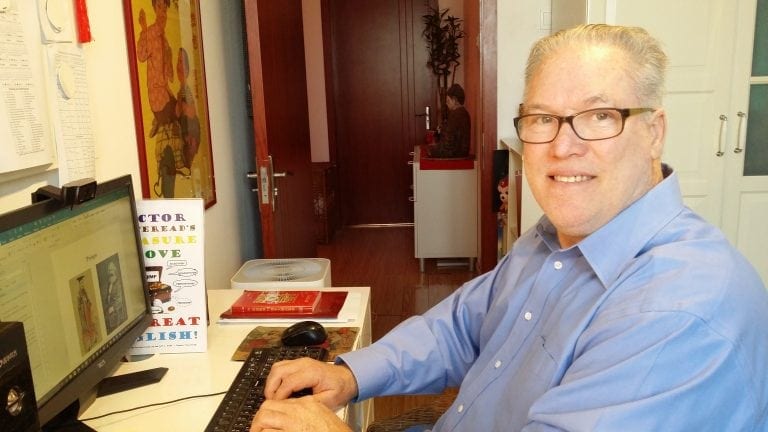
JEFF J. BROWN, Editor, China Rising, and Senior Editor & China Correspondent, Dispatch from Beijing, The Greanville Post
Jeff J. Brown is a geopolitical analyst, journalist, lecturer and the author of The China Trilogy. It consists of 44 Days Backpacking in China – The Middle Kingdom in the 21st Century, with the United States, Europe and the Fate of the World in Its Looking Glass (2013); Punto Press released China Rising – Capitalist Roads, Socialist Destinations (2016); and BIG Red Book on China (2020). As well, he published a textbook, Doctor WriteRead’s Treasure Trove to Great English (2015). Jeff is a Senior Editor & China Correspondent for The Greanville Post, where he keeps a column, Dispatch from Beijing and is a Global Opinion Leader at 21st Century. He also writes a column for The Saker, called the Moscow-Beijing Express. Jeff writes, interviews and podcasts on his own program, China Rising Radio Sinoland, which is also available on YouTube, Stitcher Radio, iTunes, Ivoox and RUvid. Guests have included Ramsey Clark, James Bradley, Moti Nissani, Godfree Roberts, Hiroyuki Hamada, The Saker and many others. [/su_spoiler]
Jeff can be reached at China Rising, [email protected], Facebook, Twitter, Wechat (+86-19806711824/Mr_Professor_Brown, and Line/Telegram/Whatsapp: +33-612458821.
Read it in your language • Lealo en su idioma • Lisez-le dans votre langue • Lies es in deniner Sprache • Прочитайте это на вашем языке • 用你的语言阅读
[google-translator]
Wechat group: search the phone number +8619806711824 or my ID, Mr_Professor_Brown, friend request and ask Jeff to join the China Rising Radio Sinoland Wechat group. He will add you as a member, so you can join in the ongoing discussion.
 I contribute to