
TRANSLATION MENU: LOOK UPPER RIGHT BELOW THE SOCIAL MEDIA ICONS.
IT OFFERS EVERY LANGUAGE AVAILABLE AROUND THE WORLD!
ALSO, SOCIAL MEDIA AND PRINT ICONS ARE AT THE BOTTOM OF THIS POST!
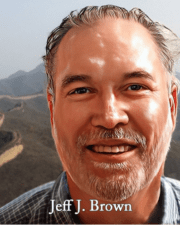
Seventeen years on the streets, living and working with the people of China, Jeff
For donations, print books, ebooks and audiobooks, please see at the bottom of this post.

Video show
Audio podcast
Quick recap
This was a video interview conducted by Jeff J. Brown with Eamon McKinney on Radio Sinoland from Taiwan, where McKinney shared his extensive experience living and working in China spanning nearly 50 years. McKinney corrected initial misperceptions about his background, explaining he lived in China from 1976-1985, including studying at Tsinghua University and working as VP of an American oil company during a period of significant political transition following Mao’s death. The discussion covered China’s historical and current economic systems, with McKinney explaining how Chinese business relationships differ fundamentally from Western approaches by focusing on cooperation rather than competition, and how China’s state-driven development projects serve long-term community benefits rather than short-term profit motives. McKinney also discussed the broader geopolitical shift away from Western dominance, arguing that Russia, China, and Iran represent a more moral world order based on Confucian, Daoist, and Islamic principles of mutual benefit and human development, contrasting with what he characterized as the morally bankrupt Western system driven by financial interests.
Summary
Business Experience in China
Jeff interviewed Eamon McKinney about his business experience in China, though Eamon clarified that he lives in Thailand on Koh Samui island. Eamon explained his background, including studying at Tsinghua University in Beijing in the 1970s and later working as VP of an American oil company in China for five years before starting his current business in China focused on project management for foreign companies.
Living in China 1976
Eamon described his experience living in China in 1976, arriving on the day Mao died and witnessing the transition from the Cultural Revolution to the era of Deng Xiaoping after the Gang of Four was ousted. He explained that living conditions for foreign students were better than for Chinese students, though resources were limited, and he had received a recommendation from a Chinese professor he met in Japan to gain admission. Eamon noted that most European students at the university were ideologically focused, while Chinese students were more reserved and had largely moved past extreme communist ideology.
China Writers’ Group Connections Discussion
Jeff and Eamon discussed their connections to the China Writers’ Group, including mutual friends like Godfree Roberts, Eric Arnow, and Pepe Escobar. They talked about a documentary that Carl Zha made with Pepe about their trip to Xinjiang, which is still in editing. Jeff mentioned his upcoming Red Tour in Xinjiang with Amir Khan, a Canadian professor and China Writer, to visit historical sites including the location where the atomic bomb was developed.
Global Media Bias Discussion
Eamon discussed the pervasive negative media coverage of China, Russia, and Iran in the West, noting how this creates unconscious bias. He shared insights about Iran potentially having nuclear weapons and mentioned that hypersonic missile technology has made nuclear weapons somewhat obsolete. Eamon also recounted his experience working in China in the 1980s as Vice President of an oil company, where he helped establish one of the first modern Chinese joint ventures, though his actual role was to produce positive reports about Chinese prospects for the stock market.
Chinese Business Culture Differences
Eamon discussed his experience working with Chinese businesses, explaining how American companies often misunderstand Chinese business logic and culture. He described how Chinese business relationships focus on mutual benefit and cooperation rather than the competitive win-lose mindset prevalent in Western business culture. Jeff responded by tracing Western competitive attitudes back thousands of years, while Eamon concluded by attributing global suffering to what he called a malevolent financial class (Jewish money) that has controlled major decisions for centuries.
Global Power Dynamics Shift
Eamon discussed the shifting global power dynamics, highlighting how America’s dominance in financial and military control has diminished over the past decade. He noted that while the Western financial system is weakening, alternative systems like the CIPS allow countries to trade without relying on Western currencies. Eamon expressed optimism about the emergence of a new global order following the current great power conflict, citing recent visits by Trump and Putin to Beijing as significant indicators of this shift.
Emergence of New Moral World Order
Eamon discussed the decline of Western power and the emergence of a new moral world order led by Russia, China, and Iran. He argued that these countries represent a shift away from Western-style imperialism and war crimes, citing their adherence to moral principles and cultural values. Eamon expressed optimism about this new world order, contrasting it with the historical Western model characterized by slavery and conflict, and Jeff agreed with this perspective, adding that North Korea should also be included due to its Confucian ethics.
Chinese Payment Systems Discussion
Jeff and Eamon discussed the Chinese International Payment System (CIPS) and its use of blockchain technology for payments with African countries, which the West cannot trace due to encryption. They explored the moral differences in approaches to money between Western and Chinese systems, with Eamon explaining how Islamic banking prohibits usury and how China’s public banking model focuses on long-term infrastructure projects that benefit society rather than maximizing short-term profits for private capital. The conversation included an example of the Sutong Bridge project in China, which was funded through government-issued bonds and has generated significant economic benefits for the regions it connects, demonstrating how public investment can drive GDP growth and improve quality of life.
Western vs Eastern Economic Systems
Eamon and Jeff discussed the differences between Western and Eastern economic systems, with Eamon arguing that Western systems prioritize profit over people’s needs while Eastern systems like China’s focus on essential services and infrastructure. Eamon explained how privatization in the West, particularly in the UK with examples like NHS and British Rail, creates economic inefficiencies by consuming people’s disposable income on basic necessities. The discussion concluded with Eamon highlighting China’s rapid development over 45 years as evidence of their successful economic model focused on serving the majority rather than benefiting a small elite group.
Multipolar World and Historical Context
Eamon and Jeff discussed historical examples of stolen assets and the geopolitical shift toward a multipolar world. Eamon expressed optimism about the future, believing that the decline of Western dominance will lead to a better future for generations to come, though many will be hurt in the process. They discussed China’s historical “Century of Humiliation” from 1839 to 1949, when Western powers imposed opium and later heroin on China, leading to widespread addiction and suffering, which continues to influence Chinese foreign policy and national rejuvenation efforts.
Travel Plans and Location Updates
Jeff and Eamon discussed their travel plans, with Jeff planning to visit Chiang Mai in October and potentially visiting Eamon in Koh Samui. They also talked about various visitors Eamon has hosted, including Cynthia McKinney who will be visiting next month. Jeff shared that he and his wife Evelyne are moving to Kunming in September due to Evelyne’s allergies to tropical heat and humidity, and they discussed the cultural similarities between Taiwan and Thailand regarding theft and spirituality.
Interview: Jeff J. Brown and Eamon McKinney
Radio Sinoland — Jeff J. Brown interviews Eamon McKinney
Jeff: Good morning, everybody. This is Jeff J. Brown, Radio Sinoland, on the beautiful Jade Island of Taiwan. I have on the show today a very special guest, Eamon McKinney, who hails from — well, lives in — Thailand. A couple of months ago, he told me the most amazing story by email about how he started a business in China back in the early days. It’s just so unimaginable. So we finally got him on the air. I’ll let him do his own introduction, and then just take it away, Eamon. If I can maybe ask a question or two along the way, that would be great.
Eamon: Sure, Jeff. Well, first of all, anybody watching this will probably figure out that I don’t, in fact, hail from Thailand — I live in Thailand. I live on the paradise island of Koh Samui, which you should know well, Jeff. You’ve spoken to the group a couple of times. But another correction: I didn’t start a business in China in the 70s. I actually arrived to start a language course in Beijing at Tsinghua University in 1976. I had several months there, then I was in America for about a year and a half, and then I was back in Beijing as VP of an American oil company for five years. In 1985, I’d had enough of that and moved back to America, and that’s when I started my business in China.
So we’ve been doing project management in China for foreign companies — about the majority of which are North American — on large industrial work. We’ve been involved in literally hundreds of projects over that period of time. I go back with China nearly fifty years now.
Jeff: Wow.
Eamon: I know it sounds extraordinary. I was a sweet young thing back then — not anymore, as you can clearly see — but it’s been a ride. Most people look at China and take a snapshot. But if you’ve got some longevity with China and you go back, you see it differently. You see it as a long-running movie that continues to change.
Jeff: Yeah, for thousands of years.
Eamon: Yes.
Jeff: So tell us what it was like living in China in 1976. That would have been the end of the Cultural Revolution.
Eamon: Or rather the Cultural Revolution had been over by then, but there was still the hangover and the social effects of it. You didn’t see the Red Guard marching or anything like that.
No. I actually arrived there on the day Mao died, which was September the 9th. But it wasn’t actually announced. Nobody knew about it until the 11th.
Jeff: Oh, that’s right. You told me that in your email. The day Mao died. Golly.
Eamon: That first month at the university was, well, surreal, really. It was hard to know what to make of it. I’d had about a year and a half in Japan prior to that, and the contrast was just night and day. Nobody really knew what was going to happen. There was certainly no published succession plan. When Mao died, he hadn’t made one. So you had what they called the Gang of Four, which was largely led by Mao’s wife, Jiang Qing. It looked like they were trying to consolidate power, but they were ousted and arrested towards the end of October. That really was the transition into the Deng era. Once the Gang of Four were gone, that was really the end of hardline communism and hardline communist policies in China.
Jeff: So what were your living conditions like?
Eamon: Austere. They had dormitories for the foreign students. I’d say there were about fifty foreign students on the course at Tsinghua, mainly — almost exclusively — European. There were no Americans. It wasn’t that China didn’t allow them in; it was that Americans weren’t allowed to go. The conditions were better for us than for the Chinese students, and they tried to make us welcome, but there wasn’t much to go around.
Jeff: And did you pay tuition, or did you apply and they covered all your costs?
Eamon: There was a small tuition fee, but I can’t even remember what it was — it was insignificant. I got a recommendation from a Chinese professor I’d met in Japan who was a Tai Chi instructor, so I was well introduced. But it was kind of challenging. Most of the other foreign students were middle-class kids from Europe who all thought they were communist, and that’s all they wanted to talk about. It’s like anybody else who buys into an ideology and is devoid of free thought or original ideas — they’re just spouting clichés. The Chinese students, most of whom were great and many of whom spoke very good English, didn’t want much to do with the other foreign students either. The Chinese were pretty much burned out on that extreme version of communism by then.
Jeff: When you were there in 1976 — I know Godfree Roberts — I assume you’re from Australia or New Zealand? You sound Australian.
Eamon: Well, my accent, I guess, is English. I was born in Ghana.
Jeff: Oh, really? Okay, that’s interesting.
Eamon: I have photos but no real memory of our time in Ghana. I grew up in England, basically.
Jeff: My apologies.
Eamon: That’s okay. I’ve been called worse than Australian before.
Jeff: Well, Godfree Roberts from Australia was in Beijing, though he moved around, starting in 1976. Did you ever meet him there?
Eamon: The name is familiar. I think I might have seen him on your China Writers’ Group before.
Jeff: Yeah, he lives in Chiang Mai. There’s a mutual friend of ours who lives up there too — Eric Arnow.
Eamon: Yes, he’s another China Writer. Eric has actually come down to the Samui Real Group on a couple of occasions. He came down when we had Pepe Escobar here, and I think he was actually interviewing Pepe at some point during that trip — for you.
Jeff: Yeah, I’ve interviewed Pepe several times. He’s also a member of the China Writers’ Group, which is a collective I created when my wife and I were living in Chiang Mai. It’s now six years old.
Eamon: Oh, okay. Do you also know Carl Zha?
Jeff: I just know who he is. We’ve communicated a couple of times by email about possibly doing a show together, but it never worked out. Carl’s good though — he’s spoken to our group a few times. I met Carl down in Krabi last year. He’s just done a documentary with Pepe about their trip to Xinjiang.
Eamon: Oh, really?
Jeff: Yeah. It’s not out yet, but they made the trip a few months ago and they’re still editing it. Which is significant, because whenever people throw out the clichés they hear about China, they always bring up human rights, and a lot of that is centered on Xinjiang. In August, another China Writer, Amir Khan — a Canadian of Pakistani origin who is a professor at Changsha Normal University — he and I did a Red Tour last summer in the southern part of the country and then in Yan’an. This August we’re going to Xinjiang. We’re going to do a Red Tour of Xinjiang. We had no idea there were all these red sites in Xinjiang, and we’re going to get to visit the place where they developed the atomic bomb. It should be very interesting.
Xinjiang is such a joke. It’s such a joke, but unfortunately it works. All these blatant lies — just gratuitous propaganda — but it works. You talk to people and it’s, “Those poor Muslims in Xinjiang.” It’s really sad that people around the world can be so manipulated.
Eamon: It’s the same thing about Russia. And North Korea. And Iran. It’s all the same. It’s one big projectile vomit, basically, is what it boils down to. Awful. Well, I occasionally do a talk on China now. The first question I ask is: have you ever seen or heard anything in the West about China that wasn’t in some way negative? And the answer is no, they haven’t. So whether or not you consider yourself a critical thinker, when you’re bombarded with all this ambient propaganda — and it’s relentless — you develop an unconscious negative bias towards the subject.
And there’s a lesson in the North Korea example — you notice they were always talking about how terrible North Korea was. And then all of a sudden North Korea got a nuclear bomb and the conversation stopped. They were off the table.
Jeff: And listening to some of the people I respect who know what they’re talking about, they believe Iran also has that capability. Pepe Escobar and Larry Johnson have both written about it. Larry Johnson backed it up by saying he talked to someone who was privy to a phone call between Iranian President Pezeshkian and the prime minister of Pakistan — and they made sure it was not encrypted so the Americans would pick it up. Someone that Larry knows was privy to that call, and Pezeshkian said that if they keep bombing Lebanon, et cetera, Iran would pull out of the Nuclear Non-Proliferation Treaty, and then detonate an atomic explosion deep underground to prove they have nuclear weapons. I think Donald Trump privately believes Iran has nuclear bombs.
Eamon: Well, they don’t actually need them, with the new missile technology. The hypersonic technology has, to a certain extent, made nuclear weapons obsolete. If you look at how Russia recently employed the Oreshnik — they bombed multiple targets in Kyiv and there was like one fatality and four injuries. That’s the precision available now. The opportunity to frighten the enemy and avoid collateral damage exists for the first time. It never did before.
Jeff: Tell us what it was like to work in China in the 80s and 90s. By the way, you were using the first-person plural, saying “we” — so I assume you had a company or worked in one.
Eamon: Long story short: I did an MBA in Chicago, and then I was recruited to join a large American oil company. Literally the day I started, it turned out they were planning a trade mission to China to meet the Chinese government and discuss a joint venture. Because I apparently spoke Chinese, I ended up on the flight. I didn’t know why I was there, nobody asked who I was — I just got ticked off the list as we boarded. I did a little bit of interpreting when we were in the Great Hall of the People, so they thought, “He’s the guy.” So I was sent back as Vice President of that oil company to try and set up what was at least one of the first joint ventures in modern Chinese history. There was no precedent for anything like this — no set of rules or guidelines, no research agencies, nothing like that at all.
In order to help me with what I needed to get done, I worked very closely with well-connected friends I still had at Tsinghua. But it took me about eighteen months to realize that my job was actually just to produce positive reports about prospects for the company in China, for the stock market.
Jeff: Sounds like pump-and-dump — pumping the stock market.
Eamon: Literally, that’s what it was. After five years, they never got anything done. Not a single specific business deal was actually discussed with the board. It started as an oil venture but shifted to open-cast mining. The object was never really to do business with China, but to talk about doing business with China — because you could tell people in the American financial sector anything you wanted about China at that time. You could tell them it was made of green cheese and they wouldn’t know the difference. That first stretch was lucrative — I was getting paid tax-free offshore in Hong Kong. But what I did do, through my association with Tsinghua, was sit in on a lot of important meetings. I had things to contribute, given that my PhD thesis was on China in the global economy, and they were very interested in some of what I had to say.
One of the problems I think American businesses have when they go to China is they’ll come up with a business plan that makes complete sense to them, and they assume it’s going to make perfect sense to the Chinese as well — on the assumption that it’s logical, and logic, as we know, is universal, like mathematics. They go to China and discover the Chinese have a completely different framework.
But the more I began to understand about the Chinese mindset — about what it is supposed to be — the more I realized that if you want to understand the Chinese mindset today, it’s simple: the Century of Humiliation. Never again. And that still drives them.
When I was working with leading professors and government officials at the university who were interested in these subjects, I realized they had the same problem in reverse — they also assumed that logic was immutable and that Americans looked at things the same way they did, which of course they didn’t.
And a few years ago, at the prompting of a friend, I gave a lot of thought to Sun Zi’s The Art of War. As a martial artist — which was the real reason I was in Asia, studying Chinese became a byproduct — I knew The Art of War very well. But I never heard it mentioned in China at all. When I went to business school in Chicago, however, The Art of War was like the Bible. That’s what they were teaching. Everything was a contest, a conflict. It reflected the corporate Wall Street mindset — for every business deal, there’s a winner and a loser, and if you’re not winning, you’re a loser.
When I got back to China after that, I realized I never heard that from the Chinese. When they talked about cooperation and mutual benefit, it sounded like business speak to me at first, but it isn’t. It’s genuinely the way they look at business and relationships. It’s not a conflict. And we still see that today. That win-lose mindset is so embedded in the Western psyche, I’m not sure they can shake it. The Chinese look at a business relationship as an asset. When you have one, both sides are obliged to work through any specific issue that arises. And there’s this Confucian sense of responsibility: that business associates’ happiness and success is important to you — what can you do to help? There is a mutuality that is completely, uniquely Chinese. But it resonates, and you’re seeing how people around the world are beginning to accept that way — that it isn’t just talk, it isn’t just political rhetoric — as evidenced by the way they’ve worked and invested in Africa and all over the world.
Jeff: Yeah. I think that zero-sum, winner-take-all mentality in the West goes back thousands of years — the Greeks, the Romans, Byzantine Europe, colonialism and imperialism, and then post-World War II complete domination of much of the world. The Mossad-CIA-MI6 creating absolute havoc around the world — all for domination and total control of human resources, natural resources, and political processes in those countries. This is nothing new. It’s just the way “we” do things. We killed millions of Native Americans to clear the land. Look at what’s going on in West Asia right now. To me, it’s just Western business. And it’s the antithesis — 180 degrees different — from Confucianism, Daoism, and Buddhism.
Eamon: They have absolutely nothing in common, which is why I think Eastern thought is in many ways superior to Western thought. It’s not who we are as humans. It’s not the natural state of things. There has been a malevolent force in the West — for centuries — that has been the root of so much evil. Today we can call them the Epstein class, the Zionist class, the central banking cartel, or the financial power elite. Call them whatever you want. But this goes back hundreds of years.
The money power picks winners. When you see the billionaires and oligarchs, that is not organically achieved — they are selected, funded, installed so that a small group can control the dominant paradigm. In the mid-to-late 1800s, or post-Civil War America, the Rothschild financial class went in and picked champions — the Rockefellers, the Harrimans, the Carnegies — who all of a sudden had unlimited capital to corner entire sectors of industry. That’s when America lost its soul, and it’s been slowly losing more of it ever since.
That class of people was centered in London and essentially still is, though it’s now widespread. If you look at any piece of misery — any war, suffering, or deprivation going on anywhere in the world — you can trace it back to these people in five moves or less, one way or another. Most of the evil is conducted through their corporations.
The Rothschild clan was an exceptionally powerful family — the richest in the world by the mid-1800s. But they decided they were going to take America as a host, because it was far more valuable than the UK. And you had other powerful, primarily Jewish families — the Sassoons, the Montefiores — who had been heavily involved in the opium trade for more than a century. And the scars are still there. If you go to Shanghai, you can see the building that used to be called the Cathay Hotel.
Jeff: Now the Peace Hotel. We were just there in March.
Eamon: Yes. That money power has been behind every piece of misery you can imagine. They financed both sides of both World Wars. And that has gone completely unchallenged for an awful long time.
But this is why I’m optimistic, Jeff. We’re in a great power conflict now — you can call it World War III if you want. But at the end of every great conflict, a new order emerges. And for anyone paying attention and able to interpret things properly, we saw that with Trump’s visit to Beijing followed by Putin’s trip to Beijing.
Here’s what America hasn’t figured out. There were about nine years separating Trump’s two visits to Beijing. The first, in 2017, when he’d just become president, resulted in an unprecedentedly warm welcome — including a visit to the Forbidden City, which is usually off-limits to foreigners. There was real warmth between him and Xi. He also received an enormously warm welcome in Saudi Arabia — the sword dance — and in Moscow, where Putin symbolically handed him the football. So whatever Trump promised in that initial period, it didn’t come to pass, because Xi showed no warmth the second time around, and they all seem to have turned cold on him.
What Xi and most of the world understand — and what America doesn’t appear to grasp — is this: go back twenty years, America controlled the world financial system through the dollar system and the SWIFT system. It could sanction you, steal your money, and force other countries not to do business with you, as we’ve seen with Iran. It no longer controls the world financial system. The Western financial system has been running on fumes for decades and cannot keep going much longer. There is now another financial system in place that bypasses it altogether — so if the Western system collapses, countries can still trade through alternative payment systems using their own currencies.
The most serious countries in terms of resources are Russia, China, and Iran. The Western world is bankrupt — morally, spiritually, and financially. The other pillar of American control post-World War II was its military. They had the most powerful military in the world, unchallenged. That’s no longer the case — it’s self-evident from what’s happened in the Persian Gulf. They have no technology or arms that could effectively attack China or Russia. They used to control the world’s energy supplies — they don’t anymore. The resources are largely in the hands of the other side. And despite claims of American energy self-sufficiency, they produce light crude oil, which is fine for running cars but not the heavy diesel oil used for aviation fuel and heavy industry.
They don’t control rare earth materials — which, interestingly, was never even discussed publicly after the Beijing meeting. And they don’t control the narrative anymore. America is not a great power anymore in the way it once was. People are standing up to it and saying no. But what we’re seeing is only the tip of the iceberg. That Western empire mentality is anti-human. It has no regard for humanity.
Look at how America conducted the war in Vietnam — napalm, burning civilians. And look at what’s happening now: bombing civilian targets, bombing girls’ schools. Iran, by contrast, has deliberately avoided attacking civilian infrastructure. If they used their missiles to take out the desalination plants in the Gulf, including in Israel, those places would be out of water in three days. But it’s the Shia Islamic morality that you don’t attack non-combatants, you don’t attack civilians.
And again, look at Putin. With the technology Russia has, they could have ended the Ukraine war in weeks if they’d adopted the American model — shock and awe, destroy everything and everybody. They chose not to.
So my cause for optimism is this: we’re seeing the failing empire losing control of everything it once held. They don’t control the money, they’re not the most powerful military, they don’t control the narrative. Nobody believes them. They have absolutely no credibility. You cannot deal with them. The West is a failing power, and with it dies the malignancy that has been at the heart of so much human misery over the last several centuries — the opium wars, countless endless wars for power and resources. That is over.
The new order — and it’s not arriving, it’s already here — is centered on Russia, China, and Iran. They are the great regional powers. And before you say “new boss, same as the old boss” — no, it’s not. This new world order is moral. It’s not Stalin’s Russia. Russia is now a deeply Christian country where every other religion is also present — Hindu, Buddhist, synagogues — all living peacefully, because nobody is stoking division anymore. Western families with traditional Christian values are actually relocating to Russia. I have a friend, an American, who has been living in Moscow for about fifteen years, and his business is helping Western families relocate because of what they see as cultural sickness in the West.
Russia has not committed war crimes against Ukraine. The Ukrainians, by contrast, are bombing civilians — just like the Israelis.
China — I lived in China when it was in a period of nihilism, when people really didn’t believe in anything. The communist dream was gone. Xi Jinping, who a lot of people don’t warm to because he’s not a particularly charismatic or outwardly warm character, has nonetheless done extraordinary work in China in terms of eliminating corruption. Trust has been reestablished. And we’re seeing a re-emergence of Confucian and Daoist Chinese philosophy — the idea that you live for your fellow man, that society is an ecosystem, that everybody has a role to play and we’re all equally important.
That’s what the Russians and the Chinese talk about when they get together — human development. Which is what they’re doing throughout the Global South, without seeking to be a hegemon, dominate, or establish any kind of vassalage.
Iran is a deeply moral society. The people there are not necessarily very happy right now because they’ve been under sanctions for decades and they’re broke. But these ongoing attacks on Iran have unified the people in a way that has never happened before. The religious leadership — the mullahs — are Shia, and the Shia and Sunni are completely different. The Sunnis are more literalist — everything you need is in the Quran. The Shia tradition is different. These religious leaders are highly educated men. They speak multiple languages, hold PhDs in various subjects, and embrace culture, arts, literature, and science. That has always been the Islamic tradition. And it’s in that religious tradition that they refused — until very recently — to develop nuclear weapons or weapons of mass destruction. Even during the Iran-Iraq War, which was Western-backed and started by Iraq, when Iran was being attacked by Western-supplied chemical weapons from Saddam’s forces, they said no — it is haram, it is forbidden.
You don’t have to personally like Xi or Putin. Personally, I think that if there is a God, He chose to send the world Putin at this particular time — a reasonable, intelligent, courageous man. What we’re looking at now is the changing of the world order. It’s fifty years too late, but we might as well rejoice that it’s here, because a better future beckons.
Jeff: We need to include North Korea in this picture, because it’s arguably the most Confucian country in the world. It has thousands of Confucian temples and the people genuinely believe in those principles. And it all comes back to ethics. The Chinese version of the Golden Rule is: do not do unto others what you do not want done to you. That’s the morality of China, Russia, Iran, and North Korea. It all boils down to ethics — not the Western monotheistic morality of “my religion is superior to your religion,” which has caused nothing but misery.
And we can’t forget the Crusades, which killed perhaps one percent of the human population — seven or eight million people, including many Slavs and Muslims. Rome ground through hundreds of thousands of slaves a year. It was the only way the empire could survive economically. That’s the Western model — expropriation, extraction, theft, slavery. It needs to end. And right now, not only is there the Chinese international payment system, but Russia has its own and they’re integrating it with China’s. The most exciting development is what the Chinese are doing with blockchain payments with African countries. The West can’t even trace it because it’s all encrypted. And as you say, countries are paying in local currencies — Nigeria pays in naira, China pays in RMB. That’s the real threat to the West right now. They’re hanging on to dollar supremacy, and when that goes, the whole house of cards gets flushed. What do you think?
Eamon: You’re absolutely right. And when we speak about the inherent sickness of the Western model, the lack of morality drives all of these systems. Look at Iran, and this is one of the reasons why there has been consistent clash — it’s because the Jews were historically the only people permitted to practice usury. No other religion allowed it because it was considered immoral. Islam has its banking system where interest is illegal — or more precisely, compound interest, which is usury. We’ve been living in the West under a system of usury for centuries. That’s why all the wealth disappears upwards.
There was an enormously influential Islamic scholar from roughly the 11th century — Al-Ghazali — who wrote about the morality of money and its function as a moral issue. If the love of money for its own sake is the root of all evil, then getting rich simply to pile up wealth for personal use is immoral. Money should circulate. If the baker has a windfall, he should buy more flour; the flour merchant can then buy more butter; the butter supplier can then buy another cow. Money circulates and generates productivity. They have a fundamentally different attitude toward it.
That was also the case in Europe until the influence of the financial power elite. Even the Vatican banned usury. But when they wanted to pick some Norman or French noble to go and fight a crusade, they’d send a Jewish moneylender to provide the financing.
China operates on the same principle. Xi Jinping has said no one needs more than a billion dollars. The man who invented DeepSeek had originally developed complex algorithmic systems for trading on the stock market and made a great deal of money. Xi essentially said: well done, you’re obviously intelligent — why don’t you use some of that money to do something genuinely good? And he developed DeepSeek.
If you look at how their system works, they have public banking. It’s not a private central bank lending money created out of thin air at interest. And when the state creates money, yes it’s created out of nothing, but it becomes something productive.
Take the difference between state capital and private capital. You know Nantong — in the Yangtze Delta north of Shanghai. As the crow flies it’s perhaps a hundred kilometers from Shanghai. But it’s separated by the Yangtze Delta, so if you wanted to travel from Nantong to Shanghai, you had to drive all the way around — it was about a three-hour journey. So they built the Sutong Bridge, about twelve miles across the Delta, the largest bridge of its kind in the world. At the time — going back maybe twenty years — it cost around 8 billion dollars. The government issued a bond split between Nantong on one side and Shanghai on the other, and both sides collect the tolls. In time the tolls will pay off that debt — maybe it takes thirty years.
Private capital is not interested in anything that takes thirty years to get paid back. The return is too slow and too small. So the bridge doesn’t get built under the Western model. But here’s the thing: the Chinese don’t just look at the toll revenue. There are perhaps a hundred thousand cars a day using that bridge, with an average of one and a half persons per car. That’s a hundred and fifty thousand people, each saving roughly six hours a day — millions of hours every single day that can be put to some productive use, rather than sitting in traffic burning fuel, generating pollution, going crazy. And on both sides of that bridge, GDP exploded exponentially. Private capital has no way of monetizing that. So they look at it very narrowly.
Now that bridge continues to serve well over a hundred thousand cars a day, saving all that time. It was paid off long ago and is still collecting tolls. That’s how it works: you do something genuinely productive with the capital. You don’t just funnel money into the financial system to enrich the top one percent.
Xi Jinping is fond of quoting Abraham Lincoln, who said money should be the servant of man, not its master. If you look at a lot of the projects China is doing with Russia and in the Global South, they’re based on human development. They’re not always commercially successful in narrow terms, but they are things that are simply good for people and worth doing. You’ll never sell that on Wall Street, because there is no morality attached to money there.
Jeff: Right. And the same applies to Western infrastructure spending. Trump came out saying he’d spend trillions on infrastructure through public-private partnerships, but private money cannot tolerate anything below a double-digit return on investment. They’re not going to do anything that takes thirty years for a return, and they won’t accept depreciation as their compensation either. That’s why the West is falling apart. The infrastructure is better in Europe than in the US, but it’s rapidly falling to American standards.
Eamon: And that has been deliberate. Under the post-Thatcher era, Britain used to have what some call socialism but what really just means: meeting Maslow’s hierarchy of needs. You had the NHS, you had British Rail. Once everything was privatized, even basic commuting consumed all of a person’s disposable income. I had an office in London once, and we employed a summer intern — a Chinese girl, a friend of a friend. I was paying her about 80 pounds a week. Her train fare to come in from the county cost about 70 pounds a week. She could pay the rent, commute to work, and eat, but she had no disposable income. She couldn’t go out with friends, buy clothes, go to dinner. When a system absorbs all the money just for basic necessities, there’s nothing circulating in the broader economy. The Chinese have understood this. They’re not going to privatize infrastructure, banking, energy, schooling, or healthcare, because the more cost-effectively you supply those services, the more money people have to invest and circulate in the economy. It’s just good economic sense — for everyone except the top one percent.
The whole economic structure of the West, and the precepts that underwrite it, are flawed — because they’ve all been written to benefit a very narrow group of people. Look, I’ve seen communism firsthand. I’m not any kind of communist. But I believe people should get something for their money. I always got a kick out of it when Americans would talk about “free” healthcare in England. Where does that word come from — free? It’s not free. It’s just a question of who pays for it and how. The British people pay for it through taxation and other means. You still get taxed in America. You just don’t get anything for your money.
The system of governance that the Chinese have developed will only work in China. But a lot of their principles are transferable, and Xi has said as much — the Chinese system is unique to China, don’t try to copy it, but if there’s anything you can take from it and use, do so. The most important principle is about how you run the economy and for whose benefit. China is a shining example of how you go from less than zero — they started with literally nothing, their national gold wealth had been stolen by Chiang Kai-Shek and taken to Taiwan, the Americans then convinced them it would be safer held in New York and it was never seen again — to becoming the world’s most powerful economy in fewer than seventy-five years.
Like so many other countries. The Romanov wealth was never recovered either.
And there was no one left alive to reclaim it. But look, I’m very optimistic about the future.
Jeff: So am I.
Eamon: The Western world is going to go through a very tough period. But when this crash comes — which is inevitable and probably more imminent than ever — it’s not going to be the same everywhere. Everywhere will be affected, but everywhere won’t be destroyed, because the rest of the world, for the most part, has contingency plans. They can continue to trade and do business with each other. The Western world doesn’t appear to have any Plan B at all.
Jeff: I’m a fervent advocate for seeing the Western empire crash — ironically, even though I get a significant portion of my income from Social Security in the United States. When there’s a run on the dollar and my check disappears, I’ll be in trouble. But it’s worth it. It needs to happen.
Eamon: Well, I don’t think most people understand what’s going on in terms of the geopolitical shift. It’s been happening gradually, and it’s become more obvious lately, but it’s been obvious to those paying attention for a long time. I think it’s something to celebrate. A lot of people are going to get hurt in the process, but in the long run, it bodes a better future for generations to come. This evil needs to be eradicated. But they’re not going to go down without a fight. They’ll probably take it out on someone like Cuba next — try to consolidate and become more of a regional power in Latin America.
But they’re widely despised there as well.
Jeff: Sure. Well, we’ve been going for a solid hour. Would you like to have any closing comments? And maybe we can try to do this again, because this has been a lot of fun.
Eamon: Keep the faith. See the big picture about what’s going on. The world is rising. I remember I did my first talk at the Samui Group about five years ago — most of the group were just waking up through COVID. The talk was “China and the New World Order,” and I finished it by saying: if in ten years you have any freedoms left, you can thank the Russians and the Chinese, because they’re the only ones fighting the New World Order. That’s no longer true. They’re not the only ones fighting it. We’ve got Iran, North Korea, Pakistan, the Global South almost in its entirety. And if you look at the Sahel group — Mali, Burkina Faso, and the others — this is all part of the same battle. What we’re seeing in the conflict between Israel and Iran, in the Middle East broadly, in Ukraine — it’s the same evil behind all of it. These are the forces of good against the forces of evil. People have got to get out of their heads the idea that China is somehow going to be the next America. It is not, and it has no intention of being.
You’re familiar with Zheng He, right?
Jeff: Oh, absolutely.
Eamon: When Zheng He came back from his long voyages — when he’d been virtually all over the world — they’d brought botanists and scientists and engineers, scholars, linguists, and medical people. They didn’t bring soldiers. They went to all these different countries and peacefully interacted with them, learned about them, studied them. When they returned to China and presented all of this, the emperor said we must stop. And it was poorly translated by many people over the years, but if you read the original, he said “the cost is too high.” He wasn’t talking about money. It was back to this Confucian-Daoist principle about society as an ecosystem. He was essentially saying: we are so far advanced of these people — if we go back, there is no way we cannot change their system, cannot influence their ecosystem. We must leave them alone. That might be the first recorded example of anti-imperialism.
And those principles were repeated by Deng Xiaoping way back in the early days of reform. The Communist Party had studied imperialism deeply. That’s what drives Chinese policies more than anything else — the Century of Humiliation. Never again.
Jeff: For those who don’t know what the Century of Humiliation is: it runs roughly from 1839 to 1949. During that time, Western powers got their fangs into China and were importing opium illegally, foisting it on the Chinese population starting in the 1830s. Then beginning in the 1870s and 1880s, they started bringing in morphine, and then heroin was invented and they started bringing that in too. At peak addiction, the drugs were affecting perhaps 25% percent of the population. Imagine every fourth house on your street being a drug house — that’s essentially what it was like in China for over a century. It didn’t change until communist liberation in 1949. And shamefully, Chiang Kai-Shek was involved in the trade and making money from it — alongside the Sassoons and the Rothschilds. It was a terrible, terrible period. China was humiliated, completely wracked with drugs. That’s why the Chinese commonly say that China’s rejuvenation started 200 hundred years ago — they’re talking about 1839, not 1978. The rejuvenation started when they finally got rid of the Western drug dealers and Western bankers and gained their freedom and independence. Dark, dark days. If you want to get a Chinese person excited, just bring up the Century of Humiliation.
Eamon: And it wasn’t just the drugs. During that period there were also two enormous internal rebellions against the weak Qing dynasty — the Taiping Revolution and then about fifty years later the Boxer Rebellion — and millions upon millions died. Another thing that’s poorly recorded from that era is the Chinese slave trade. When you had all those Chinese workers building the railroads in America — they didn’t go to a job center and get a relocation package. They were literally shanghaied, taken over there, enslaved, not paid, mistreated, and murdered. The same happened all over South America and Africa.
Absolutely. A terrible period. But every Chinese person understands it. The Century of Humiliation is foundational.
Jeff: It is. Well, listen, Eamon, this has been a fun talk. I hope you enjoyed it as much as I did.
Eamon: I did. Thank you so much for inviting me.
Jeff: Now, Evelyne and I are supposed to go to Chiang Mai in October to visit a good friend — an American who has a house up there in Pai. Maybe we can come down and visit you guys in Koh Samui. Last time I was there, my wife was pregnant with our second child. I’ll never forget our first child freaking out about all the little crabs crawling on the beach.
Eamon: Ha! It’s changed a lot since then, I’m sure. We do get a lot of very interesting people visiting us — Pepe was here about a year ago, and of course Matt Ehret and Cynthia Chung came here as well. In fact, I think it was Matt who actually put us together a few years ago.
Yes. And you know Cynthia McKinney?
Jeff: Yes, she’s a member of the China Writers’ Group too, as are Matt Ehret and Cynthia Chung.
Eamon: Cynthia McKinney is going to be with us next month. She did an amazing talk about five or six weeks ago — if you haven’t seen it, I’ll send you the link.
Jeff: Please do send me the link.
Eamon: She’s an extraordinary woman. I remember back in the post-9/11 period — I was an early member of Scholars for 9/11 Truth and Justice — and there was only one official who actually gave us any time and tried to do anything, and that was Cynthia McKinney.
Jeff: And her book — When China Sneezes — I wrote the first chapter in that book.
Eamon: Oh, that’s right! She’s going to China after she leaves us. She’s in Dhaka in Bangladesh at the moment. We’re flying her here to Samui, and from here she wants to get to China, so we found her a direct flight to Hong Kong where she can catch the high-speed rail up to Guangzhou. She’s been there, teaching and flying around, for several years.
Jeff: Is she going to live on the Mainland?
No, I don’t think so right now — she has some friends there she’s going to visit.
Jeff: Actually, we ourselves are moving to Kunming in September. Kunming — K-U-N-M-I-N-G.
Eamon: The Spring City.
Jeff: It’s about 1,900 meters above sea level, so it’s the same latitude as here and as Shenzhen — close to the Tropic of Cancer — but because Kunming is nearly two kilometers up in altitude, we spent about nine days there on our last trip and really loved it. The weather is about ten degrees cooler and the humidity is half as high. There’s wind there, too — here where we live there’s not an ant fart’s worth of wind almost all the time.
Eamon: Where are you now? Taipei?
No, no. We’re in a small town called Puli, P-U-L-I, in Nantou County — N-A-N-T-O-U — which was actually supposed to be the capital of Taiwan after Chiang Kai-Shek arrived, because it’s the most centrally located city on the island. We’re just east of Taichung, the big city in the central part of the island on the coast facing China, about forty or fifty kilometers away. We thought: our house is at 530 meters, that should work, it’s high enough. But, it’s only a degree or two cooler than Taichung on the coast. We’re right up against the foothills. I can literally look out my window and see the mountains. And there is no wind. It’s like a greenhouse. And poor Evelyne is just miserable in it.
So we’re going to have to leave, as much as we love the people here, and we love the culture — their Confucianism, their Daoism, their Buddhism. We have neighbors who are robed Buddhists. We’re just surrounded by spirituality. We will really miss it. They’re among the most honest people in the world. You can leave your wallet and phone in an open cubbyhole at a public swimming pool and no one will touch it. I kid you not.
Eamon: Same here in Thailand. I haven’t locked the door of my house in five years. I’ve got a key somewhere, but damned if I know where it is. People don’t steal here — they just don’t have that culture.
Jeff: No, they don’t. So we’re going to miss it. Go ahead.
Eamon: When you were talking about spirituality — I don’t claim to be a particularly spiritual person at all. I’m actually fairly pragmatic. But this is, without doubt, what I see as a spiritual battle between good and evil. And good will win out. That’s what keeps me going, Jeff.
Jeff: Yeah, absolutely. Well, this is Jeff J. Brown, Radio Sinoland, on the island of Taiwan, talking to Eamon McKinney in Koh Samui, Thailand. Thank you so much, Eamon. I will give you a Buddhist bow — and you too, since Thailand is the most Buddhist country in the world.
Eamon: Thank you, Jeff. It’s been a real pleasure.
Jeff: All right, bye-bye. Take care.
Eamon: Take care. Bye-bye.
Interview conducted via video call between Puli, Nantou, Taiwan and Koh Samui, Thailand.
###
Support, donations and contributions for my work here, any amount, one time or monthly,
A to Z support. Thank you in advance, Jeff
Checks or cash: mail to: Jeff J. Brown, 7 rue du Général de Gaulle, Équeurdreville 50120, France
Donorbox: www.donorbox.com, find China Rising Radio Sinoland
Euro bank wires: 44 Days Publishing, Bank: TransferWise, IBAN: BE70 9672 2959 5225
FundRazr: https://fundrazr.com/CRRS_2021_fundraiser?ref=ab_78aX23
Patreon: https://www.patreon.com/China_Rising_Radio_Sinoland OR https://www.patreon.com/China_Tech_News_Flash
Paypal: https://www.paypal.me/ChinaRisingRadioSino
Stripe US$/ApplePay: https://buy.stripe.com/14k8zl5tp5mVeT66op
Stripe Euros/ApplePay: https://buy.stripe.com/fZe02P8FB9DbcKY28a
US bank wires: Jeff J. Brown, Bank of Oklahoma, Routing Number/ABA: 103900036, Account: 309163695
WeChat and Alipay:

Do yourself, your friends, family and colleagues a favor, to make sure all of you are Sino-smart:
Google ebooks (Epub) and audiobooks:
44 Days Backpacking in China: The Middle Kingdom in the 21st Century, with the United States, Europe and the Fate of the World in Its Looking Glass https://play.google.com/store/books/details?id=YBKHEAAAQBAJ
https://play.google.com/store/audiobooks/details?id=AQAAAECCkQXRlM
China Rising: Capitalist Roads, Socialist Destinations https://play.google.com/store/books/details?id=YNmLEAAAQBAJ
https://play.google.com/store/audiobooks/details?id=AQAAAECCfHo86M
BIG Red Book on China: Chinese History, Culture and Revolution
https://play.google.com/store/books/details?id=6Wl4EAAAQBAJ
https://play.google.com/store/audiobooks/details?id=AQAAAECCfHo86M
Amazon print and ebooks (Kindle):
44 Days Backpacking in China: The Middle Kingdom in the 21st Century, with the United States, Europe and the Fate of the World in Its Looking Glass
https://www.amazon.com/gp/product/1484939999/
China Rising: Capitalist Roads, Socialist Destinations
https://www.amazon.com/China-Rising-Capitalist-Socialist-Destinations/dp/0996487042
BIG Red Book on China: Chinese History, Culture and Revolution
https://www.amazon.com/BIG-Red-Book-China/dp/1673322719/
Author page:
https://www.amazon.com/Mr.-Jeff-J.-Brown/e/B00TX0TDDI
Praise for The China Trilogy:
Jeff J. Brown’s libraries and catalogues A-Z: 1,000s of hours of research, writing, editing and podcasting.
Why and How China works: With a Mirror to Our Own History


JEFF J. BROWN, Editor, China Rising, and Senior Editor & China Correspondent, Dispatch from Beijing, The Greanville Post
Jeff J. Brown is a geopolitical analyst, journalist, lecturer and the author of The China Trilogy. It consists of 44 Days Backpacking in China – The Middle Kingdom in the 21st Century, with the United States, Europe and the Fate of the World in Its Looking Glass (2013); Punto Press released China Rising – Capitalist Roads, Socialist Destinations (2016); and BIG Red Book on China (2020). As well, he published a textbook, Doctor WriteRead’s Treasure Trove to Great English (2015). Jeff is a Senior Editor & China Correspondent for The Greanville Post, where he keeps a column, Dispatch from Beijing and is a Global Opinion Leader at 21st Century. He also writes a column for The Saker, called the Moscow-Beijing Express. Jeff writes, interviews and podcasts on his own program, China Rising Radio Sinoland, which is also available on YouTube, Stitcher Radio, iTunes, Ivoox and RUvid. Guests have included Ramsey Clark, James Bradley, Moti Nissani, Godfree Roberts, Hiroyuki Hamada, The Saker and many others. [/su_spoiler]
Jeff can be reached at China Rising, [email protected], Facebook, Twitter, Wechat (+86-19806711824/Mr_Professor_Brown, and Line/Telegram/Whatsapp: +33-612458821.
Read it in your language • Lealo en su idioma • Lisez-le dans votre langue • Lies es in deniner Sprache • Прочитайте это на вашем языке • 用你的语言阅读
[google-translator]
Wechat group: search the phone number +8619806711824 or my ID, Mr_Professor_Brown, friend request and ask Jeff to join the China Rising Radio Sinoland Wechat group. He will add you as a member, so you can join in the ongoing discussion.
 I contribute to