TRANSLATION MENU: LOOK UPPER RIGHT BELOW THE SOCIAL MEDIA ICONS.
IT OFFERS EVERY LANGUAGE AVAILABLE AROUND THE WORLD!
ALSO, SOCIAL MEDIA AND PRINT ICONS ARE AT THE BOTTOM OF THIS POST!
Seventeen years on the streets, living and working with the people of China, Jeff

For donations, print books, ebooks and audiobooks, please see at the bottom of this post

 Article
Interesting convergence: June 19 was Dragon Boat Festival, making a three-day weekend, with Summer Solstice and Fathers’ Day both on June 21! Y-O-W-Z-E-R!
HAPPY DRAGON BOAT FESTIVAL 2026! A beloved, 2,500-year-old tradition celebrated everywhere in Sinoland! Tons of Sino-culture, visuals, videos, stories and history. Radio Sinoland 260619
The Mandarin name for this two-week period of the Chinese agricultural calendar 21 June – 7 July means “Summer Solstice” (夏至 = Xiàzhì), when the Sun is directly perpendicular to the Tropic of Cancer. Notice the time of 16:24 in calendar page below. This is the moment when the Sun crosses 120 degrees on its annual journey across our sky – Beijing time, of course! For astronomers, it equals eight hours of Right Ascension. The weather is starting to heat up and hopefully plenty of rain as well. Of course, in the Southern Hemisphere, it is the exact opposite: shortest day of the year, winter and cold.
You can really appreciate its deep significance, since this calendric cadence has been cycling for 5,000 Chinese years!
Below is the page from our Daoist calendar

In the Calendar Library referenced below, read “ADVENTURES IN ASIA WITH LADYB, LAOLAO AND GONGGONG- Story #25”, which explains the bottom half. Truly fascinating!
Here is the explanation for the top half,
Summer Solstice (xiàzhì = 夏至) — the Longest Day
Let’s start with our Daoist daily almanac calendar, which is so fun and interesting. If you want to learn more about the intricacies of Daoism, check out this article,
Here is what our ever-intriguing Daoist calendar says about Spring Equinox and Zhonghe Festival. 5,000 years of fascinating culture and traditions. Radio Sinoland 260320
The vertical couplet to the left and right of the drawing
Left side
Chinese: 黄昏饮马傍交河
Pinyin: Huáng hūn yìn mǎ bàng jiāo hé
English Meaning: At dusk, watering horses by the Jiao River.
Context: This is a line evocative of border life and military campaigns in ancient China (the Jiao River/He is associated with the western regions/frontier). It sets a scene of a soldier or traveler at the edge of the empire as evening falls.
Right side
Chinese: 彩虹如昼其彩现
Pinyin: Cǎi hóng rú zhòu qí cǎi xiàn
English Meaning: The rainbow is as bright as daylight, its colors appear.
Context: This describes a vivid natural phenomenon. Since the date is the Summer Solstice (a time of frequent rain and sun), it refers to a bright rainbow appearing after a summer shower, symbolizing beauty or a change in weather.
Significance of the Woman in the Drawing
The woman in the drawing is a traditional Chinese beauty in a boudoir (inner chamber) setting.
The “Boudoir Lament” (Gui Yuan) Theme: The couplet creates a contrast. The left line (“Watering horses by the Jiao River”) describes a husband or lover away at the distant, harsh frontier. The woman in the drawing is at home, standing next to a dressing table (indicated by the round mirror and the box on the table). This is a classic theme in Chinese art and poetry known as Gui Yuan (Boudoir Repentance/Lament), where a wife waits faithfully for her husband’s return from war or travel.
Traditional Beauty (Mei Ren): In traditional almanacs (Tong Shu), it is very common to feature illustrations of “Beauties” (Mei Ren Tu) to represent the months or solar terms. She is depicted holding a long ribbon or sash, possibly for dancing or arranging her attire, which adds an element of grace and elegance to the page.
Summer Solstice Context: The date is June 21, the Summer Solstice (Xia Zhi). In ancient times, women would often give fans to their lovers on this day to help them cool down (since “fan” shan sounds like “goodness” shan). While she isn’t holding a fan clearly, the light clothing and the ribbon depict a summer setting.
Summary: The woman likely represents a wife at home, contrasting with the soldier/husband implied in the top line of the couplet (“watering horses at the border”), embodying the traditional theme of longing and faithfulness.
Fathers’ Day
To the lower left is a celebration of Fathers’ Day, which happens to fall on the Summer Solstice. It show a traditional father surrounded by seven children. Seven in Chinese numerology signifies harmony, balance, luck and positive energy, which all papas can appreciate. Six of the children have bouquets of flowers and the seventh, is presenting Dad a big peach. Peaches in Chinese symbolism mean longevity and prosperity, something all fathers aspire to!
More about Chinese Summer Solstice
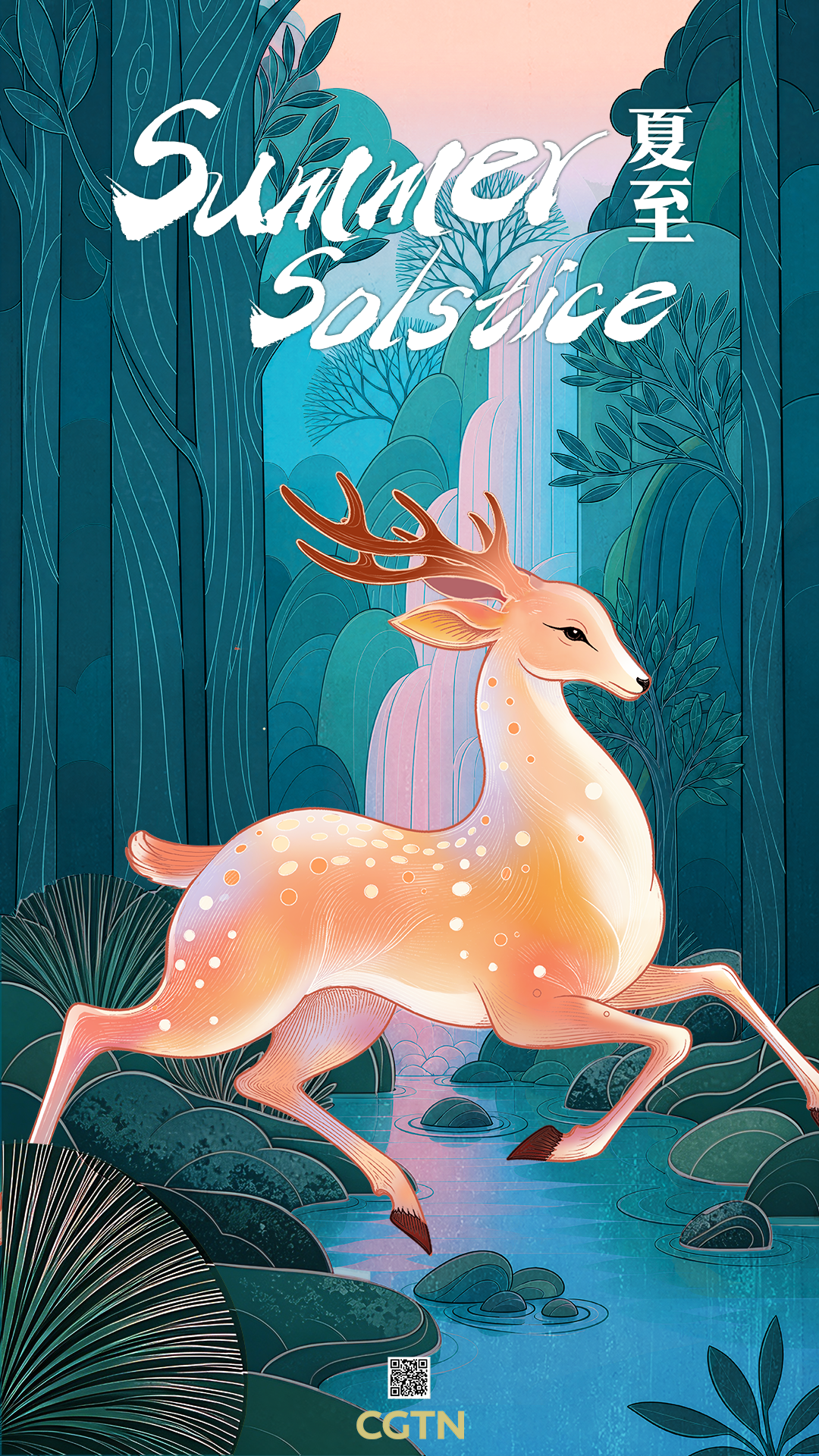
The Summer Solstice (xia zhi) falls on June 21 this year. On this day, the Northern Hemisphere experiences the longest day of the year. At this time, all things flourish and male sika deer shed their old antlers to begin a new growth cycle. Farmers in Northern China are busy with summer sowing and field management, while the South enters the plum rain season. Midsummer thus arrives, filling the world with warmth and vitality.
In the Chinese agricultural calendar, Summer Solstice lasts for the next two weeks, as the Sun makes its way across the sky’s ecliptic. Slight Heat begins on 7 July.
Solar terms are a Chinese conception of the seasons and a product of the tireless exploration of the natural sciences by Chinese people’s ancestors.
‘Summer Solstice’ is one of the most important solar terms in traditional Chinese culture and the first one to be identified as a solar term. It generally occurs on June 21st or 22nd in the Gregorian calendar.
In Northern China, at the Summer Solstice, daytime is much longer than nighttime, but in the tropical South the difference is only about 2 hours. The length of daytime reaches 15 hours in Beijing and 17 hours at higher latitudes.
The Origin of ‘Summer Solstice‘
‘Summer Solstice’ is the fourth solar term of ‘summer’, which, in its original form, was a solar term extremely relevant to astronomy. This is because it marks the time when the sun ultimately shines perpendicular to the Tropic of Cancer.
After this day, the sun seems to move toward the South, thus decreasing the daytime length in the Northern Hemisphere with each passing day.
Celebration Activities
Earth Worship Festivals
The winter solstice has the shortest daytime while the Summer Solstice has the longest, so these two solar terms were chosen by the ancient emperors as occasions to hold great festivals: the winter solstice was a time to worship Heaven and the Summer Solstice was a time to worship Earth.
The two festivals represented Chinese cognition of astronomy and geography; that is, the sky being round and the Earth being square. Therefore, the festival to worship heaven on the winter solstice was held at the Circular Mound Altar in the Temple of Heaven, and the festival to worship Earth on the Summer Solstice was held at Fangze (‘Square Pool’) Altar, which was also called Fangqiu (‘Square Mound’) Altar or the Temple of Earth.
Noodle Eating
Besides the festivals, the ancient Chinese also took a holiday on the Summer Solstice. The holiday activities differed individually, but there was a unified activity: eating noodles.
The days around the time of the Summer Solstice are when wheat becomes ripe. Therefore, making noodles out of the wheat not only came in handy for the festival, but also allowed people to taste the new wheat harvest, which was a way of killing two birds with one stone.
Summer Solstice Foods
Beijing
As the classic saying goes, the winter solstice is a time for dumplings and the Summer Solstice is a time for noodles.
For foodie Beijingers, particular attention is paid to noodles on the Summer Solstice. According to the custom upheld in old Beijing on every Summer Solstice, they fEast on lettuce and cold noodles. This is because the hot weather means it’s more palatable to eat cold foods.
During the Summer Solstice, noodle houses in Beijing win the love of the masses. No matter whether they make Sichuan cold noodles, Dandan noodles, braised pork noodles, or noodles with soybean paste, all kinds of noodles are very popular.
Wuxi
On the day of the Summer Solstice, people in Wuxi eat rice porridge in the morning and wontons at noon, representing chaos and harmony.
There is a saying that eating wontons on the Summer Solstice and gnocchi on the winter solstice invites reunions and happiness throughout the four seasons. After eating wontons, Wuxiers weigh their children, with wishes that their children have gained more weight and become healthier.
Shandong
People in Shandong usually eat cold noodles, which are commonly known as guoshuimian, literally meaning ‘through the water noodles’. Their proverb also says that the winter solstice is a time for dumplings and the Summer Solstice is a time for noodles.
In areas around Laiyang County in Eastern Shandong, new wheat crops become ready to harvest for the Summer Solstice.
In the past, in areas around Huangxian (‘Yellow County’, now named Longkou County, to the north of Laiying), people cooked the grains from the new wheat. Children in Huangxian would use wheat straw to make a delicate small hedge, and take the grains out to eat, which was also an interesting game providing great fun.
In areas around Pingyin County, in Western Shandong, people commemorate their ancestors at the Summer Solstice.
Guangdong
At the Summer Solstice, Cantonese people like to cook all kinds of soup and porridge, such as pork ribs soup and millet congee, as well as herbal tea.
References
https://news.cgtn.com/news/2026-06-21/Summer-Solstice-1O95HLiZu0M/p.html
https://www.chinahighlights.com/festivals/summer-solstice.htm
Conclusion
Talmud-Tanakh West simply cannot compare to Sinoland’s millennial civilization, going back 5,000 years. Chinese take calendar events VERY seriously, day after day, week after week, month after month. They are in harmony with the Sun, Moon and seasons. A few people, especially farmers and gardeners, still use almanacs (more so in Europe than North America). In Judeo-USA, it reached its pinnacle in the early 19th century, with Benjamin Franklin’s “Poor Richard’s Almanac”. Other than an occasional, pithy Franklin aphorism here and there, it has all atrophied in Judeo-West. In China, we live and breath it all!
Further reading
Jeff J. Brown’s many libraries and catalogues EXPANDED and they R-O-C-K with all of humanity – past, present & future! Our Pale Blue Dot’s story all on one page! Radio Sinoland 260531
Radio Sinoland’s Library on the Chinese Zodiac, Lunar, Agricultural and Civil Calendars. Want to understand the Chinese people? It all starts here! Radio Sinoland 260522
My long, slow arc of spiritual awareness from childhood Presbyterianism to Eastern Thought today. With expanded and improved, printable “Noble Attributes of Chinese Civilization” summary. Radio Sinoland 260213
A look at China’s education system versus the West. Different cultures, expectations and outcomes. China Rising Radio Sinoland 240618
China has the world’s best merit-based education system. Here’s why. China Rising Radio Sinoland 191210
Living library on Judaism. Continually updated. With image texts and video transcripts to easily copy for your use, and for translating them and this webpage in all available languages!
https://radiosinoland.com/2025/01/23/judaism/
Go Russia GO!
Go Iran GO!
Go China GO!
Go DPRK GO!
Go “RICK”! Go Asian Quad!
KICK JUDEO-TALMUD-TANAKH ASS!!!
Support, donations and contributions for my work here, any amount, one time or monthly,
A to Z support. Thank you in advance, Jeff
Checks or cash: mail to: Jeff J. Brown, 7 rue du Général de Gaulle, Équeurdreville 50120, France
Donorbox: www.donorbox.com, find China Rising Radio Sinoland
Euro bank wires: 44 Days Publishing, Bank: TransferWise, IBAN: BE70 9672 2959 5225
FundRazr: https://fundrazr.com/CRRS_2021_fundraiser?ref=ab_78aX23
Patreon: https://www.patreon.com/China_Rising_Radio_Sinoland OR https://www.patreon.com/China_Tech_News_Flash
Paypal: https://www.paypal.me/ChinaRisingRadioSino
Stripe US$/ApplePay: https://buy.stripe.com/14k8zl5tp5mVeT66op
Stripe Euros/ApplePay: https://buy.stripe.com/fZe02P8FB9DbcKY28a
US bank wires: Jeff J. Brown, Bank of Oklahoma, Routing Number/ABA: 103900036, Account: 592243855
WeChat and Alipay:

Books by Mike Palecek
“The Truth is Here”
Mike Palecek writes with passion, wit, and always
with a strong social conscience.
— Howard Zinn
 https://mikepalecek.substack.com/p/common-sense-6df
Paid Advertisement
Further study
The China Trilogy is an honorary degree in Chinese Studies. Don’t miss out!
https://www.amazon.com/stores/author/B00TX0TDDI/allbooks and
Jeff J. Brown’s libraries and catalogues A-Z: 1,000s of hours of research, writing, editing and podcasting.
https://radiosinoland.com/2025/11/30/jeff-j-browns-ever-expanding-collection-of-living-libraries-and-catalogues-many-years-and-1000s-of-hours-of-writingpodcasting-take-advantage-of-them-radio-sinoland-2025-year-of-the-wood-snake/
Do yourself, your friends, family and colleagues a favor, to make sure all of you are Sino-smart:
Google ebooks (Epub) and audiobooks:
44 Days Backpacking in China: The Middle Kingdom in the 21st Century, with the United States, Europe and the Fate of the World in Its Looking Glass https://play.google.com/store/books/details?id=YBKHEAAAQBAJ
https://play.google.com/store/audiobooks/details?id=AQAAAECCkQXRlM
China Rising: Capitalist Roads, Socialist Destinations https://play.google.com/store/books/details?id=YNmLEAAAQBAJ
https://play.google.com/store/audiobooks/details?id=AQAAAECCfHo86M
BIG Red Book on China: Chinese History, Culture and Revolution
https://play.google.com/store/books/details?id=6Wl4EAAAQBAJ
https://play.google.com/store/audiobooks/details?id=AQAAAECCfHo86M
Amazon print and ebooks (Kindle):
44 Days Backpacking in China: The Middle Kingdom in the 21st Century, with the United States, Europe and the Fate of the World in Its Looking Glass
https://www.amazon.com/gp/product/1484939999/
China Rising: Capitalist Roads, Socialist Destinations
https://www.amazon.com/China-Rising-Capitalist-Socialist-Destinations/dp/0996487042
BIG Red Book on China: Chinese History, Culture and Revolution
https://www.amazon.com/BIG-Red-Book-China/dp/1673322719/
Author page:
https://www.amazon.com/Mr.-Jeff-J.-Brown/e/B00TX0TDDI
Praise for The China Trilogy:
Why and How China works: With a Mirror to Our Own History


JEFF J. BROWN, Editor, China Rising, and Senior Editor & China Correspondent, Dispatch from Beijing, The Greanville Post
Jeff J. Brown is a geopolitical analyst, journalist, lecturer and the author of The China Trilogy. It consists of 44 Days Backpacking in China – The Middle Kingdom in the 21st Century, with the United States, Europe and the Fate of the World in Its Looking Glass (2013); Punto Press released China Rising – Capitalist Roads, Socialist Destinations (2016); and BIG Red Book on China (2020). As well, he published a textbook, Doctor WriteRead’s Treasure Trove to Great English (2015). Jeff is a Senior Editor & China Correspondent for The Greanville Post, where he keeps a column, Dispatch from Beijing and is a Global Opinion Leader at 21st Century. He also writes a column for The Saker, called the Moscow-Beijing Express. Jeff writes, interviews and podcasts on his own program, China Rising Radio Sinoland, which is also available on YouTube, Stitcher Radio, iTunes, Ivoox and RUvid. Guests have included Ramsey Clark, James Bradley, Moti Nissani, Godfree Roberts, Hiroyuki Hamada, The Saker and many others. [/su_spoiler]
Jeff can be reached at China Rising, [email protected], Facebook, Twitter, Wechat (+86-19806711824/Mr_Professor_Brown, and Line/Telegram/Whatsapp: +33-612458821.
Read it in your language • Lealo en su idioma • Lisez-le dans votre langue • Lies es in deniner Sprache • Прочитайте это на вашем языке • 用你的语言阅读
[google-translator]
Wechat group: search the phone number +8619806711824 or my ID, Mr_Professor_Brown, friend request and ask Jeff to join the China Rising Radio Sinoland Wechat group. He will add you as a member, so you can join in the ongoing discussion.
 I contribute to