TRANSLATION MENU: LOOK UPPER RIGHT BELOW THE SOCIAL MEDIA ICONS.
IT OFFERS EVERY LANGUAGE AVAILABLE AROUND THE WORLD!
ALSO, SOCIAL MEDIA AND PRINT ICONS ARE AT THE BOTTOM OF THIS POST!
Seventeen years on the streets, living and working with the people of China, Jeff

For donations, print books, ebooks and audiobooks, please see at the bottom of this post.

My comments before starting
It is really unfortunate for people outside of China, especially in the brainwashed Judeo-West, who do nothing but denigrate Mao Zedong, demonize him, call him a monster. Most of you believe Mao was a bloodthirsty, criminal, sadistic, genocidal maniac. Too bad for you. It’s your loss. One point four billion Chinese know better.
Mao was an amazing philosopher, teacher, writer, poet, artist, political-, social-, military- and cultural leader, as well as a master strategist and charismatic statesman.
To this day, he is considered a guru by millions of Chinese for their work, for their businesses, for their family lives and education. Here are a couple of examples.
The founder of Huawei, Ren Zhengfei, considers Mao to be his mentor. No wonder Huawei is kicking Talmud-Tanakh ass across the planet. Pony Ma, CEO of Tencent, which has WeChat and is the biggest video game company in the world, also considers Mao Zedong to be a guru for him. There are countless other CEOs, managers, shopkeepers, businesspeople, families and employees who feel the same way.
Hard to believe? Here is a quote about young Mao Zedong I found on the Chinese web (translated),
“Striving upward” was Mao Zedong’s lifelong character and pursuit. In a letter to Li Jinxi in August 1917, he quoted Liang Qichao’s words, “Today’s me challenges yesterday’s me.” Before establishing the New People’s Society in 1918, he discussed with the founding members over a hundred times for more than half a year, focusing on “how to improve the lives of individuals and all mankind.” The final decision was to establish the New People’s Society, to be a new citizen, to improve oneself daily, and to continuously improve oneself.
In 1917, Mao was only 24 years old. Still today, his visionary outlook beats the hell out of most Judeo-Western, self-help/self-improvement gurus!
In the article below about Mao’s philosophy on research and investigation, this is a page right from the great Chinese philosophers, like Confucius, Mengzi, Han Feizi and many others, where accountability and consequences stand for everything.
This short piece is full of great quotes by the Great Helmsman.
Mao’s approach was very famous in meetings. If someone wanted to speak up, he would say, have you studied this topic? Have you researched this topic? Have you investigated this topic? If they said no, then he would say, you have no right to talk, because you don’t know what you’re saying and you have nothing valuable to offer us. However, if you have done your investigation and your research and understand the topic, we would love to hear from you.
This is the kind of accountability and meritocracy under which the Chinese function. This common sense approach to credibilty and trust goes back thousands of years.
I have a couple of links below this article about Mao’s life and work. You really should take a look at Mao Zedong for Dummies Library. It’s the most complete collection on the Internet about 20th century’s greatest leader.
As I always say, never has one person done so much good for so many people in such a short period of time!
Article (translated from the Chinese)
This article, in which Mao Zedong said, “I can’t find it, it’s like losing a child.”
“Without investigation, there is no right to speak.”
“Investigation is like ‘ten months of pregnancy,’ solving problems is like ‘childbirth,’ investigation is solving problems.”
“The victory of the Chinese revolutionary struggle depends on Chinese comrades understanding the Chinese situation.”
…
These well-known classic quotes come from Mao Zedong’s early work on the Chinese revolution, “Opposing Book Worship.” This was an important work he wrote during the Land Revolution War to oppose dogmatism within the Red Army at the time.
This article was originally titled “Investigation Work,” not “Opposing Book Worship,” and was lost for 30 years due to the war. Its experience of being lost and then rediscovered, and its enduring philosophical insights, are worth reflecting upon.
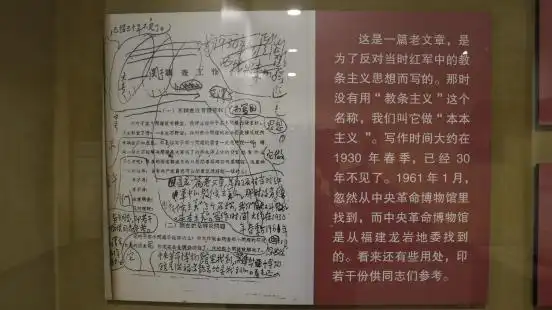 The image shows a photograph of the manuscript of “The Investigation Work,” provided by the Publicity Department of the Xunwu County Committee.
In January 1929, Comrades Mao Zedong and Zhu De led the Fourth Red Army down from Jinggang Mountain, subsequently establishing the revolutionary base areas in southern Jiangxi and western Fujian. With the expansion of the revolutionary base areas, dogmatic thinking resurfaced regarding issues such as the treatment of rich peasants and commerce. At this time, Comrade Mao Zedong hoped to find a city of typical significance for analysis.
In May 1930, Comrade Mao Zedong led the Fourth Red Army to Xunwu County. There, taking advantage of the Red Army’s mobilization of the masses, he held more than ten days of symposiums, conducting a comprehensive investigation into Xunwu County’s geography, transportation, economy, politics, and the history and current situation of various classes. The results of this investigation were compiled into “The Xunwu Investigation.” This investigation report, comprising 5 chapters, 39 sections, and over 80,000 words, provided practical basis for formulating correct policies for dealing with the urban poor and the commercial bourgeoisie, and for determining the principle of “redistributing wealth to the poor” in land distribution to limit the rich peasants.
In the same month that he conducted his investigation in Xunwu, Comrade Mao Zedong, from a philosophical perspective, summarized some of the experiences he had gained during his long-term investigation and research, and wrote the article “Investigation Work.” After its publication, a small number of copies were printed within the Party and circulated widely within the Fourth Red Army and the Central Soviet Area. Comrade Mao Zedong highly valued his research findings and carried “Investigation Work” and other materials with him during his campaigns across the country. Unfortunately, the article was lost during the campaigns, a loss he never forgot.
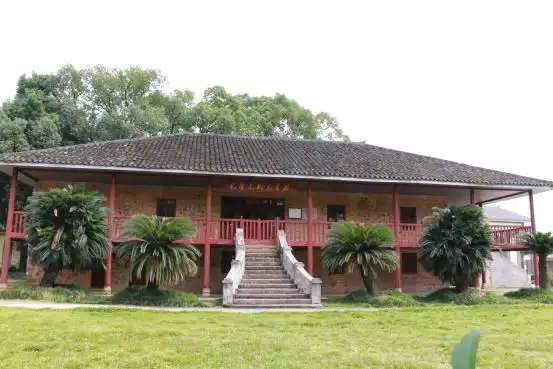 Above: Comrade Mao Zedong’s former residence in Xunwu. Photo provided by the Xunwu County Publicity Department.]
Fortunately, during the White Terror (conducted by fascist Chiang Kai-Shek and his Guomingdang against the Communists) era, a farmer named Lai Maoji from Shanghang County, Fujian Province, risked his life to hide this booklet, thus recovering this important work.
Lai Maoji’s home had been an underground arsenal for the Red Army. After the Long March, Lai Maoji accidentally discovered a lithographed copy of “Investigation Work” reprinted by the CPC Western Fujian Special Committee on August 21, 1930. At that time, Shanghang County had fallen under Guomindang control. To evade enemy searches, Lai Maoji wrapped the booklet “Investigation Work” and some documents issued by the Party organization and the Soviet government in oiled paper, placed them in a small wooden box, and hid the box inside a hole he drilled in the wall of his bedroom before sealing the hole. Later, the Guomindang conducted a thorough search of Lai Maoji’s home, but thanks to its clever concealment, the booklet survived.
In January 1961, after many twists and turns, Mao Zedong’s secretary, Tian Jiaying, discovered the booklet. When Mao Zedong saw the yellowed pages of “Investigation Work” again, he was overwhelmed with emotion and joy, subsequently mentioning the article on many occasions. He once said, “I don’t like some of my own articles, but I like this one”; “I used to search everywhere for it, but couldn’t find it, like losing a child”; “When other articles are lost, I’m not sad, and I don’t remember them,” but I always remembered this one, and when it was suddenly found, “I was happy.”
Comrade Mao Zedong left behind a vast body of writings. Why did he particularly favor this short article?
This article was written in response to the erroneous tendency to sanctify the resolutions of the Communist International and the Soviet experience. Its core message is that Marxism must be combined with the actual conditions in China. The article begins by raising the important proposition, “No investigation, no right to speak,” criticizing those within the Party who always resort to “reading from the books” when discussing issues. In his article, Comrade Mao Zedong drew an important conclusion: “We should study the ‘books’ of Marxism, but they must be combined with the actual conditions of our country.”
On March 11, 1961, Comrade Mao Zedong requested that “On Investigation Work” be printed and distributed to comrades attending the Sannan Conference in Guangzhou. He also personally added a note: “This is an old article, written to oppose dogmatism in the Red Army at that time. We didn’t use the term ‘dogmatism’ then; we called it ‘bookishness.’ It was written around the spring of 1930, and hadn’t been seen for thirty years. In January 1961, it was suddenly found in the Central Revolutionary Museum. The Central Revolutionary Museum had found it from the Longyan Prefectural Committee in Fujian. It seems it still has some use; print several copies for comrades’ reference.” Before printing, Comrade Mao Zedong changed the title to “On Investigation Work” and made minor textual revisions.
In March 1961, at the Central Work Conference in Guangzhou, Comrade Mao Zedong, drawing on Party history, his own research experience, and practical work, personally explained the article “On Investigation Work” to the attendees in detail, section by section, and put forward many important viewpoints:
“We must still conduct investigation and research work even after ten thousand years”;
“Documents issued by the Central Committee cannot be implemented without concrete measures. To have correct measures, we must conduct investigation and research work”;
“Whenever we are worried and have no solution, we should conduct investigation and research. Once we conduct investigation and research, the solution will emerge, and the problem will be solved.”
As time went by, the significance of the article “On Investigation Work” became increasingly recognized. In 1964, the article was included in “Selected Readings from Mao Zedong’s Works” (Volume A) and published for the first time. When reviewing the manuscript, Comrade Mao Zedong renamed it “Opposing Book Worship.”
Epilogue
China Writer Godfree Roberts passed away last week in Chiang Mai, Thailand, age 86. RIP to a great friend. Here is a comment he made on social media to an Indian making erroneous comments about Mao,
Your knowledge of India is impressive, but your knowledge of China is straight from Fox News.
• Mao Zedong didn’t kill anyone, he forbade killing and was the least vindictive leader in world history.
• He launched the Great Leap Forward, but a disastrous 3-year El Nino reduced per capital cereal harvests to India’s levels—and India reported no general famine in those years. Nobody starved to death because superb logistics ensured everyone had something to eat every day.
• The Cultural Revolution achieved all of its goals, and taught 400 million illiterate peasants to read, write, vote and care for their health.
Through all this, and despite American invasions and embargoes, Mao grew GDP by 6.5% per year and left the country’s infrastructure completely restored and debt-free.
References
Source: Qiushi Magazine
Editor: Chen Yihao, Tang Junzhong
Further reading
The Mao Encyclopedia for Dummies. Updated and it’s all here: books, articles, movies, visuals. China Rising Radio Sinoland 240103
Ren Zhengfei, founder of Huawei says, “My mentor is Chairman Mao Zedong”. I’m not surprised. Are you? China Rising Radio Sinoland 200515
Noble Attributes of Chinese Civilization – A Radio Sinoland Cultural Cheat Sheet. Download two-page PDF to earn your Chinese Studies Degree! By: Jeff J. Brown.
Samui Real invited Jeff J. Brown to give his presentation on China’s great philosophers. Part I of II, with critical Q&A afterwards. Must see to understand the Chinese people! Radio Sinoland 260705
###
Support, donations and contributions for my work here, any amount, one time or monthly,
A to Z support. Thank you in advance, Jeff
Checks or cash: mail to: Jeff J. Brown, 7 rue du Général de Gaulle, Équeurdreville 50120, France
Donorbox: www.donorbox.com, find China Rising Radio Sinoland
Euro bank wires: 44 Days Publishing, Bank: TransferWise, IBAN: BE70 9672 2959 5225
FundRazr: https://fundrazr.com/CRRS_2021_fundraiser?ref=ab_78aX23
Patreon: https://www.patreon.com/China_Rising_Radio_Sinoland OR https://www.patreon.com/China_Tech_News_Flash
Paypal: https://www.paypal.me/ChinaRisingRadioSino
Stripe US$/ApplePay: https://buy.stripe.com/14k8zl5tp5mVeT66op
Stripe Euros/ApplePay: https://buy.stripe.com/fZe02P8FB9DbcKY28a
US bank wires: Jeff J. Brown, Bank of Oklahoma, Routing Number/ABA: 103900036, Account: 309163695
WeChat and Alipay:

Do yourself, your friends, family and colleagues a favor, to make sure all of you are Sino-smart:
Google ebooks (Epub) and audiobooks:
44 Days Backpacking in China: The Middle Kingdom in the 21st Century, with the United States, Europe and the Fate of the World in Its Looking Glass https://play.google.com/store/books/details?id=YBKHEAAAQBAJ
https://play.google.com/store/audiobooks/details?id=AQAAAECCkQXRlM
China Rising: Capitalist Roads, Socialist Destinations https://play.google.com/store/books/details?id=YNmLEAAAQBAJ
https://play.google.com/store/audiobooks/details?id=AQAAAECCfHo86M
BIG Red Book on China: Chinese History, Culture and Revolution
https://play.google.com/store/books/details?id=6Wl4EAAAQBAJ
https://play.google.com/store/audiobooks/details?id=AQAAAECCfHo86M
Amazon print and ebooks (Kindle):
44 Days Backpacking in China: The Middle Kingdom in the 21st Century, with the United States, Europe and the Fate of the World in Its Looking Glass
https://www.amazon.com/gp/product/1484939999/
China Rising: Capitalist Roads, Socialist Destinations
https://www.amazon.com/China-Rising-Capitalist-Socialist-Destinations/dp/0996487042
BIG Red Book on China: Chinese History, Culture and Revolution
https://www.amazon.com/BIG-Red-Book-China/dp/1673322719/
Author page:
https://www.amazon.com/Mr.-Jeff-J.-Brown/e/B00TX0TDDI
Praise for The China Trilogy:
Jeff J. Brown’s libraries and catalogues A-Z: 1,000s of hours of research, writing, editing and podcasting.
Why and How China works: With a Mirror to Our Own History


JEFF J. BROWN, Editor, China Rising, and Senior Editor & China Correspondent, Dispatch from Beijing, The Greanville Post
Jeff J. Brown is a geopolitical analyst, journalist, lecturer and the author of The China Trilogy. It consists of 44 Days Backpacking in China – The Middle Kingdom in the 21st Century, with the United States, Europe and the Fate of the World in Its Looking Glass (2013); Punto Press released China Rising – Capitalist Roads, Socialist Destinations (2016); and BIG Red Book on China (2020). As well, he published a textbook, Doctor WriteRead’s Treasure Trove to Great English (2015). Jeff is a Senior Editor & China Correspondent for The Greanville Post, where he keeps a column, Dispatch from Beijing and is a Global Opinion Leader at 21st Century. He also writes a column for The Saker, called the Moscow-Beijing Express. Jeff writes, interviews and podcasts on his own program, China Rising Radio Sinoland, which is also available on YouTube, Stitcher Radio, iTunes, Ivoox and RUvid. Guests have included Ramsey Clark, James Bradley, Moti Nissani, Godfree Roberts, Hiroyuki Hamada, The Saker and many others. [/su_spoiler]
Jeff can be reached at China Rising, [email protected], Facebook, Twitter, Wechat (+86-19806711824/Mr_Professor_Brown, and Line/Telegram/Whatsapp: +33-612458821.
Read it in your language • Lealo en su idioma • Lisez-le dans votre langue • Lies es in deniner Sprache • Прочитайте это на вашем языке • 用你的语言阅读
[google-translator]
Wechat group: search the phone number +8619806711824 or my ID, Mr_Professor_Brown, friend request and ask Jeff to join the China Rising Radio Sinoland Wechat group. He will add you as a member, so you can join in the ongoing discussion.
 I contribute to