TRANSLATION MENU: LOOK UPPER RIGHT BELOW THE SOCIAL MEDIA ICONS.
IT OFFERS EVERY LANGUAGE AVAILABLE AROUND THE WORLD!
ALSO, SOCIAL MEDIA AND PRINT ICONS ARE AT THE BOTTOM OF THIS POST!
Seventeen years on the streets, living and working with the people of China, Jeff
For donations, print books, ebooks and audiobooks, please see at the bottom of this post

Note before starting,
Samui is an excellent, thoughtful gathering of people from around the world, working towards win-win solutions and mutual respect among humanity. It’s free. I’m a member. I hope you will join,
Video show (original on YouTube is in References below)
Samui Real visual presentation Part 1
Presentation transcript with Q&A
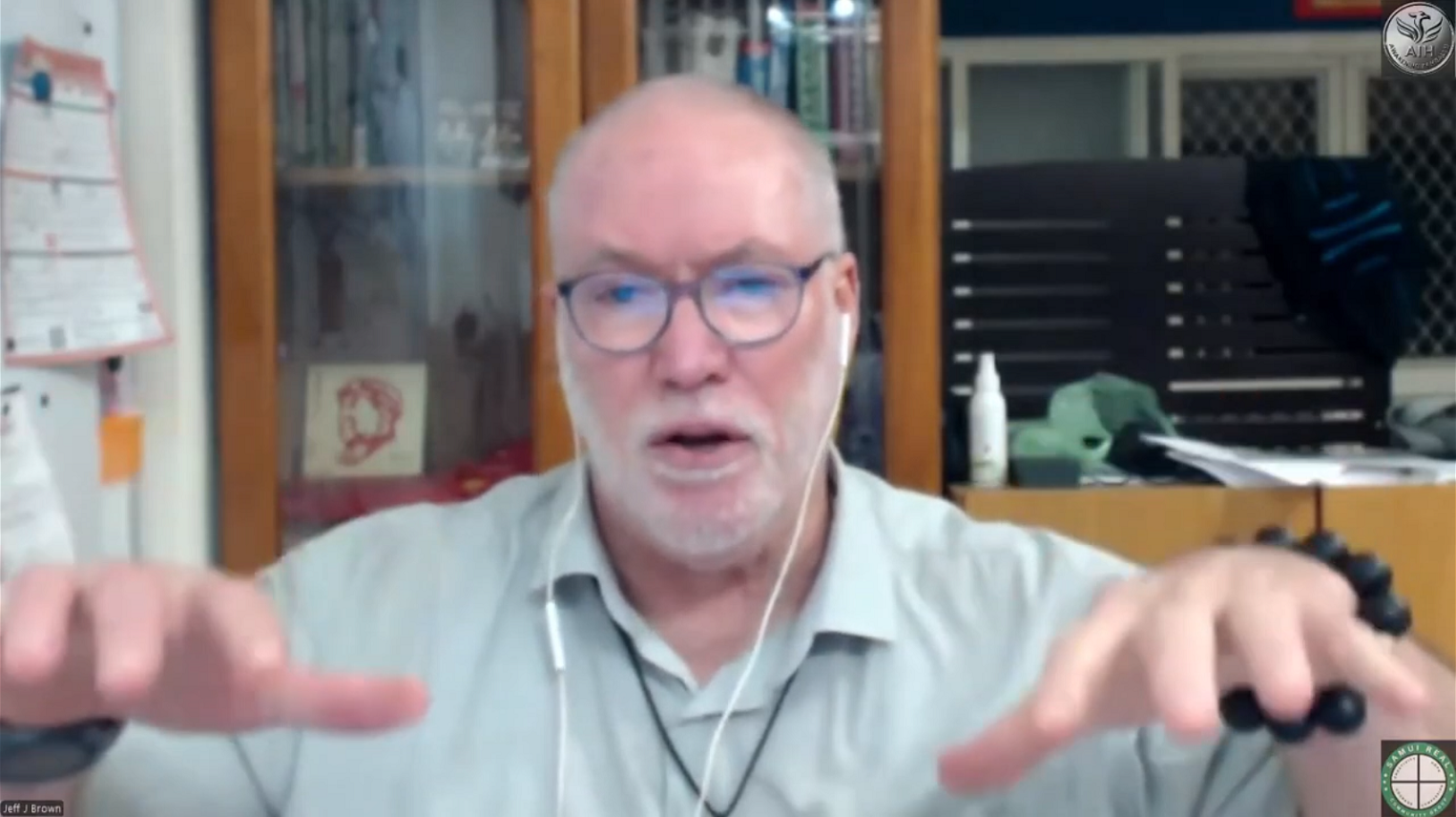
Pat Kell: Welcome to session 249. Thank you. I wasn’t sure if I had the number right — just stabbing in the dark there. So for those of you who are new in the bunker, we’ve done 249 sessions in the bunker, and we started in 2021, so we’ve been doing this for quite a long time now — about five, six years. We’ve got Frans Vandenbosch, so we have a friend in the Netherlands, another expert on China.
Today, same format: Jeff will do a presentation, I’ll introduce him in a minute, and it will be 45 minutes, followed by a Q&A session where you’re free to ask questions. Before we start, I just want to say thank you to Dennis O’Connor and Awakening in Health, because Dennis will videotape everything, record the audio, and then edit and put out a video later for all of us to view, and we’ll send a copy to Jeff.
So let me introduce our speaker tonight. Our guest speaker, Jeff J. Brown, wrote the China Trilogy and is the creator of Radio Sinoland, which Cloudflare certifies as receiving over 50 million visitors a year. Sinoland is noteworthy for its large collection of libraries covering a wide spectrum of topics. He’s the co-founder and curator of the Bioweapon Truth Commission, the founder of the Seek Truth from Facts Foundation, and creator of the China Writers’ Group. Jeff lived in Mainland China for over 17 years, and he’s currently based in Taiwan Province. He’ll be moving to Kunming, Yunnan, in September of this year. Jeff.
Jeff J. Brown: Yes, sir.
Pat Kell: Okay, so Kunming, Yunnan — that borders Tibet and Myanmar, is that correct?
Jeff J. Brown: Yeah, it’s right next to Tibet, and Myanmar — well, actually Vietnam and Myanmar.
Pat Kell: Okay, great. So without further ado, a big hand please for Jeff J. Brown. Today’s topic is Noble Attributes of Chinese Civilization: 15 Great Philosophers Who Bettered Humanity. But I don’t think we’re going to get through the whole lot today, so think of it as part one. Thank you, Jeff.
Jeff J. Brown: Thank you, Pat, and thank you, Dennis, for inviting me. Hello, everybody, thank you for being here tonight. I am honored and humbled that you have taken time out of your busy schedules to hear what I have to say. I hope everybody got a copy of the presentation outline and has something to write with if you’d like to take notes.
The title of the program, as Pat said, is Noble Attributes of Chinese Civilization: 15 Great Philosophers Who Better Humanity. Notice that it is in the present tense, not past, because they still do. I call it a cultural cheat sheet. Instead of having to read volumes and volumes of books, I have basically summarized 5,000 years of Chinese and Eastern thought into just a few pages. I also include Mandarin and Pinyin for language learners.
Tonight we have time to cover the first ten wise men. When Pat has an opening, I look forward to presenting part two, with numbers 11 through 15, plus three foundational Sino-sociocultural systems. Tonight I include the references and a cross-cultural East-West timeline of philosophy, which are crucial. So let’s get started.
The first great philosopher I want to talk about tonight is Zhou Gong. If you have the notes from the photocopy, that’s what’s below — you should already have that, so I’ll just show the picture and the philosopher’s name.
The reason Zhou Gong is so important is that he was a wise king who laid the sociopolitical foundations for people’s democracy, Confucianism, and Chinese thought. You’re probably scoffing when I say “people’s democracy,” but it really is true, as you will see.
Zhou’s motto is: no more divine leaders who conduct human sacrifices. Before the Zhou Dynasty — during the Shang Dynasty and before that, the Xia Dynasty — the kings of Chinese states often conducted human sacrifices to the gods because they claimed divine representation. In other words, they were gods on earth, the same concept found in much of monarchical Western history. The Shang Dynasty lasted 750 years, the longest-running dynasty ever — not a bad run. Nevertheless, it collapsed, and the Zhous took over in 1,000 BC, a thousand years before Christ.
So the Zhou had a problem: how could they say that the Shang rulers were gods, yet they failed? Who backs them up now? Zhou Gong, the son of the king who founded the Zhou Dynasty, decided that the heavenly mandate would forevermore be based on the citizens’ consent — that is, people’s democracy. What this means is that if the king, emperor, duke, governor, mayor, or village leader does not perform, the people have the right to demand a change in leadership. Since then, there’s even an expression in Chinese meaning “raise poles and start a rebellion,” or “grab a bamboo spear and storm the palace.” This has happened countless thousands of times at the national, regional, state, provincial, county, city, and village levels going back 3,000 years.
Therefore, when you hear people talk about China’s heavenly mandate, the first thing you need to understand is that it has nothing to do with God as in the monotheistic religions, with their angry, Jewish, jealous, vindictive, violent God forcing his severe will on humanity. No — it’s the people’s mandate. As much as hubristic Western people don’t want to admit it, the Chinese have had real people’s democracy for 3,000 years, while the West, other than a few blips of direct ancient Greek democracy, has had little or none of it, or it has been rendered symbolic and useless.
Zhou Gong was all about the foundations of social harmony and virtue. Again, words have been twisted in English. “Virtue” in the Chinese sense is not the kind we talk about in the West, like a woman’s virtue when she says “get your hands off my thigh, I’m virtuous.” It’s also been reduced to “the virtues of eating vegetables” and “the virtues of getting exercise.” Virtue in Chinese is all about exemplary conduct and noble behavior in the way you treat others ethically — living the golden rule, in Chinese and in the Chinese negative form, which I will explain in part two. To this day, ritual is extremely important in Chinese culture and is still a big part of exemplary conduct. Just look at Communist Party of China meetings, and visit Chinese temples, to see what I mean.
Zhou Gong was very focused on family conduct, obligations, and respect — usually called filial piety in other languages. Piety in the West has become religious, yet filial piety really has nothing to do with religion. It has to do with those three words: family, conduct, obligations, and respect. It starts with ancestors, grandparents, then parents, down to children, brothers, sisters, aunts, uncles, cousins, nephews, nieces, and grandchildren. They are all held accountable within the Chinese family hierarchy, and there is little to no distinction between parents and aunts and uncles, or between siblings, nieces, nephews, and cousins. Nor is it about being slavishly obedient to family members above you in the hierarchy. We will get to remonstrance in part two, which is absolutely a cornerstone of Chinese civilization. It obviously worked, because the Zhou survived for 750 years.
Zhou’s core values were: revere virtue to protect the people — again, virtue meaning exemplary conduct; illuminate virtue, meaning promote noble conduct; and lastly, apply punishment cautiously. I also offer Generation Z versions for young people. For Zhou Gong, it’s “people power — citizens come first and last.” I also added a barometer for how each philosopher views humanity, based on the glass-half-empty, glass-half-full metaphor. For Zhou Gong, it is almost full.
Number two is Laozi — what a guy. Laozi’s name is really interesting because it has two meanings: “old master” and “old child.” The latter meaning that this great wise man was looking at the world around him with infinite fascination and spontaneity, just like a child.
I did not really appreciate the importance of Laozi until recently. I knew something about him, had read the Dao and other books, but I did not gain a fuller understanding of his importance until we moved here to Taiwan Island almost two years ago — a short correction, I lived in mainland China for 17 years, and my wife and I have lived in Taiwan for almost two years. That’s because Taiwan is the most Daoist place on earth. If Thailand is the most Buddhist, and North Korea is the most Confucian, then Taiwan Province is super-Dao.
Laozi gave us Daoism, the Way of the Dao. The Dao is really expansive — it covers duality, yin and yang, the I-Ching (which involves prognostication), mysticism, and the pantheon of Eastern gods and goddesses. His motto is: constant non-being and constant being; non-action and action; retreat and advance. These dualities go on and on — yin and yang, light and dark, man and woman.
Laozi’s core values are: humanity follows earth, earth follows heaven, heaven follows the Dao, and the Dao follows nature. Heaven, in Chinese thought, refers to former kings, rulers, and one’s ancestors. Heaven is to worship the people who came before us, to venerate and honor them. This is why ancestral worship is so important and widespread across Sino-influenced lands.
The Dao is “the way.” What is the Dao? It depends on who you ask. Laozi and the Dao are so profound that the explanations are manifold — that’s why thousands of books have been written about them, because they are so deep and complex. Your definition of the Dao may be different from mine, but it’s the way — the way to conduct oneself, to understand life, the universe, and one’s existence on earth. The Dao follows nature. What is nature? It could be the cosmos, living life, daily life, family life, your inner thoughts. There are endless interpretations of nature in the Dao.
I’ll dwell on this a bit longer, because Laozi is so important and there are so many Daoist enigmas. Here’s one of them, written on the bamboo scroll in his picture: “The Dao that can be spoken is not the eternal Dao. The name that can be named is not the eternal name.” What this means, at least in my interpretation — and you may come up with something different — is that if you talk and don’t use your six senses, if you try to describe life instead of shutting your mouth and just absorbing and feeling what surrounds you, then you’re going to miss it. Words and definitions just get in the way.
The Dao transcends human language. That’s why Laozi is saying that in conceptual understanding — that sixth sense — you have to back off. It’s duality: you just stop, sit there, and appreciate your existence, because if you don’t, you will lose its true infinite nature.
Daoism is extremely complex and deep, to say the least. Laozi’s Generation Z version is “Zen, baby — Zen, live and let live, que sera sera.” His level of optimism: “It’s all good.” Even though this guy lived 2,500 years ago, Laozi and the Dao are the flywheel that keeps Chinese spirituality humming, whether it’s Confucianism, Buddhism, or Mao Zedong Thought. When we’re traveling around China, we go into small, out-of-the-way restaurants, and there are paintings and statues of Laozi, Confucius, Buddha, and Mao. Below are five paintings of Laozi, all seen in no-name restaurants — big paintings, a meter or so square.
According to Sima Qian’s Records of the Grand Historian — not Sima Guang, another great historian I’ll introduce in part two — Confucius visited Laozi to ask about ritual and propriety, known as “li.” After their encounter, Confucius reportedly told his students: “Birds, I know, can fly. Fish, I know, can swim. Beasts, I know, can run. But as for dragons, I cannot tell how they ride on the wind and clouds and ascend to heaven. Today I have seen Laozi — is he not like a dragon?” That’s how important Laozi is.
Daoism is the skeleton supporting and giving structure to Eastern thought. The celebrated meeting of Laozi and Confucius is a symbolic, dialectical foundation — the duality of Chinese thought, the complementary tension between Daoist freedom and spontaneity and Confucian structure and order. This duality has literally shaped East Asia for the last 2,500 years.
There’s a great story about Laozi: after he met Confucius, he got on a green ox, took off to the west, disappeared, and was never heard from again — but believe it or not, it’s true. This painting shows him leaving. There are two versions: one, that as he was leaving, the border guard asked him to record his wisdom; the other, likely more accurate, is that Laozi asked a student to transcribe his work for him. There is some speculation that Laozi may have been illiterate, but when you have the cosmic spirituality and power of thought that Laozi had, he could be forgiven. Was Jesus literate? Muhammad wasn’t. And look what they did for humanity.
The Way of the Dao is only 5,000 words — think about that for a minute. It’s only about 15 typewritten pages, roughly the length of my oral presentation tonight, like a high school final exam essay. It’s not that long, yet those 5,000 words have literally changed the world for the better — much better. It’s just unbelievable.
Again, these paintings are from different local restaurants. Go around China and you see, over and over, Laozi, Confucius, Buddha, and Mao Zedong. Here is one titled “Laozi Riding a Green Ox” — the Chinese character actually means blue-green, not just green, for the ox. Laozi is carrying bamboo scrolls, which served as books back then. So Laozi is a big deal, and the Dao is a big deal.
Here is a photo that my wife Evelyn and I took — you can see yin and yang on top of this temple roof. This temple is only a 25-minute walk from where we live; we visit and hike around it a lot. If you see yin and yang in a temple, you know it’s Daoist or has Daoist influence. The four characters at the bottom say “Mother of the Universe” — because “Dimu” means “Earth Mother,” and this is a Daoist temple dedicated to her.
If you’re really interested in Eastern thought, I have an entire collection of about 50 books in PDF form, listed in the references at the end, available for free. Laozi is a great place to start, and a good book to download is an annotated version where a scholar discusses what Laozi meant in each passage, because otherwise it is so elliptical, deep, and mystical that it’s hard to fathom. Each scholar has their own interpretation, so reading more than one is useful.
Probably the best known to all of you is Confucius. Why he matters: he gave us Confucianism. Of course, Confucius didn’t invent this out of nothing — he was hugely influenced by Zhou Gong, number one, the wise king. There was obviously a great legacy that came before Confucius; Zhou Gong was a philosophical mentor for him.
Confucius’s motto is: cultivate humanity, uphold fairness, practice etiquette, be resourceful, and keep the faith. He is famous for his Five Constants. The first is benevolence — again, not quite the right word, but that’s the common translation; it’s really more than that. This Chinese character connects with Zhou Gong’s virtue — that exemplary conduct, noble behavior, how one interacts with others ethically. Next is righteousness, or justice, which is self-explanatory. The third character, “li,” gets pigeonholed in other languages as “propriety,” but it’s much more — it’s etiquette, manners, rituals, being polite, being humble, listening actively, and asking humble questions to learn more. This character means so much in Chinese thought. At the end of part two, I list eight key Chinese characters you need to know to understand Eastern thought, and I break them down and explain why they’re so important — “li” is one of them.
Next comes wisdom and knowledge, and then trustworthiness — I double-underline trustworthiness, meaning trust, honor, and faith, because in part two we’re going to talk about remonstrance, which is such a foundational cornerstone in Chinese thought. You will never understand the Chinese people without a firm grasp of remonstrance.
Confucius’s Generation Z version is “family, friends, fraternity, and unity.” His level of optimism: the glass is overflowing. Confucius was a sunshine-pumper — humanity is innately good, he believed. Later on, we’ll see other Chinese philosophers who say that’s not true, that humanity can be evil.
Here we see a painting from another small restaurant, showing Confucius on the right and Laozi on the left, at their meeting. The text at the top is another one of Laozi’s unfathomable quotes: “Laozi spoke of the Dao: the highest good is like water, which benefits all things without striving. It dwells in places that others disdain — thus it is close to the Dao. It resides in good places, it’s like a deep pool, it is benevolent in its interactions, trustworthy in its words, effective in its governance, skillful in its actions, and timely in its movements. Because it does not strive, it is without fault.” Chew on that for a while — again, the duality of good places and bad places, staying in place and moving, without striving. That quote is actually from the Way of the Dao, Chapter Eight. Notice the words: benefit, benevolent, trustworthy, governance — these appear again and again in foundational Eastern thought, from Zhou Gong all the way to Mao Zedong.
Here’s another painting of Confucius meeting Laozi and paying his respects to the wise sage. There’s a story that when Laozi met Confucius, Laozi upbraided him for his impertinence and arrogance. This image again shows the beautiful merging of the two most important foundations of Chinese thought, along with Buddha, coming up next.
Number four is Sunzi — a lot of people know about him, the famous man who wrote The Art of War. Why he matters: he may be history’s greatest strategist. He’s very Daoist in his philosophy — action and inaction, advance and retreat, appear and disappear, show strength then show weakness. The most respected military leaders in China — although there have been great generals who won hundreds of battles — the most respected and revered are the ones who never have to draw their sword; they outfox the enemy.
Sunzi’s famous saying is: “Know yourself, know your enemy, and you will never be defeated in a hundred battles.” As we see with what’s going on in the West — with NATO and Iran, and NATO and Europe versus Russia — they don’t know themselves and they don’t know their enemies, and they’re getting their clocks cleaned.
His Generation Z version is: “When in doubt, retreat” — very Daoist. His level of optimism: “It all depends on you — if you know yourself and know your enemy.” We can see with certain Western leadership today that the level of optimism there is delusional. Also note: the Thirty-Six Stratagems of War were not written until the fifth century AD, so don’t confuse them with The Art of War — it’s not the same thing.
Number five is actually a trio — three handsome guys. They are three of Confucius’s favorite students, out of an estimated 3,500 he actually taught: Zigong, Yan Hui, and Zilu. Hui was his favorite, and he died young, which had a huge impact on Confucius. Why they matter: they were Confucius’s three favorite students, and their motto is “ethics trump morals.” In other words, the sum of ethics in Chinese thought comes down to one ideal: the golden rule in its negative form — don’t do unto others what you don’t want done to yourself. The problem with morals is that they are conflictual: my religion is better than your religion, my God is better than your God, my rules are better than your rules, my customs are better than your customs. The Chinese don’t have any of that — it’s all based on the ethics of the golden rule in the negative.
Their core values are gentleness, kindness, respect, frugality, and humility — I double-underline humility, since we’re going to talk about remonstrance in part two. Their Generation Z version is “cool, calm, collected, in shellac.” And, like their mentor Confucius, the glass is overflowing.
Number six is someone I’m sure you all recognize: Buddha. I’m sure many of you, having spent time in Thailand, the most Buddhist of countries, know something about one of history’s greatest teachers. Disclosure: I am a lay Buddhist — meaning I study Buddhism seriously, but if you try to pry a Taiwanese pork chop and a glass of French Cabernet Sauvignon out of my cold, dead hands, you will die trying.
I’ll tell you a quick story: you can see the lotus flower cut off in this image. I asked AI to add names to these visuals — which I should have done myself, because it turned out to be a time-consuming nightmare. With all the other philosophers, AI had no problem putting their names above the person pictured. But Buddha has so much power that the AI moved him over to the right so his name wouldn’t be on top of him — and I lost the lotus flower in the process. That’s how much clout Buddha has.
Buddha gave us Buddhism. Why does he matter? While not explicitly declared Buddhist, I estimate there are at least two billion kindred souls in East and Southeast Asia who acknowledge his teachings. They may not believe in reincarnation, but they fully embrace Buddhist teachings of harmony, balance, and peace. There is not a Communist Party of China member who would say anything negative about Buddha and his ideals. This includes practicing the ten good deeds and avoiding the ten negative actions.
Buddha’s three hindrances to avoid — his core concerns — are: one, desire, which includes lust, envy, and greed; two, anger, which includes arrogance, revenge, and spite; and three, ignorance. Ignorance is not just being stupid or inattentive — it’s not understanding what’s going on around you, not being aware, denial of reality, and, of course, being brainwashed. When you think about it, this is a great recipe for living a contented life.
Buddha’s Generation Z version is “rest, relaxation, respite, and repose.” His level of optimism: “Life is full of suffering, and it’s all up to you how to cope with it.”
Number seven is Mozi. This is really interesting — Mozi lived around the end of the Warring States period, into the beginning of the Spring and Autumn period, both nonstop periods of interstate wars and fighting. Mozi and his followers were actually inventors, engineers, and scientists. He matters because he gave us Mohism. He was sort of a competitor to Confucius, expounding on ethics, logic, the idea of science, the scientific method, and rational thought and technology used to benefit the people. He actually created things to help people in their daily lives, and also to defend themselves.
After roughly 300 years of interstate wars during the Warring States period, with different states vying for supremacy, Mozi invented things to help people defend their villages or states when attacked. Yet in terms of interpersonal relations among humanity, his followers were idealists. Their motto is: universal love, condemn aggression, frugality, and heaven’s will — echoing Zhou Gong’s frugality and Laozi’s reverence for ancestors and past rulers. Mozi’s followers were deeply spiritual but also very grounded in science. You can see Mozi holding building plans and construction designs, and an ancient carpenter’s square.
Their core values were impartiality for all and mutual benefit for one another. That last part — mutually benefiting one another — is simply Xi Jinping’s idea of win-win cooperation; impartiality is Xi Jinping’s principle that even the smallest countries have as much consideration and rights as big powers. The one thing I’ve learned over the years is that from Mao to Xi, all Chinese leaders, from presidents down to town mayors, are drawing on everything I’m presenting to you tonight — they simply update it with socialism and communism. Mao was the Mao of the 20th century, and Xi is the Mao of the 21st century. Xi Jinping essentially repeats everything Mao said, simply updated for the present era.
I did a takedown of Evan Osnos at The New Yorker — the references are below — over a Time magazine cover that portrayed Chinese President Xi Jinping as Mao Zedong, apparently intending it as mockery. The joke is on Evan Osnos and the rest of the West, because that was the plan all along: Xi Jinping was meant to be China’s 21st-century Great Helmsman.
Mozi’s Generation Z version is “seek truth from facts, and holistic knowledge trumps superstition.” His level of optimism: the glass is almost full.
Number eight is a good one: Shang Yang. His given name literally means “leather horse collar” — can you believe that? His toughness and hard work were, one might say, predestined. The symbol on his chest and in the lower right corner is “fa,” meaning law, as in “obey the law.” Shang Yang is one of the greatest philosophers of the Legalist school of thought — it’s all about law, order, and organization.
He was a great statesman, a chancellor and administrator whose vision and organizational skills were instrumental in eventually unifying China for the first time, into the Qin Dynasty (221–206 BC). Shang Yang was an uncompromising figure — you did not want to disobey him. His motto: law, power, merit, and no privilege. His core values: punishment recognizes no rank, from himself down to ministers, generals, and commoners. All who disobeyed the king’s orders, violated state laws, or overthrew social order were to be executed without pardon.
It was this severity, along with Shang Yang’s unparalleled organizational and administrative skill, that allowed the state to finally unify China in 221 BC. However, once that was done, his heavy-handed harshness soon contributed to the dynasty’s collapse after only 15 years, in 206 BC.
His Generation Z version: “Mr. Hard-ass — you do it, you own it. Law and order for public harmony, safety, and prosperity.” His level of optimism: the glass is almost empty.
Number nine is a good one: Mencius. A lot of people have heard of him. In the image, you can see the I-Ching’s hexagram shape, which is Daoist, and the yin-yang symbol, also Daoist. He built on Confucianism but mixed in Daoism, which helps explain much of his popularity — my collection of free books includes a lot of his works.
Why he matters: he expounded on Confucianism by synthesizing it with Daoism, while believing in the innate goodness of humanity — the opposite of Shang Yang and Sunzi (whom we’ll return to in part two). Mencius believed we are all born to do good deeds. His motto: accountability, meritocracy, mutual honor, and respect — we often read about Chinese accountability and meritocracy, and I underline “mutual honor,” which connects to remonstrance in part two.
His core values: loyalty — again, not just loyalty to one’s spouse, though that’s important, but something deeper: loyalty to family, to community, to country, to leaders, and to ancestors. This is deeper than the Western version. Again we get filial piety, though that’s really an imprecise term today — it’s more about family conduct at all levels of the hierarchy, vertically and horizontally: obligations, respect, integrity, and remonstrance. The West could use a lot more of the next trait: shame. We really need more shame in the West right now — no one seems to feel shame for anything anymore; there are no consequences, no accountability, no punishment. And courage — which is underlined, connecting to remonstrance, as well as to being brave enough to live by the Chinese golden rule every day.
His Generation Z version: “It takes work and sacrifice to be a noble person — exemplary conduct is where one’s reputation meets the road.” His level of optimism: overflowing.
Our last one for tonight, number ten, is our most entertaining: Zhuangzi. He is the most colorful and memorable philosopher, whose name can also mean “child of the village,” giving him a folksy, down-home image — or “serious master,” lending him gravitas. He is very popular around the world among students of Eastern thought.
He expounded on Daoism and is its most free-thinking, freedom-seeking proponent — that’s why he’s shown with wings. But unlike the Greek Icarus, who flew into the sun out of hubris, Zhuangzi has a story about a man flying, being free like a bird. His motto: embrace spontaneity, transcend distinctions, wander freely, merge with the infinite. Like Laozi taking off on his green ox, Zhuangzi was something of a hippie in his time.
His core values: infinite essence, empty existence, silent stillness, and the sharing of minds. I like to joke that the two liberating things Zhuangzi loved most were good food and plenty of sex. I coined his Generation Z version by riffing on Ian Dury’s hit “Sex and Drugs and Rock and Roll,” renaming it “Sex and Dao and Fine Cuisine.” He was all for free love and epicurean joy. Zhuangzi reminds me of Mr. Natural from the old Zap Comix I grew up with in the sixties and early seventies — the horniest guy we’ll be talking about in this whole presentation, that’s for sure.
Don’t get me wrong — Zhuangzi has wonderful parables, colorful characters, metaphors, and aphorisms. He’s funny and has an ironic outlook on life, and was a very serious, deep philosopher, all while savoring fine dining and spending long nights between the tender thighs of a lustful damsel.
Thank you. Any questions?
Pat Kell: Thank you very much, Jeff — big hand for Jeff. Okay, the lights are coming back on, and then we’ll get into the Q&A. Thank you so much, Jeff, that was fascinating. I learned a lot about these philosophers — people I didn’t know, but I’d heard parts of them. I’m going to hand the mic around and see who’s up for some questions. Shoot those hands up. There we go — thank you, Max.
Max: Hi, Jeff, thanks for the presentation, it’s really interesting. To be honest, when it comes to philosophy, I just know a few quotes here and there, and I think they sum it up quite nicely. Is there any certain quote you like from the ten you’ve listed?
Jeff J. Brown: That’s a really good question, because this is where it all got started for me. I lived in China for 17 years, and what really got me going — I did read the Dao first, an annotated version, a number of years ago. Then, among the free books I’m offering, there’s a Taiwanese graphic artist and comic-book writer named Tsai; I bought his entire collection on Eastern thought and read a bunch of them, back when we moved to China the second time in 2010 — the first time was 1992 to 1997, the second was 2010 to 2019.
That’s how I got hooked on Confucius’s Five Constants, and I just memorized them. If you go back to number three, you can see the Five Constants — that one really stuck with me. All of the ones I gave you tonight, including the ones you haven’t seen yet, I’ve actually incorporated in Chinese into my self-hypnosis and meditation practice. I know them all in Chinese, and I say them almost every day. So all the quotes I gave tonight, the core values — they all mean a lot to me. And, of course, practicing Buddhism, I really enjoy Buddhist thought. I hope that answers your question.
Pat Kell: Jeff, thank you for that, and thank you for the question, Max. Do you think you could unshare your screen so we can make you big on our screen?
Jeff J. Brown: Oh — stop share.
Pat Kell: Okay, there we go, now we can all see you. Later on — is it okay if I get a list of the references, the list of books you mentioned? Are they at the bottom of the notes?
Jeff J. Brown: Hang on just a second, let me check.
Pat Kell: You can send them to me later and I’ll post them.
Jeff J. Brown: No, it should be at the bottom of the presentation copy I sent you.
Pat Kell: The references?
Jeff J. Brown: Let me see — where is it — the presentation, “Noble Attributes” — I included the timeline and the reference page. Do you have that?
Pat Kell: Got it, yep, I’ve got it on my computer. I’ll share that online for everyone else to see.
Jeff J. Brown: All right.
Pat Kell: Wonderful, okay, moving on — thank you, Max. Anyone else with a question? Tom.
Tom: Thank you, Jeff, for that overview. I didn’t see a copy of the presentation — I’ve got a document that showed me the timeline, but the one thing I’d like to ask: you’ve given us an overview of some of China’s greatest minds, obviously with part two still to come, and they’ve come from all different walks of life and professions — we’ve got an architect, I think you mentioned a shipbuilder, the founder of a religion, a general. What’s the overarching theme that connects these men?
Jeff J. Brown: In part two we’ll get to the golden rule, the jade laws, and remonstrance — those are three foundations that run concretely from Zhou Gong, number one, all the way to Mao Zedong, number 15. Until then, the overarching theme for all of Eastern thought — at least Chinese, and I assume the same is true in South Korea and North Korea — comes from Confucius: the golden rule in its negative form — don’t do unto others what you don’t want done to you. This is an extremely important distinction from the Western version, which is “do unto others what you want done to you.” That sounds like it shouldn’t matter much, but think about it: the Western version is invasive, aggressive — do unto others what you want done to you — whereas the Chinese version is very Daoist, very passive. Chinese thought can really be reduced down to that one saying, and it covers every one of these philosophers — the negative version of the golden rule. I hope I answered your question.
Pat Kell: Thank you very much, Jeff, and thank you, Tom, for your question. So, Jeff, I have a quick question. Looking at the timeline, it’s interesting that number two, Laozi, born around 604 BC, gave us Daoism, and then you look at Confucius — it’s interesting how people today often know these two words, Confucianism and Daoism. I’d guess most people in the room would recognize them. As for the others — would you say they developed their ideas based on Daoism or Confucianism generally, or do they stand completely alone in their own right, equally known among most Chinese people?
Jeff J. Brown: That’s a really good point, Pat. First off, Confucianism is based on Zhou Gong — although everybody knows Confucius, he really got his inspiration from Zhou Gong’s philosophy. And all the others, except the Legalists — Shang Yang and Sunzi, whom we’ll get to in part two, who are law-and-order guys — are based on Confucius and Laozi. Oh, and I forgot about Buddha, please forgive me — but Buddhism didn’t get introduced into China until the first century AD, a hundred years after Christ, but it melded so well with Confucianism and Daoism that it was like a philosophical marriage made in heaven, and Daoism and Buddhism exploded across China. Now China is the biggest Buddhist country in the world. So, yes — although I do cover a couple of figures in part two who aren’t strictly Confucian or Daoist, we can safely say that 12 out of the 15 are all based on Confucianism and Daoism.
Pat Kell: Okay, thank you. Any other questions?
Jeff J. Brown: Pat, if I could add one more thing — how many of you have read Aristotle? How many have read Plato? How many have read Socrates? How many can quote Aristotle, Socrates, and Plato? How many can quote the Stoics? Probably none of you, maybe one. The Chinese know this stuff. Today I can sit in a taxi and quote Mencius, and the taxi driver will say, “Oh, that’s Mencius.” They know this stuff. The leadership is constantly quoting these sages, it’s in the media, there are movie after movie — historical fiction about Buddha, Confucius, Laozi, Zhuangzi. It’s everywhere, in social media today, in 2026. These figures live in the hearts of the Chinese people, and that is why China is doing so well. The fact that the West has largely burned its bridges with its own sages is one of the reasons it’s doing so badly. You just can’t compare the two. Thank you, sorry about that.
Pat Kell: Yeah, thank you very much. Would anyone like to — no, okay. So, Jeff, can I continue and ask a few more questions? I was talking with some of the group, and they mentioned that Socrates, Plato, and Aristotle come around the same time — Socrates especially, born about ten years after Buddha — and they would be considered the pillars of Western thought. Would you agree with that?
Jeff J. Brown: Here’s what happened — we had the “big three,” and the Stoics, who came along later. By the way, the Stoics include Marcus Aurelius — everybody should read Marcus Aurelius’s little book, not even 200 pages, really good. But you had Plato, Socrates, Aristotle, and Jesus Christ — those wise figures, Jesus, Socrates, and Plato. If the West had adopted their way of thinking, we wouldn’t be where we are today. But instead the West got stuck with Aristotle, because Aristotle promoted elite dictatorship and slavery — he believed there were elites who would control everything, essentially a dictatorship, with everyone else below, and slaves below them. The elites of the time favored Aristotle because he supported their view of society, whereas Jesus, Plato, and Socrates are much closer to Confucius, Laozi, Mencius, and so on.
But no one ever really talks about that outside of an “Ancient Greek 101” college course. The imprint on Western society is Aristotelian, and it’s not good for us — it’s terrible for us, it favors the elites treating everyone else like slaves, and that’s what we’re stuck with. Jesus was wonderful, but what happened? The Old Testament wasn’t formally connected to the New Testament until 1590. The Old Testament is the Jewish Bible; Christianity itself is not Jewish, it’s Greek. Western thought has been shaped by elitism — Aristotelian elitism — and by the Old Testament. The New Testament is beautiful, the Old Testament is awful and evil. That’s what we’re stuck with, and I don’t know if it will ever change.
Pat Kell: Yeah, it’s interesting you mention Buddha — we know him in the West as Siddhartha Gautama, I guess that’s what most people would call him. It’s interesting that Buddhism didn’t spread widely until around 100 AD.
Jeff J. Brown: Yeah, exactly, 100 AD.
Pat Kell: Similar to Christianity in its organized form. And interestingly, you mention Marcus Aurelius — he was one of the “Five Good Emperors” who, through war and subjugation, united perhaps up to 25% of the world’s population at the time, in campaigns before he became known as the great philosopher we remember. Many presidents today quote Marcus Aurelius. Do you think it’s simply that, as an old man in his later years, after all those war campaigns with the Roman Empire behind him, he came to his senses and reflected?
Jeff J. Brown: I think what you just said is probably right — he reflected on what he had done. Honestly, I didn’t know that; I’m not really an expert on Western thought, I know much more about Chinese thought. But it sounds right — we all have the opportunity to reflect on what we’ve done and, in some form, make amends. His book is wonderful, really worth reading. If it’s not already in my collection of free books, I’ll add it, because even though it’s Western thought, his pithy aphorisms and observations about life are brilliant.
Pat Kell: Okay, thank you. I think we’ve got a comment here from Frans Vandenbosch online — Dennis is going to read it. This is from Frans, who’s also an expert on this topic: “We shouldn’t call the Chinese great wise men ‘philosophers’ — they are shengren. This is a fundamental paradox about global language. European languages dominate academic discourse worldwide. Asian civilizations produced equally sophisticated terminologies, yet English rarely adopts these original Asian words. This omission persists despite globalization and cultural pluralism.” Frans also dropped a link in the chat to an article he wrote on that.
Jeff J. Brown: Yeah, Frans is right about that. The whole point of this presentation is that I had to go back and redefine “virtue,” redefine “loyalty,” redefine “piety,” because translations across languages just don’t work. I’d be happy to call them “shengren.” We could call them shamans, saints, prophets — like Frans suggests — and I’d accept any of those: sages, wise men, and so on. So yes, he’s right, and it is a problem, especially given the dominance of English outside of China.
Speaker 5: Okay, thank you, Frans, and thank you, Jeff. So basically, learning about all these great Chinese philosophers, you can see the same themes recurring — righteousness, filial piety, trustworthiness, benevolence. You’re saying that Chinese people today, and even a lot of Westerners, put real weight on the words of these ancient philosophers. Would that be correct?
Jeff J. Brown: Well, I don’t know about Westerners broadly — there are people like me, and Eric Arnow, who lives in Chiang Mai, another American (I’m French-American), who study Buddha seriously. Not every worshiper of Buddha is Asian — there are Buddhists in Russia, for instance. But the vast majority of people who study Eastern thought are East Asians — Koreans, Japanese, Chinese, Cambodians, Laotians, Thais. That’s the core. To be honest, going back to France, I don’t know anyone there who studies this, although I do know there are some Buddhist temples around where we used to live. So it’s a very tiny minority in the West.
Speaker 5: What about the idea that there are Westerners who know a certain amount about Eastern philosophy and may find that their own thinking aligns with certain Chinese philosophies — for example, the middle path, or Daoism? Let me do a quick show of hands — how many people here would say they actually agree with a lot of Chinese philosophy? Okay, I only see one hand up, not two. Not that we’re Buddhist, exactly — same as in Japan, where people are a mixture: born and perhaps given a Buddhist ceremony, married in a white Christian wedding, and buried with a Shinto rite. There’s a real mixture. I think you’ll find, especially in this group, and among monks and the yoga community around these islands, that many people do adopt certain principles and align themselves with Eastern philosophy, because it has permeated the West quite a lot these days. So, again, not that we’re all practicing the religion we were raised in, but many people take the best from different philosophies. For myself, there’s a lot I take from Chinese philosophy.
Jeff J. Brown: That brings up a really good point, Pat, because one thing about the Chinese — and I talk to waitresses, taxi drivers, hairdressers, anyone in restaurants — Chinese spirituality, including in Taiwan Province, is extremely syncretic. There are very few Chinese who are purely Buddhist, purely Daoist, or purely Confucian — it all melds together. I’ve met Daoist priests, and you see them during temple ceremonies in Taiwan. I’m sure there are devoted Confucians in North Korea, given how Confucian a state it is. But when you ask a Chinese person what they believe, it’s all one big ball of wax. Go into a temple anywhere in China — and for me, Taiwan is part of China — and you’ll find panels with Confucian parables, panels with Daoist parables, Buddhist icons everywhere, all jumbled together. The only place you don’t see that mixing is at a pure Buddhist monastery with monks and nuns — and even there, you’ll find Guanyin, who is Daoist, the goddess of compassion. So there’s really no clean distinction — that’s why it’s simply called “Chinese Thought.”
Pat: I’d say a lot of Westerners are like that too. Given the examples you’ve shared — Buddhists incorporating Daoist sayings, for instance — would you say, as a closing, uplifting message, that it’s a good thing to surround yourself with words of positivity and benevolence and love, and to see them every day as a reminder to put them into practice?
Jeff J. Brown: Absolutely. I grew up in Oklahoma, raised Presbyterian, and I actually wrote a piece — I don’t know if I included it in the references, but if you search my website, Sinoland, look for “Arc of Awareness.” I wrote it within the last six months, as I was developing this whole cheat-sheet concept, about how my own thinking evolved. I also interviewed Ian McKinney a couple of weeks ago, and we both agreed that Eastern thought is better than Western thought. That could have been different if the West had really built on Jesus, Plato, and Socrates, but instead we got Aristotle and the Jewish Bible. As it stands today, with the dominance of the Tanakh and Aristotle, I believe Eastern thought is better for humanity. I feel so much better here with Buddha, Confucius, and Laozi than I do back in the West with Aristotle and the Jewish Bible.
Pat: Okay, thank you, Jeff. I think we’ll round it up here — this has just been an introduction to some of the philosophers from China, but thank you so much. I know there are probably more comments online, but I think we’ll wrap up this portion, and maybe in part two we can pick up more questions from Zoom. So again, thank you very much for your time — your talk was absolutely fascinating tonight, I loved it, and I look forward to part two.
Jeff J. Brown: Thank you. And the presenter also bows to the audience.
Pat: Yeah, there you go — look, I’m clapping too.
Speaker 6: Thank you very much.
Jeff J. Brown: And I will give you a Buddhist bow — thank you very much.
Pat: Thank you very much, and thank you to everyone who watched on Zoom tonight as well. Thank you, Jennifer, Awakening in Health. Okay, good night, Jeff — enjoy the rest of your evening. Bye-bye.
Jeff J. Brown: Greetings from China.
Pat: Thank you, bye-bye.
Have a great day!
真子 (Zhēnzǐ), aka Jeff J. Brown
References
A critique of the recent article in The New Yorker Magazine by Evan Osnos, “China’s Age of Malaise”
A critique of the recent article in The New Yorker Magazine by Evan Osnos, “China’s Age of Malaise”
Time magazine thought it was mocking Chinese President Xi Jinping, by portraying him as Mao Zedong on the inside. The joke is on Evan Osnos and the rest of the West. That was the plan all along: Xi was elected to be the Chinese people’s 21st century Great Helmsman.
Further reading
Amir&Jeff’s Excellent China Adventure Series
Evelyne&Jeff’s Excellent China Adventure Series
ADVENTURES IN ASIA WITH LADYB, FASHU, LAOLAO AND GONGGONG Series (focused on Taiwan Province and the rest of Asia)
The Mao Encyclopedia for Dummies. Updated and it’s all here: books, articles, movies, visuals. China Rising Radio Sinoland 240103
Jeff J. Brown’s many libraries and catalogues EXPANDED and they R-O-C-K with all of humanity – past, present & future! Our Pale Blue Dot’s story all on one page! Radio Sinoland 260531
Radio Sinoland’s Library on the Chinese Zodiac, Lunar, Agricultural and Civil Calendars. Want to understand the Chinese people? It all starts here! Radio Sinoland 260522
My long, slow arc of spiritual awareness from childhood Presbyterianism to Eastern Thought today. With expanded and improved, printable “Noble Attributes of Chinese Civilization” summary. Radio Sinoland 260213
A look at China’s education system versus the West. Different cultures, expectations and outcomes. China Rising Radio Sinoland 240618
China has the world’s best merit-based education system. Here’s why. China Rising Radio Sinoland 191210
Living library on Judaism. Continually updated. With image texts and video transcripts to easily copy for your use, and for translating them and this webpage in all available languages!
https://radiosinoland.com/2025/01/23/judaism/
Go Russia GO!
Go Iran GO!
Go China GO!
Go DPRK GO!
Go “RICK”! Go Asian Quad!
KICK JUDEO-TALMUD-TANAKH ASS!!!
Support, donations and contributions for my work here, any amount, one time or monthly,
A to Z support. Thank you in advance, Jeff
Checks or cash: mail to: Jeff J. Brown, 7 rue du Général de Gaulle, Équeurdreville 50120, France
Donorbox: www.donorbox.com, find China Rising Radio Sinoland
Euro bank wires: 44 Days Publishing, Bank: TransferWise, IBAN: BE70 9672 2959 5225
FundRazr: https://fundrazr.com/CRRS_2021_fundraiser?ref=ab_78aX23
Patreon: https://www.patreon.com/China_Rising_Radio_Sinoland OR https://www.patreon.com/China_Tech_News_Flash
Paypal: https://www.paypal.me/ChinaRisingRadioSino
Stripe US$/ApplePay: https://buy.stripe.com/14k8zl5tp5mVeT66op
Stripe Euros/ApplePay: https://buy.stripe.com/fZe02P8FB9DbcKY28a
US bank wires: Jeff J. Brown, Bank of Oklahoma, Routing Number/ABA: 103900036, Account: 592243855
WeChat and Alipay:

Books by Mike Palecek
“The Truth is Here”
Mike Palecek writes with passion, wit, and always
with a strong social conscience.
— Howard Zinn
 https://mikepalecek.substack.com/p/common-sense-6df
Paid Advertisement
Further study
The China Trilogy is an honorary degree in Chinese Studies. Don’t miss out!
https://www.amazon.com/stores/author/B00TX0TDDI/allbooks and
Jeff J. Brown’s libraries and catalogues A-Z: 1,000s of hours of research, writing, editing and podcasting.
https://radiosinoland.com/2025/11/30/jeff-j-browns-ever-expanding-collection-of-living-libraries-and-catalogues-many-years-and-1000s-of-hours-of-writingpodcasting-take-advantage-of-them-radio-sinoland-2025-year-of-the-wood-snake/
Do yourself, your friends, family and colleagues a favor, to make sure all of you are Sino-smart:
Google ebooks (Epub) and audiobooks:
44 Days Backpacking in China: The Middle Kingdom in the 21st Century, with the United States, Europe and the Fate of the World in Its Looking Glass https://play.google.com/store/books/details?id=YBKHEAAAQBAJ
https://play.google.com/store/audiobooks/details?id=AQAAAECCkQXRlM
China Rising: Capitalist Roads, Socialist Destinations https://play.google.com/store/books/details?id=YNmLEAAAQBAJ
https://play.google.com/store/audiobooks/details?id=AQAAAECCfHo86M
BIG Red Book on China: Chinese History, Culture and Revolution
https://play.google.com/store/books/details?id=6Wl4EAAAQBAJ
https://play.google.com/store/audiobooks/details?id=AQAAAECCfHo86M
Amazon print and ebooks (Kindle):
44 Days Backpacking in China: The Middle Kingdom in the 21st Century, with the United States, Europe and the Fate of the World in Its Looking Glass
https://www.amazon.com/gp/product/1484939999/
China Rising: Capitalist Roads, Socialist Destinations
https://www.amazon.com/China-Rising-Capitalist-Socialist-Destinations/dp/0996487042
BIG Red Book on China: Chinese History, Culture and Revolution
https://www.amazon.com/BIG-Red-Book-China/dp/1673322719/
Author page:
https://www.amazon.com/Mr.-Jeff-J.-Brown/e/B00TX0TDDI
Praise for The China Trilogy:
Why and How China works: With a Mirror to Our Own History


JEFF J. BROWN, Editor, China Rising, and Senior Editor & China Correspondent, Dispatch from Beijing, The Greanville Post
Jeff J. Brown is a geopolitical analyst, journalist, lecturer and the author of The China Trilogy. It consists of 44 Days Backpacking in China – The Middle Kingdom in the 21st Century, with the United States, Europe and the Fate of the World in Its Looking Glass (2013); Punto Press released China Rising – Capitalist Roads, Socialist Destinations (2016); and BIG Red Book on China (2020). As well, he published a textbook, Doctor WriteRead’s Treasure Trove to Great English (2015). Jeff is a Senior Editor & China Correspondent for The Greanville Post, where he keeps a column, Dispatch from Beijing and is a Global Opinion Leader at 21st Century. He also writes a column for The Saker, called the Moscow-Beijing Express. Jeff writes, interviews and podcasts on his own program, China Rising Radio Sinoland, which is also available on YouTube, Stitcher Radio, iTunes, Ivoox and RUvid. Guests have included Ramsey Clark, James Bradley, Moti Nissani, Godfree Roberts, Hiroyuki Hamada, The Saker and many others. [/su_spoiler]
Jeff can be reached at China Rising, [email protected], Facebook, Twitter, Wechat (+86-19806711824/Mr_Professor_Brown, and Line/Telegram/Whatsapp: +33-612458821.
Read it in your language • Lealo en su idioma • Lisez-le dans votre langue • Lies es in deniner Sprache • Прочитайте это на вашем языке • 用你的语言阅读
[google-translator]
Wechat group: search the phone number +8619806711824 or my ID, Mr_Professor_Brown, friend request and ask Jeff to join the China Rising Radio Sinoland Wechat group. He will add you as a member, so you can join in the ongoing discussion.
 I contribute to